Advances in Engineering Advances in Engineering features breaking research judged by Advances in Engineering advisory team to be of key importance in the Engineering field. Papers are selected from over 10,000 published each week from most peer reviewed journals.

Significance
Solid-oxide fuel cells and proton-conducting ceramic fuel cells are built around broadly similar electrochemical architectures: porous Ni-based anodes, dense ceramic electrolytes, mixed-conducting oxide cathodes, and gas–solid interfaces where adsorption, charge transfer, ion transport, and steam formation occur within a narrow reaction zone. However, the two cell types differ in a fundamental way and in conventional SOFCs, oxide ions migrate through the electrolyte and steam is produced at the fuel electrode while in PCFCs, protons migrate through the electrolyte and steam is produced at the air electrode. That reversal of mobile ionic species changes not only where water is formed, but also how electrode resistance should be interpreted when several elementary reactions overlap in the impedance response. Fuel-cell impedance spectra are difficult to interpret because hydrogen dissociation, surface diffusion, charge transfer, oxygen adsorption, oxygen incorporation, proton oxidation, oxide-ion reaction, and steam desorption may contribute with relaxation times close enough to overlap. Equivalent circuit fitting can separate spectra mathematically, and distribution of relaxation time analysis can resolve multiple components more clearly, although additional chemical markers are needed to assign a resistance component to a specific elementary reaction. The problem becomes especially delicate when gas partial pressure is used as a diagnostic variable, because changing the gas atmosphere can alter not only the active reactant concentration but also the defect chemistry of the electrode and electrolyte.
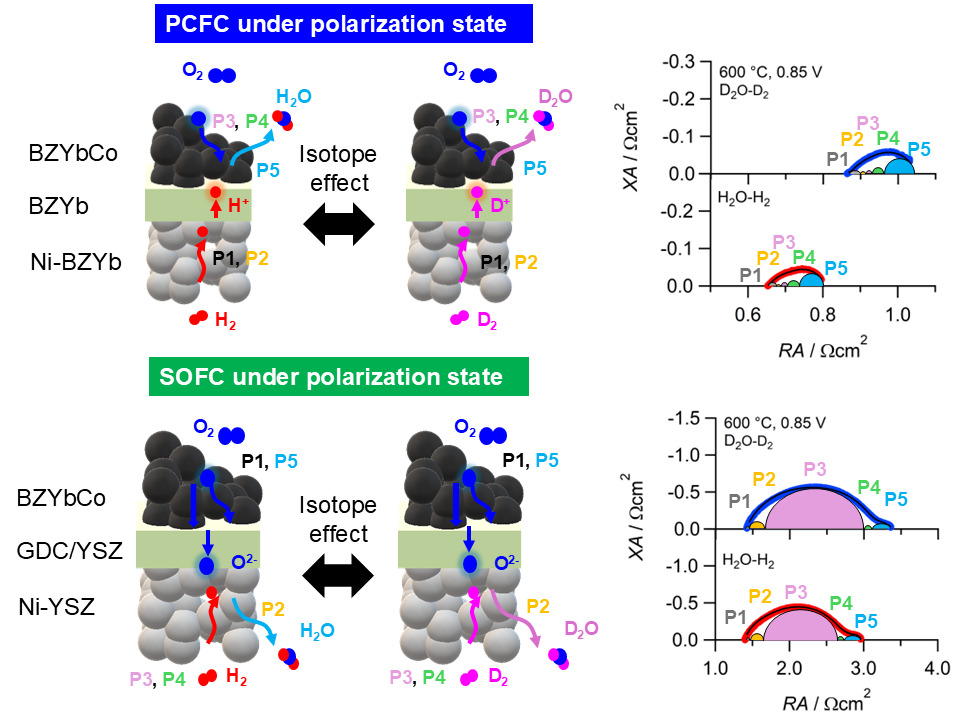
In a recent research paper published in Journal of Materials Chemistry A, Dr. Yuji Okuyama et al. developed an isotope-effect-based impedance assignment method for separating electrode resistance components in PCFCs and SOFCs using H2O–H2 to D2O–D2 substitution at the anode. They combined this perturbation with distribution of relaxation time analysis, or DRT analysis to assign five impedance components to anodic reactions, cathodic reactions, and steam-formation processes. The technically distinct feature is the use of isotope response under both open-circuit and polarized conditions to identify where hydrogen-related reactions and water-vapor formation appear in cells with different mobile ionic carriers.
The researchers fabricated anode-supported PCFCs using BaZr0.8Yb0.2O3−δ as the proton-conducting electrolyte and SOFCs using Zr0.84Y0.16O2−δ as the oxide-ion-conducting electrolyte, while using BaZr0.3Yb0.2Co0.5O3−δ as the common cathode material in both cell types. BZYbCo was important because it provides oxygen/hole mixed conduction and oxygen permeability, while lacking hydrogen permeability. That material feature matters: in PCFCs, it confines the relevant cathodic reaction involving protons to the three-phase boundary between electrolyte, cathode, and gas phase, rather than allowing hydrogen transport through the cathode itself. The mechanistic separation began with impedance measurements while replacing the anode gas from H2O–H2 to D2O–D2. For PCFCs, distribution of relaxation time analysis separated the electrode impedance into five components, which were then assigned using their isotope response. Under open-circuit conditions, isotope effects appeared in the two high-frequency components, P1 and P2, identifying them as hydrogen-related anodic processes. Under polarization, the isotope effect newly appeared in the lowest-frequency component, P5. Since protons or deuterons traverse the electrolyte during operation and form steam at the cathode, this low-frequency component was assigned to cathodic water-vapor formation. The absence of isotope effects in P3 and P4 indicated that these middle-frequency components were not directly associated with hydrogen oxidation or steam formation.
The authors found the SOFC response followed a different pattern, as expected from the different ionic carrier. In the SOFC, the high-frequency intercept corresponding to electrolyte resistance showed no isotope effect, consistent with oxide ions rather than protons moving through the electrolyte. Under open-circuit conditions, isotope effects appeared in the middle-frequency P3 and P4 components, assigning them to anodic hydrogen-related reactions. Under bias, an isotope effect emerged in P2, which was attributed to steam formation at the anode, where oxide ions arriving through the electrolyte react with adsorbed hydrogen. The team performed current-density dependence and noticed in SOFCs, the electrolyte resistance remained higher than in PCFCs and was essentially independent of current density. In PCFCs, the apparent electrolyte resistance increased at low current density and then lost that dependence at higher current density, a behavior attributed to electron leakage under high oxygen partial pressure and its suppression as the oxygen-potential distribution changed during operation. A similar current dependence appeared in PCFC cathode components associated with steam formation and oxygen-related reactions, consistent with the influence of electronic leakage on the apparent resistance.
One cathode component in PCFCs matched a corresponding cathode component in SOFCs, supporting their identification as reactions common to both cells, most plausibly oxygen dissociation, adsorption, and dissolution at the BZYbCo cathode surface. In contrast, PCFC cathode P4 appeared associated with electron leakage and oxygen reduction occurring on the cathode surface, while SOFC cathode P5 decreased with current density and was linked to oxide transport within the cathode and reaction at the cathode/electrolyte double-phase boundary. On the anode side, PCFC P1 and P2 were assigned to hydrogen dissociation, adsorption, surface diffusion, and oxidation at the Ni electrode, while SOFC P2 was assigned to the biased steam-formation reaction involving oxide ions and adsorbed hydrogen. The larger SOFC anode resistance was identified as a major contributor to its lower output under intermediate-temperature operation
The engineering implications of the new study of Dr. Yuji Okuyama et al. are clearest in the design of intermediate-temperature ceramic fuel cells, where performance losses are often difficult to assign to a specific electrode process. Instead of simply observing that polarization resistance is high, cell developers can identify whether the dominant penalty comes from hydrogen adsorption and oxidation at Ni, oxygen dissociation and incorporation at the cathode, oxide-ion transport through the cathode, proton oxidation, or water-vapor formation at the triple-phase boundary. The larger limitation is associated with steam formation or proton oxidation at the cathode, meaning that future PCFC cathodes should be engineered to expand the effective reaction field for proton-involved water formation. The authors specifically conclude that imparting proton conductivity to the cathode is necessary to reduce electrode resistance further, because the present BZYbCo cathode lacks hydrogen permeability and confines key PCFC cathodic reactions to the triple-phase boundary. In practical terms, this supports the development of composite or mixed proton–oxygen–electronic conducting cathodes, improved cathode/electrolyte interfaces, and microstructures that increase the density and accessibility of active reaction sites without relying only on oxygen surface exchange. For SOFC engineering at 600 °C, the conclusions are that BZYbCo appears useful as a cathode because the resistance associated with oxygen dissociation, adsorption, and dissolution is low, and oxide-ion conductivity in the cathode can enlarge the reaction field beyond the triple-phase boundary. The study found that SOFC anode resistance, together with electrolyte resistance, reduces power density relative to PCFCs under intermediate-temperature operation. This implies that low-temperature SOFC improvement may require equal attention to anode microstructure, steam formation, hydrogen transport, and reaction resistance under operating current.

Reference
Okuyama, Yuji & Nishiya, Tomohiro & Mikami, Yuichi & Yamauchi, Kosuke & Kuroha, Tomohiro. (2025). Assignment of elementary reactions to impedance components for solid-oxide fuel cells and proton-conducting ceramic fuel cells with Yb and Co-doped barium zirconate as the cathode. Journal of Materials Chemistry A. 13. 35480-35488. 10.1039/D5TA06004D.
Go to Journal of Materials Chemistry A