Advances in Engineering Advances in Engineering features breaking research judged by Advances in Engineering advisory team to be of key importance in the Engineering field. Papers are selected from over 10,000 published each week from most peer reviewed journals.

Significance
Re-entrant honeycombs are compelling architected materials because their internal geometry gives them a deformation behavior that conventional cellular solids cannot achieve. Their negative Poisson’s ratio means that, under compression or tension, the transverse deformation can proceed in the same sense as the imposed axial deformation. For protective and energy-absorbing structures, that unusual kinematic response is attractive because it can alter load transfer, delay local collapse, and increase the capacity of the structure to dissipate mechanical work through controlled deformation. The main challenge is that the same geometry responsible for the negative Poisson’s ratio also creates a mechanical compromise. A re-entrant honeycomb requires open internal space and inclined cell walls to deform inward or outward in the desired auxetic mode. That porosity lowers strength and stiffness before densification. Strengthening the cell by adding material or constraining deformation can improve load-bearing capacity, but it may also reduce the negative Poisson’s ratio effect that gives the structure its distinctive mechanical value. The design problem is therefore not simply to make the honeycomb stronger. It is to improve crushing resistance, stiffness, deformation stability, and energy absorption while retaining the essential re-entrant deformation mechanism. In a recently published research paper in Composite Structures, Dr. Ran Gu and Dr. Wanhai Han from Guangxi University, Professor Yonghui An from Dalian University of Technology and Guangxi University, and Professor Jinping Ou from Harbin Institute of Technology (Shenzhen) developed a biomimetic arc support enhanced re-entrant honeycomb in which curved internal supports are embedded within conventional re-entrant unit cells. The technically distinct feature is the use of arc walls to provide simultaneous vertical and lateral resistance while increasing coupled plastic hinge formation during compression. They also developed a plateau-stress theoretical model based on plastic dissipation and a parameter optimization framework that identifies which geometric variables most strongly control crushing performance and energy absorption.
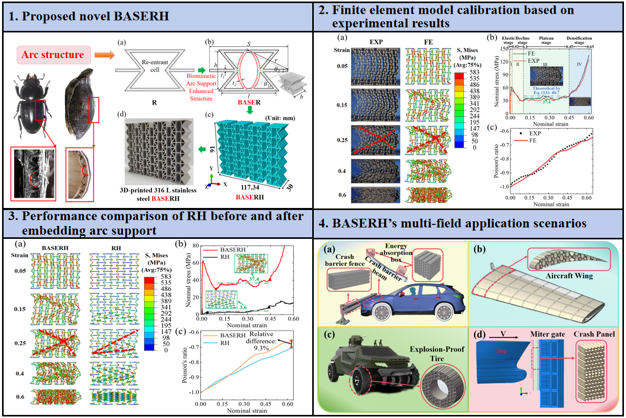
The research team defined the BASERH geometry through a baseline unit cell with specified height, horizontal wall length, inclined wall angle, arc angle, arc radius, inclined wall thickness, arc wall thickness, and out-of-plane width. For parameter analysis, the geometry is expressed through four dimensionless variables: the length-to-height ratio, radius-to-height ratio, width-to-height ratio, and wall thickness ratio between the inclined and arc walls. This formulation allowed the researchers to vary one geometric feature at a time while preserving a controlled reference design.
The physical specimens were manufactured from 316L stainless steel by selective laser melting. Material tensile testing supplied the elastic-plastic properties used later in simulation, including the measured modulus, yield stress, and ultimate stress. Quasi-static compression tests then provided the mechanical response of the BASERH arrays, while digital image correlation was used to determine the deformation field and Poisson’s ratio during loading. The authors calibrated the finite element model against the experimental deformation modes, stress-strain response, plateau stress, specific energy absorption, and Poisson’s ratio. Agreement between experiment and simulation gave the subsequent parameter study a firm mechanical basis.
The team divided the compression response of the baseline BASERH into four stages: an initial elastic stage, a decline stage after the first peak, a plateau stage, and a densification stage. During the plateau stage, most of the cell walls entered plastic deformation, and plastic hinges developed at joints and buckling regions. The arc support generated vertical reaction forces while also resisting inward deformation of the inclined walls. That design choice, embedding an arc inside the re-entrant cell rather than just thickening the original walls, changed the collapse mechanism by increasing coupled plastic hinge deformation and sustaining a higher plateau stress. The comparison with the conventional re-entrant honeycomb is the strongest evidence for the role of the arc support. BASERH developed an X-shaped deformation mode, whereas the traditional honeycomb followed a different re-entrant collapse pattern with lower deformation stability. The plateau stress of BASERH reached 37.4 MPa, compared with 3.6 MPa for the conventional structure. Its linear stiffness was about 4.4 times higher, and its plateau stress and specific energy absorption were reported as 10.4 times those of the traditional re-entrant honeycomb. The negative Poisson’s ratio effect was not lost; after densification, the reduction relative to the conventional structure was only 9.3 percent.
The theoretical model for plateau stress used an energy-conservation approach, treating collapse in terms of plastic dissipation at hinges in the inclined and arc walls. The model required only geometry and material parameters and predicted the baseline plateau stress with an 8.8 percent relative error against the experimental value. Across the examined configurations, the average error remained below 9 percent. The parameter study then identified the arc wall thickness as the dominant factor for strength and energy absorption, followed by the height-to-length relationship. Width had the smallest effect. Smaller structural height also suppressed global buckling and improved energy absorption stability. They extended the work from planar arrays to tubular structures made of PLA, comparing BASERH tubes with conventional tubes of identical mass and external dimensions. Under axial and radial compression, the BASERH tubes also carried higher peak loads than conventional tubes of the same mass and dimensions, with increases of 19.7 percent under axial compression and 32.9 percent under radial compression. Their specific energy absorption improved under both loading directions, although the radial response remained lower than the axial response, confirming the directional nature of the tube’s energy absorption behavior.
The engineering value of the BASERH design comes from its ability to strengthen a re-entrant honeycomb without removing the deformation mechanism that makes auxetic structures useful in the first place. By embedding arc supports into the re-entrant cells, the structure develops additional plastic hinge regions and a more stable collapse pattern, allowing mechanical energy to be absorbed through controlled deformation and a more stable collapse process. In automotive crash beams, the design could be used as an energy-absorbing core where high plateau stress and stable crushing are desirable. The reported improvement in axial and radial tube compression suggests that BASERH-based tubular members may be useful in components that must resist impact from different directions while maintaining predictable deformation. The negative Poisson’s ratio response is also important here, because inward lateral motion during compression can help concentrate deformation and reduce uncontrolled spreading or premature local failure.
For aerospace structures, the same design logic could support lightweight protective or load-bearing elements where stiffness and energy absorption must be balanced carefully. The study specifically identifies aircraft wings as a possible application area, and the relevance is clear: a cellular architecture that offers improved compressive strength and energy dissipation without a large penalty to auxetic behavior may be useful in internal cores, panels, or protective substructures subjected to complex loading. The authors’ findings also point toward civil and protective infrastructure uses. Canal gate impact panels, for example, require materials that can absorb accidental impact while preserving structural integrity under repeated or localized loading. BASERH offers a geometry-driven route to improve crushing resistance and energy dissipation in such panels. The design uses architecture to guide collapse and dissipate energy. Its practical importance extends beyond one product to structures where deformation must be controlled as carefully as load capacity.
Reference
Ran Gu, Yonghui An, Wanhai Han, Jinping Ou, A novel biomimetic arc support enhanced re-entrant honeycomb with enhanced strength: Experiments and simulations of mechanical performance, Composite Structures, Volume 373, 2025, 119607.
Go to Composite Structures