Advances in Engineering Advances in Engineering features breaking research judged by Advances in Engineering advisory team to be of key importance in the Engineering field. Papers are selected from over 10,000 published each week from most peer reviewed journals.

Significance
Thermal vacancies play an important role in the thermodynamics of metallic phases. They are structural defects, and their equilibrium population rises with temperature, affecting measurable properties including heat capacity, diffusivity, thermal conductivity, and melting behavior. Any thermodynamic description intended to represent metals at elevated temperature must therefore accommodate vacancies in a way that is consistent with both phase stability and chemical equilibrium. Within CALPHAD-based thermodynamics, the Compound Energy Formalism provides a widely used language for representing phases with one or more sublattices, while the substitutional solution model serves as its single-sublattice form. In that setting, vacancies are commonly introduced as an additional component occupying lattice sites. A vacancy endmember represents a hypothetical crystal containing only vacancies, and assigning a molar Gibbs energy to such an entity has long been problematic. When the vacancy-endmember parameter is chosen poorly, the resulting thermodynamic description can yield unstable phases or more than one equilibrium vacancy concentration. Positive values have often been introduced to maintain a unique equilibrium state, but the physical interpretation of those choices remains unsettled. The issue becomes especially important when vacancy formation energies are temperature dependent or when vacancy-related interactions are incorporated into multicomponent alloys. An earlier thermal-vacancy model treated vacancies as forming a solution with the matrix alloy and avoided some of the difficulties associated with a conventional substitutional description. That formulation, however, separates the Gibbs energy into alloy and vacancy contributions in a manner that complicates derivatives such as the chemical potentials of non-vacancy components. Such derivatives become really important when the thermodynamic model is intended for diffusion calculations or future extension to phases containing multiple sublattices.
In a recently published paper in Acta Materialia, Dr. Cheng-Hui Xia of Hangzhou City University and Professor Xiao-Gang Lu of Shanghai University developed a modified substitutional solution model for metallic phases containing thermal vacancies. The modified substitutional solution model distinguishes between the site fractions of all lattice occupants and the mole fractions of the non-vacancy components. In the conventional substitutional solution model, binary and ternary interaction terms are written in terms of site fractions, so the presence of vacancies changes the compositional variables entering every interaction contribution. The modified formulation instead writes interactions among non-vacancy species through their atomic mole fractions, while vacancy-related interactions are multiplied explicitly by the vacancy site fraction. This design choice separates the alloy thermodynamics from the vacancy population without discarding their coupling.
That distinction produces a useful expression for the vacancy chemical potential. In the modified model, the equilibrium vacancy concentration follows analytically from the condition of zero vacancy chemical potential and takes an exponential form determined by an effective vacancy formation energy. The same formulation gives a simple logarithmic relation between vacancy chemical potential and the ratio of the instantaneous vacancy concentration to its equilibrium value. Such relations are important because non-equilibrium vacancy concentrations enter diffusion simulations through chemical-potential driving forces. The conventional substitutional model does not yield an equivalent analytical expression, even for a pure metal with a vacancy interaction parameter.
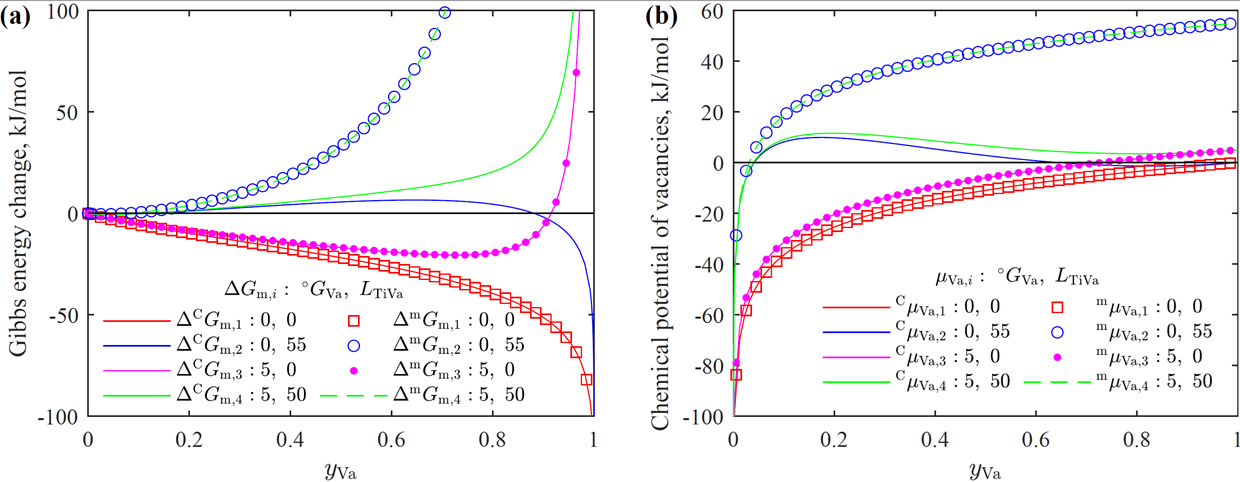
The authors first examined pure BCC titanium to expose the contrasting behavior of the two models across a wide range of vacancy concentrations. When vacancy-related interaction terms were absent, the two descriptions coincided. Once positive vacancy interactions were introduced, however, the conventional model could generate multiple equilibrium vacancy concentrations unless both the vacancy-endmember energy and the vacancy interaction parameter were selected carefully. The modified model retained a single equilibrium solution and a stable phase description. Its vacancy-endmember parameter could be zero or assigned a physically meaningful value, because the effective formation energy is determined through the combined vacancy-related terms.
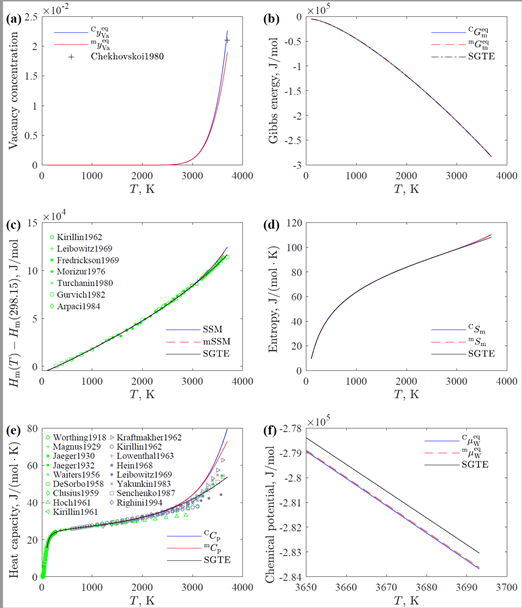
Dr. Cheng-Hui Xia and Professor Xiao-Gang Lu tested how the modified treatment affects temperature-dependent thermodynamic properties by performing calculations for BCC tungsten and found at near melting temperature, the two models predicted closely related equilibrium vacancy concentrations and nearly indistinguishable Gibbs energies. Their effects became more visible in quantities involving temperature derivatives of the Gibbs energy, especially heat capacity. The analysis showed that a relatively high vacancy concentration combined with a rapidly changing vacancy-related interaction parameter can increase the calculated heat capacity substantially. Enthalpy and entropy also departed from vacancy-free reference calculations at high temperature, reflecting the thermodynamic contribution of the equilibrium vacancy population.
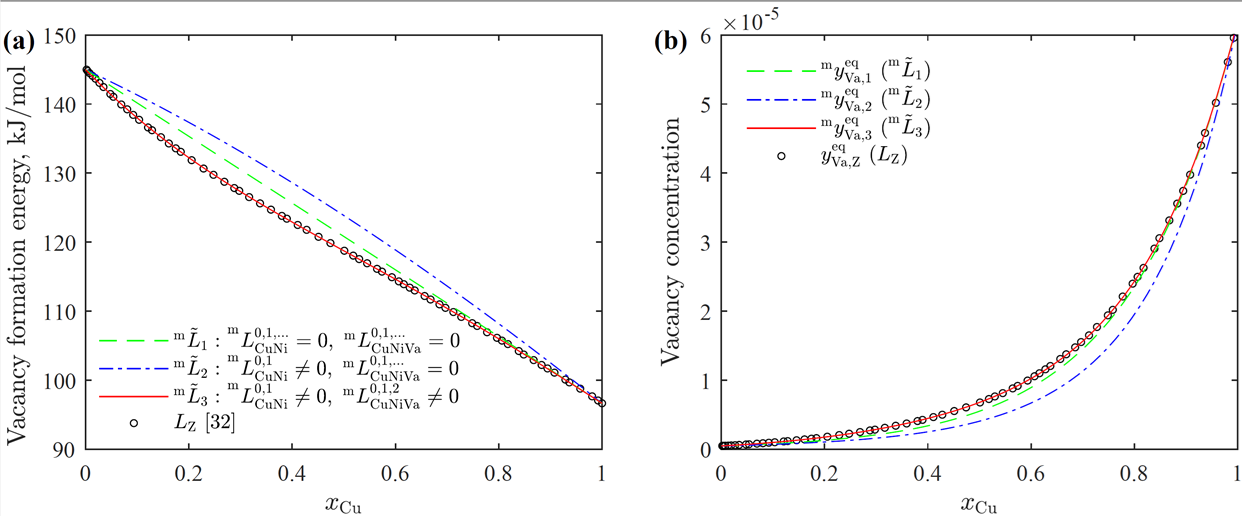
Binary Co–Cr calculations provided a more demanding comparison because alloy composition and vacancy concentration vary simultaneously. At equilibrium, the conventional and modified models produced similar heat capacities, Gibbs energies, and chemical potentials of Co and Cr when vacancy concentrations remained low. Their vacancy chemical potentials differed more fundamentally. In the modified model, the vacancy chemical potential rose monotonically with vacancy concentration at fixed alloy composition, preserving the one-to-one relation required for a unique equilibrium concentration. The conventional model showed non-monotonic behavior over part of the concentration range, a feature associated with the possibility of multiple equilibrium solutions. Xia and Lu then examined the role of interaction parameters and found interactions among non-vacancy components affected the vacancy concentration differently in the two models: attractive mixing increased the equilibrium vacancy concentration predicted by the modified model but decreased that predicted by the conventional model. Vacancy-related binary and ternary interaction parameters, by contrast, could be adjusted in the modified model to fit equilibrium vacancy concentrations while exerting little influence on other equilibrium thermodynamic properties when vacancies were dilute. Finally, the FCC Cu–Ni system was used to evaluate composition-dependent vacancy formation energies. By incorporating Cu–Ni–vacancy interaction parameters, the model reproduced the assessed vacancy formation-energy trend and its corresponding equilibrium vacancy concentrations across composition.
The modified substitutional solution model reported by Xia and Lu offers a practical thermodynamic basis for engineering calculations in metallic systems where thermal vacancies cannot be treated as negligible background defects. In high-temperature processing and service, vacancy populations influence diffusion-related phenomena, heat capacity, chemical potentials, and the effective thermodynamic state of an alloy. A model that provides a unique equilibrium vacancy concentration is therefore useful wherever computational predictions must remain stable across changing temperature and composition. CALPHAD databases for FCC and BCC metallic phases provide one immediate setting for applying the modified model. The modified model retains the conventional substitutional description when vacancies are excluded, allowing established alloy thermodynamic parameters to remain relevant. At the same time, it separates vacancy-related parameters from the interaction terms that describe the atomic alloy. This can make it easier to refine vacancy thermodynamics without unnecessarily changing the calculated Gibbs energies, phase equilibria, or chemical potentials of the major alloying elements. For database development, that separation is valuable because vacancy formation energies and equilibrium vacancy concentrations can be fitted more directly to appropriate thermodynamic information.
The analytical vacancy-concentration expression is relevant to diffusion modeling. Vacancy-mediated transport calculations require chemical potentials that respond consistently when the vacancy concentration differs from equilibrium. The modified model supplies a direct logarithmic relation between vacancy chemical potential and the ratio of actual to equilibrium vacancy concentration. This provides a clear thermodynamic driving force for simulations involving vacancy diffusion, vacancy generation, and vacancy relaxation. It may therefore support computational descriptions of processes in which local vacancy populations change during thermal treatment or under composition gradients.
The Cu–Ni calculations also show how vacancy formation energies can vary systematically with alloy composition when vacancy-related binary and ternary interaction parameters are included. That capability is relevant to alloy design tasks in which compositional changes alter vacancy populations without strongly altering the broader equilibrium thermodynamics of the phase. Engineers can evaluate how alloy composition changes equilibrium vacancy concentrations across a composition range, without assigning a single vacancy energy based only on the pure constituents. The model is also suited to situations where heat capacity, enthalpy, and entropy must be evaluated near elevated temperatures. The tungsten calculations demonstrate that vacancies can affect these quantities through their contribution to the temperature derivatives of Gibbs energy, especially when vacancy concentrations rise rapidly. Incorporating this effect in thermodynamic calculations can improve consistency between vacancy behavior and temperature-dependent property predictions within the same modeling framework.
Reference
Cheng-Hui Xia, Xiao-Gang Lu, A modified substitutional solution model for describing thermal vacancies, Acta Materialia, Volume 301, 2025, 121564,
Go to Acta Materialia