Advances in Engineering Advances in Engineering features breaking research judged by Advances in Engineering advisory team to be of key importance in the Engineering field. Papers are selected from over 10,000 published each week from most peer reviewed journals.

Significance
Composite sandwich structures achieve high bending efficiency by placing strong skins on either side of a lightweight core. The outer skins carry most of the bending stresses, and the core keeps them separated and resists transverse shear which provide a combination of low weight, stiffness, and resistance to bending and makes sandwich structures useful in transport, marine, aerospace, and industrial applications. However, the performance of composite sandwich depends heavily on a reliable bond between the skins and the core and when the bond is weak, debonding, local shear, and stress concentration at the interface can control failure before the full strength of either material is reached. Material extrusion additive manufacturing provides an interesting route for producing sandwich cores because it can generate internal and surface geometries that are difficult to obtain through conventional molding or machining. A printed core need not remain a passive lightweight spacer. Its surface can be shaped to influence resin flow, contact area, and the way the skin becomes mechanically engaged with the core. Such opportunities are especially relevant for short-carbon-fiber-filled thermoplastic cores, where the deposited-bead morphology and fiber orientation can introduce microstructural features at the printed surface. Even with additive manufacturing, the mechanical response of the assembled structure remains closely dependent on resin infiltration and the quality of skin-core load transfer. A carbon-fiber-reinforced skin bonded to a printed polymer core still depends on the quality of resin infiltration and the ability of the cured interlayer to distribute stress without premature separation. Previous approaches to improving skin-core bonding have included chemical modification, surface treatment, reinforcement through inserts or perforations, and the incorporation of nanoscale additives into polymer matrices. Surface texturing can enlarge the effective bonding area and create geometrical resistance to separation. Nanofillers can influence local stress transfer, crack development, and the adhesion of resin to reinforcing fibers. Their combined use in composite-to-composite sandwich bonding, particularly where a printed core carries deliberately formed mesoscale grooves, remained insufficiently examined.
In a recently published paper in Polymer Composites, Mr. Yang Liu, Professor Zhaogui Wang, and Mr. Bohao Yi from Dalian Maritime University developed a hybrid composite sandwich structure combining a fused-deposition-modeled short-carbon-fiber/ABS core with carbon-fiber-fabric skins bonded by vacuum-assisted epoxy infusion. The resulting design couples core-surface architecture with nanoparticle-assisted resin-fiber bridging rather than relying on a conventional smooth adhesive boundary.
The researchers first established the effect of panel placement within the sandwich architecture. Carbon-fiber fabric positioned as outer skin sheets produced a more favorable bending response than fabric placed in the middle layer of the structure. Increasing the number of skin layers raised bending strength and bending modulus, confirming that the outer carbon-fiber plies carried the principal tensile and compressive stresses generated during three-point bending. The investigators noticed the printed CF-ABS cores patterned with shallow and deeper meso-grooves to create a controlled increase in surface texture without changing the basic sandwich geometry. Optical measurements confirmed that groove depth substantially increased surface roughness relative to the untreated core. This mattered because the deeper texture allowed liquid epoxy to penetrate recessed regions during vacuum-assisted curing, enlarging the resin-accessible contact area and producing a stronger geometrical connection between the carbon-fiber skins and core.
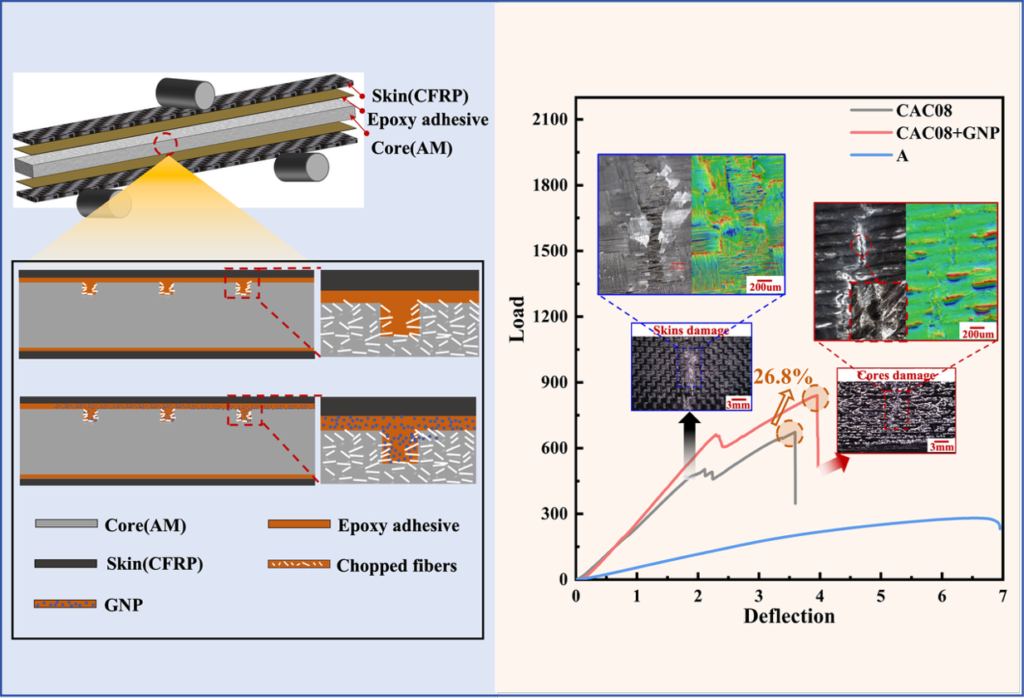
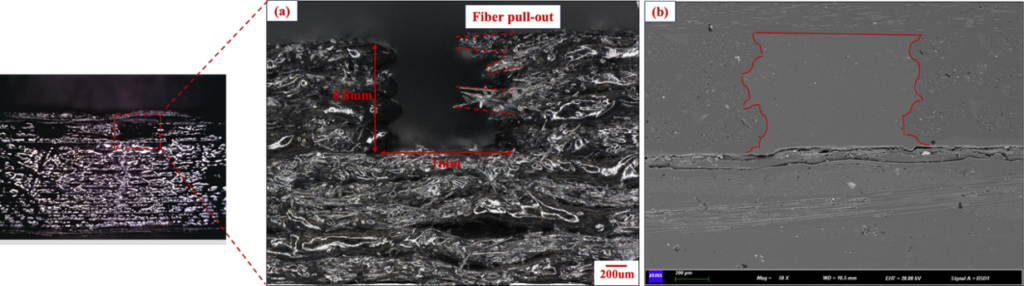
The authors performed mechanical testing and showed that both grooved configurations improved bending behavior relative to the untreated sandwich, with the deeper grooves producing the stronger response. Stiffness also increased after surface texturing. Load-deflection behavior changed as well: instead of reaching a maximum load followed by a sharp drop, the grooved specimens failed more gradually. Increasing groove depth therefore influenced not only strength and stiffness, but also the way the structure accommodated progressive damage under bending. Microscopy supplied an important interpretation of that response. The fused-deposition process produced irregular burr-like regions around the groove boundaries. These regions contained short carbon fibers and residual ABS material extending beyond the deposited-bead profile. After resin infusion and curing, epoxy penetrated the groove network and surrounded these exposed features. The result was not a smooth adhesive boundary but a mechanically interlocked region in which resin, printed polymer, protruding short fibers, and carbon-fiber fabric became locally connected. In the grooved specimens without graphene, core shear remained the dominant failure mode despite the improved interfacial connection.
The team incorporated graphene nanoplatelets into the epoxy resin used with the deeper-grooved core as their final modification. Compared with the grooved structure without graphene, the graphene-containing sandwich showed further gains in bending strength and stiffness. Its failure behavior also changed: while the meso-grooved specimens mainly failed through core shear, the graphene-modified structure showed yielding of the carbon-fiber skin sheets. This shift indicates that the reinforced interface transferred load more effectively to the external skins instead of allowing early damage to remain concentrated in the core or bonded region.
The authors conducted SEM and EDS and found that Graphene nanoplatelets were distributed through the resin-rich region near the interface, including areas adjacent to the residual fibers located at groove edges. he examined graphene-modified interfacial regions appeared continuous after bending, without prominent cracks or gaps in the observed areas. Liu and colleagues interpreted the nanoplatelets as bridges within the resin-fiber region, where they reduced stress concentration, impeded crack extension, and strengthened the connection between the epoxy matrix and carbon-fiber surfaces. The interfacial architecture therefore developed through the combined action of printed groove geometry, microscale fiber-related features, and graphene-assisted resin bridging.
The interfacial strategy developed by Professor Zhaogui Wang and colleagues is relevant wherever lightweight sandwich panels must carry bending loads without allowing the skin-core boundary to become the first location of failure. Their approach is especially suited to composite structures in which a material-extrusion-manufactured core can be combined with carbon-fiber skins through vacuum-assisted curing and instead of treating the core as a geometrically simple spacer, the study shows that its printed surface can be designed to participate directly in structural load transfer. In marine engineering, the new principle could be applied to lightweight interior panels, equipment enclosures, deck-adjacent partitions, protective covers, and non-primary structural components where reduced weight and resistance to flexural loading are both desirable. The use of a carbon-fiber-reinforced ABS core offers the practical advantage of manufacturing complex core shapes through fused deposition modeling, while the meso-grooved surface improves the connection to carbon-fiber skins. For components exposed to repeated handling, vibration, or local bending, a stronger skin-core interface could reduce the likelihood that deformation becomes concentrated at the bonded boundary.
The same concept may be useful for aerospace and transportation panels that require tailored geometry but are not easily produced through conventional core-forming routes. Material extrusion permits local modification of core surfaces, allowing grooves or related textural features to be placed only where higher interfacial stresses are expected. This could be valuable near fasteners, support locations, edges, cut-outs, or regions subjected to concentrated loading. The study indicates that deeper meso-grooves increased the effective contact area available to the infused resin and promoted mechanical interlocking, suggesting a method for locally tuning the core-skin connection without changing the entire panel architecture.
The graphene-modified resin formulation adds a second level of design control. In the reported sandwich structures, graphene nanoplatelets strengthened the resin-fiber region and shifted the observed failure mode from core shear toward yielding of the carbon-fiber skins. From an engineering standpoint, this shift is meaningful because it indicates that the interface can sustain a greater share of the applied load before damage becomes localized. Components designed for bending-dominated service may therefore benefit from an interface that transfers stress more effectively into the outer skins. The hybrid manufacturing method reported by Liu, Wang and Yi also has relevance for prototyping and low- to medium-volume production. A core can be digitally redesigned, printed, and then integrated with conventional carbon-fiber fabric and epoxy processing. This flexibility may be useful for customized structural panels, curved protective housings, marine outfitting elements, and application-specific sandwich components. Overall, the new approach combines printed core design with resin modification to improve interfacial performance under bending.



Reference
Liu, Yang & Wang, Zhaogui & Yi, Bohao. (2025). Enhancing Mechanical Performances of Material Extrusion Additively Manufactured Composite Sandwich Structures via Multi‐Scale Interfacial Bonding Strategies. Polymer Composites. 46. 17041-17055. 10.1002/pc.70094.
Go to Polymer Composites