 Advances in Engineering Advances in Engineering features breaking research judged by Advances in Engineering advisory team to be of key importance in the Engineering field. Papers are selected from over 10,000 published each week from most peer reviewed journals.

Digital light processing (DLP) 3D printing uses patterned light to convert liquid resins into solid objects, which can make it possible to produce complex structures with fine details. Most commercially available resins are based on acrylates, which cure rapidly but have several disadvantages. Unreacted acrylate components can be toxic, and the resulting crosslinked materials often resist degradation which limits their suitability for applications that require biocompatible materials or controlled degradation after use.
Polyesters offer an alternative because their ester bonds can undergo hydrolysis. They can be prepared through ring-opening copolymerization (ROCOP), in which cyclic anhydrides react with epoxides to form polyester chains. The polymer structure and molecular weight can be adjusted during synthesis to obtain properties suited to different applications.
Most established ROCOP methods depend on metal-containing catalysts and these catalysts provide good control over polymer synthesis, but residual metals may be undesirable in applications where material purity is important. Catalyst costs and purification requirements can also complicate large-scale production. Metal-free catalysts provide a possible solution, but achieving high activity at low concentrations without sacrificing control over polymer structure remains challenging.
Producing a polyester that can be used in DLP printing requires careful control of viscosity and light-induced curing. High-molecular-weight polymers tend to be more viscous, making it difficult for the liquid resin to flow between successive printed layers. Solvents can improve the flow but excessive dilution may affect the mechanical properties and dimensional accuracy of the finished objects. The resin must also cure at a suitable rate to produce layers with the intended thickness.
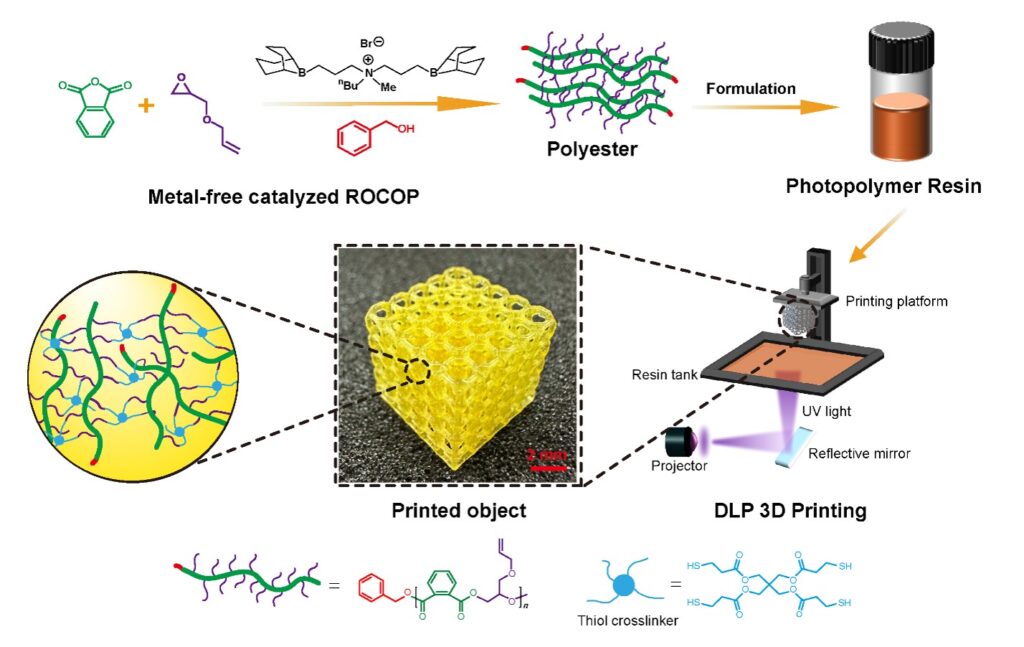
In a recent research paper published in Green Chemistry, Dr. Jiahao Liu, Dr. Meichen Liu, Dr. Yujiao Li, and Professor Chunwang Yi from Hunan Normal University, together with Dr. Jie Li from Hengyang Normal University in China, developed a metal-free method for producing degradable polyester resins for high-resolution DLP 3D printing. Using a bifunctional organoboron catalyst, they synthesized poly(allyl glycidyl ether phthalate) (PAGEP) from phthalic anhydride and allyl glycidyl ether. The polyester was then formulated into a photocurable resin for producing detailed three-dimensional structures.
Experiments and Findings
The researchers investigated how catalyst concentration and the amount of benzyl alcohol, used as a chain transfer agent, affected PAGEP synthesis. The organoboron catalyst achieved approximately 99.9% conversion of phthalic anhydride, even at low concentrations. They found reducing the catalyst concentration increased the reaction time but had relatively little effect on polymer molecular weight. Benzyl alcohol had a stronger influence on chain length. Increasing its proportion produced shorter polymer chains, with little additional reduction beyond a certain amount. When they adjusted the benzyl alcohol content, the researchers obtained low-molecular-weight PAGEP with a narrow molecular weight distribution using only 100 ppm of the catalyst.
The team performed structural analysis and confirmed that phthalic anhydride and allyl glycidyl ether formed a well-defined alternating polyester. Nuclear magnetic resonance spectroscopy showed no evidence of unwanted homopolymerization of allyl glycidyl ether, and mass spectrometry supported the expected repeating-unit structure. The synthesis was successfully demonstrated on a kilogram scale using commercially available starting materials. The polymer was isolated by vacuum distillation, and excess allyl glycidyl ether could be recovered for reuse, reducing material waste and simplifying purification.
The authors then prepared a resin suitable for DLP printing. Neat PAGEP had a viscosity of approximately 19.9 Pa s, which decreased to 0.37 Pa s after adding 20 wt% ethyl acetate. The formulation contained a tetrathiol crosslinker that reacted with the allyl groups of PAGEP through light-induced thiol–ene chemistry to form a solid polymer network. They tested several photoinitiators and selected BAPO because it could cure the resin under relatively short light exposures. Small amounts of additional compounds were included to limit unwanted curing and improve printing accuracy.
To establish suitable printing conditions, the team measured the thickness of resin layers cured under different exposure times using scanning electron microscopy. Longer exposures produced thicker cured layers, allowing the researchers to select an exposure time of approximately 18.5 seconds for a target layer thickness of 100 μm. Using these conditions, they printed a small boat model and complex gyroid and cubic lattice structures. Microscopic examination showed that the resin could reproduce fine geometric features.
Mechanical testing showed that the printed polyester behaved as a soft material, with an average tensile strength of approximately 1.9 MPa and an elongation at break of 30%. The relatively limited elongation was attributed to the dense crosslinked network formed during photopolymerization. A printed cubic lattice supported a load approximately 100 times its own weight without visible deformation or structural failure.
The researchers tested how the printed material degraded in 0.1 N sodium hydroxide under accelerated conditions. The samples gradually lost mass as their ester bonds broke down through hydrolysis, with complete mass loss within ten days. This showed that the polyester remained degradable even after being crosslinked during printing.
Engineering Significance
The research work of Professor Chunwang Yi and colleagues demonstrates how the chemical structure of a polyester can be adjusted to meet the different requirements of DLP 3D printing. Controlling polymer chain length during synthesis makes it easier to prepare resins with suitable flow properties. The use of a metal-free catalyst also avoids the introduction of metallic residues, an important consideration for materials intended for applications where purity is critical.
Another important aspect is the combination of light-induced crosslinking and degradability. Crosslinking provides the solid network needed to preserve the shape of printed objects, but the polyester backbone retains ester bonds that can be broken down through hydrolysis. This makes it possible to produce complex structures that maintain their shape during use yet remain susceptible to chemical degradation under appropriate conditions.
The production method has practical advantages for larger-scale manufacturing. Commercially available starting materials, low catalyst consumption, and straightforward product isolation reduce some of the difficulties associated with preparing polyester resins. The direct measurement of cured-layer thickness also provides a practical way to select printing conditions for accurate fabrication of small and complex features.
These materials may be useful in tissue scaffolds, soft robotics, and microfluidic devices, where complex geometries and degradable polymers are desirable. The degradation experiments established their susceptibility to hydrolysis under accelerated alkaline conditions, providing useful information for evaluating their potential in these applications.
The researchers also identified opportunities to further improve the resin formulation. During extended printing, solvent evaporation increased viscosity and affected printing precision. Future research in this field may focus on developing solvent-free formulations and modifying the polymer network to improve mechanical performance.


Reference
Jiahao Liu, Meichen Liu, Jie Li, Yujiao Li, Chunwang Yi*, Metal-free, scalable synthesis of degradable polyester resins for high-resolution DLP 3D printing via organoboron-catalyzed ROCOP, Green Chemistry, Volume 28, Issue 19, 2026, Pages 8213-8222,