 Advances in Engineering Advances in Engineering features breaking research judged by Advances in Engineering advisory team to be of key importance in the Engineering field. Papers are selected from over 10,000 published each week from most peer reviewed journals.

Significance
Ferroelectric ceramics are commonly used in sensors, actuators, and devices that convert electrical energy into mechanical motion or vice versa. Their properties depend on the arrangement of electric polarization within the material. This polarization is organized into regions called domains, which can change their orientation when an electric field or mechanical stress is applied.
Controlling these domains is important for improving the performance of ferroelectric materials. However, high temperatures and strong electric fields can disturb their arrangement, causing a loss of polarization and reducing their ability to respond to electrical or mechanical loading. When the applied electric field exceeds a certain threshold, known as the coercive field, domains can switch permanently, making it difficult for the material to recover its original state.
One way to control polarization is through engineered interfaces between materials with different compositions. These interfaces can generate internal electric fields and mechanical stresses that influence the arrangement and stability of ferroelectric domains. Such effects have been demonstrated in thin-film heterostructures, where different materials are deposited in extremely thin layers. However, thin films have limited active volumes and their fabrication and operating conditions restrict their use in many applications requiring bulk materials.
Creating similar interfaces throughout a bulk ceramic could provide greater control over its electrical and mechanical properties. The challenge is to produce these interfaces without disrupting the crystal structure while controlling how they interact with the surrounding ferroelectric domains. A possible route is spinodal decomposition which is a process that initially uniform solid solution separates into regions with different chemical compositions and can create nanoscale structures within a continuous crystal lattice.
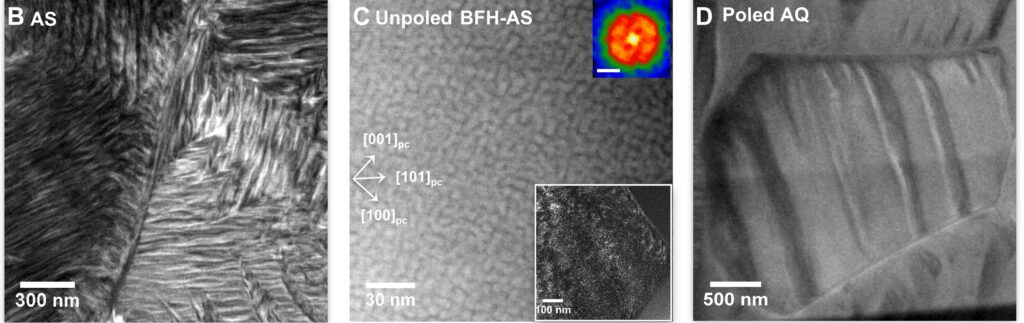
To address this challenge, Dr. Yizhe Li, Dr. David A. Hall, and colleagues at the University of Manchester and collaborating institutions developed bulk ferroelectric heterostructures using ceramics containing 70% bismuth ferrite (BiFeO₃) and 30% barium titanate (BaTiO₃). They investigated how controlled heat treatment, combined with electrical or mechanical processing, could create internal interfaces that improve thermal stability and allow reversible domain switching. Electron microscopy showed that thermal aging caused the initially more uniform material to separate into nanoscale regions with different chemical compositions. The new research work is now published in Science Advances.
The researchers prepared ceramics containing 70% BiFeO₃ and 30% BaTiO₃ and subjected them to different heat treatments. Electron microscopy revealed that thermal aging transformed the initially more uniform material into a structure containing nanoscale regions with alternating chemical compositions.
Detailed elemental analysis showed that these regions were enriched in either bismuth or barium, forming interconnected networks with characteristic dimensions of about 8 nanometers. Three-dimensional electron microscopy confirmed that the networks extended through the ceramic rather than forming isolated particles. Importantly, the crystal lattice remained continuous across the interfaces.
The arrangement of these nanoscale regions depended on the polarization state before heat treatment. Samples aged without prior electrical polarization developed relatively disordered structures, whereas samples electrically polarized before aging formed more regularly oriented patterns. These patterns followed the preferred polarization directions, indicating that the initial domain configuration influenced how chemical separation developed.
The researchers then examined how the internal interfaces affected polarization. Bismuth and barium carry different ionic charges, so their separation produces local charge imbalances. Atomic-scale imaging revealed corresponding changes in polarization direction, including regions where neighboring polarization vectors converged or diverged. These arrangements formed charged domain walls within the ceramic.
Phase-field simulations, which describe how material structures and polarization evolve, helped explain these observations. The calculations indicated that local electric fields arising from chemical separation influenced polarization orientation, while mechanical stresses between neighboring regions changed its magnitude. The interaction between chemical composition, electric fields, and lattice strain therefore provided a way to stabilize particular domain configurations.
These structural changes also affected the material’s thermal properties. The Curie temperature, above which ferroelectric ordering is lost, increased to 824°C, more than 350°C higher than that of the original ceramic. The researchers attributed this increase to the high Curie temperature of the bismuth-enriched regions and the tensile stresses generated by the surrounding barium-enriched regions.
The ceramics also maintained strong piezoelectric properties at elevated temperatures, with a piezoelectric charge coefficient exceeding 400 pC/N and an electromechanical coupling factor above 0.4. During prolonged exposure to 580°C, the piezoelectric coefficient decreased by less than 3% after 1,000 hours, indicating good thermal stability.
Another important observation was the development of strong internal bias fields, which favor particular polarization orientations and resist permanent changes in the domain arrangement. These fields exceeded 8 MV/m and could be adjusted by changing the aging temperature and duration.
The team then investigated whether these internal fields could restore a predefined domain arrangement after exposure to strong electric fields. By applying mechanical compression before thermal aging, they produced ceramics with an initial preference for polarization within the plane perpendicular to the intended actuation direction. An applied electric field temporarily reoriented these domains, but much of the original arrangement returned when the field was removed. This produced reversible axial strains reaching 0.52%.
A second design used electrical polarization before thermal aging to establish a preferred domain orientation perpendicular to the subsequent applied electric field. During electrical loading, the domains rotated away from this initial direction and returned when the field was removed, producing reversible shear deformation.
The authors found shear strain reached 0.85% at room temperature and increased to 0.98% at 100°C under alternating electric fields. These values exceeded those reported for conventional lead zirconate titanate ceramics by more than fourfold. They conducted synchrotron X-ray diffraction and the measurements confirmed that the large strains were associated with reversible domain switching. The measurements also agreed with direct observations of macroscopic deformation. Repeated electrical cycling showed that the imprinted domain configuration remained stable, with no evidence of the progressive loss of internal bias commonly associated with conventional defect-based ferroelectric hardening.
The new study establishes a way to create functional interfaces throughout a bulk ferroelectric ceramic without assembling separate material layers. Controlled chemical separation produces an interconnected nanoscale structure whose electrical and mechanical interactions influence the behavior of the entire material. A useful feature is that the internal interfaces can preserve a domain arrangement established before heat treatment. The ceramic therefore retains a preferred polarization state even when an external electric field temporarily drives the domains into another configuration. This differs from conventional ferroelectrics, where strong electric fields can permanently change polarization and compromise the original electromechanical response.
The work also connects improved thermal stability with the same internal structure responsible for domain control. The compositionally distinct regions generate both local mechanical stresses that influence the ferroelectric transition temperature and internal electric fields that stabilize polarization. These effects allow high-temperature piezoelectric performance and reversible switching to be achieved within the same lead-free ceramic system. The ability to control axial and shear deformation is especially relevant to electromechanical actuators and transducers operating under demanding electrical and thermal conditions. It also demonstrates how the functional behavior of bulk ferroelectrics can be adjusted through thermal processing and domain engineering without changing the overall chemical composition.



Reference
Li Y, Yang Z, Chen Y, Zhang Z, Tang YL, Smith M, Lindley M, Cao X, Kleppe AK, Koemets E, Hopkinson DG, Bell AJ, Milne SJ, Feteira A, Haigh SJ, Eggeman AS, Pan J, Shi J, Yang Y, Hall DA. Bulk ferroelectric heterostructures. Sci Adv. 2026;12(40):eaef9861. doi: 10.1126/sciadv.aef9861.