 Advances in Engineering Advances in Engineering features breaking research judged by Advances in Engineering advisory team to be of key importance in the Engineering field. Papers are selected from over 10,000 published each week from most peer reviewed journals.

Significance
Amorphous carbon materials are valued for their mechanical strength and ability to withstand demanding conditions. Unlike crystalline materials, their atoms do not follow a regular repeating pattern. Their properties depend on how carbon atoms are bonded and connected where at high temperatures, these connections can change, reducing the material’s stiffness and resistance to deformation.
In many conventional amorphous materials, softening occurs through a process known as kinetic unfreezing. As temperature rises, atoms that were previously restricted to small local movements become more mobile and can rearrange over larger distances and this allows the material to deform more easily without fundamentally changing its underlying structure.
Amorphous carbon is more complex because its atoms can form different bonding arrangements. In sp² bonding, each carbon atom typically connects to three neighboring atoms, forming graphene-like structures that can bend, slide, and rearrange, while in sp³ bonding, carbon atoms connect to four neighbors in a three-dimensional arrangement, which produce a more rigid, diamond-like network.
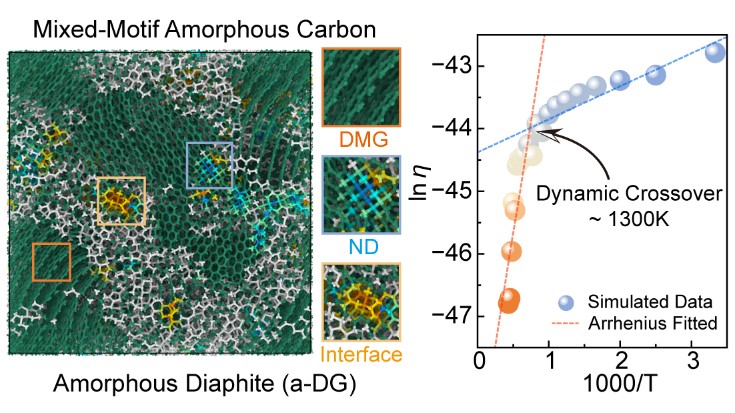
Some forms of amorphous carbon contain both types of bonding such as amorphous diaphite (a-DG), which has a flexible disordered multilayer graphene (DMG) matrix interpenetrated by a rigid continuous random network (CRN) containing diamond-like regions. These two components have different mechanical properties and respond differently to heating.
The interaction between these components raises an important question about how amorphous diaphite softens. As temperature increases, changes in carbon bonding may alter how the different regions are connected and this allow atoms to move more freely. Scientists need to understand how these changes contribute to kinetic unfreezing in order to explain the material’s behavior at elevated temperatures.
In a recent research paper published in ACS Nano, Dr. Kang Wang, Dr. ZhongTing Zhang, Professor YinBo Zhu, and Professor HengAn Wu from the University of Science and Technology of China investigated why amorphous diaphite softens at high temperatures. Using molecular dynamics simulations, they examined how its flexible graphene-rich regions and rigid diamond-like network respond to heating, focusing on changes in atomic bonding, movement, and mechanical properties.
The study reports a clear change in behavior occurred near 1300 K and below that temperature, the rigid network was largely intact, limiting atomic movement. At higher temperatures, the network gradually broke down as more carbon atoms shifted from sp³ to sp² bonding. This process, known as graphitization, was accompanied by faster expansion as atoms gained greater freedom to rearrange.
The researchers found the material’s mechanical properties also changed as its atomic structure evolved. Young’s modulus, which measures resistance to elastic deformation, decreased as the temperature rose, with a noticeable change in the rate of decline near 1300 K. Hardness, on the other hand, decreased more steadily, showing a gradual loss of resistance to permanent deformation.
Shear simulations helped explain how these changes affected the material under loading. At lower temperatures, they observed deformation concentrated in narrow regions, and shear stress dropped sharply after reaching its peak. At higher temperatures, the material deformed more evenly, with a smoother stress response. Instead of concentrating strain in a dominant shear band, the structure accommodated deformation through many smaller atomic rearrangements.
The team also examined atomic mobility and viscosity to better understand this transition. At lower temperatures, atoms remained largely confined to their immediate surroundings, with little long-range movement. As the temperature increased, diffusion became more pronounced, particularly near 1300 K. Viscosity analysis revealed two distinct kinetic regimes. The higher effective activation energy above the transition temperature was associated with the additional energy needed to rearrange carbon bonds and transform the rigid network.
To understand the contribution of each structural component, the authors simulated the graphene-rich and diamond-rich networks separately. They found that graphene-only material remained relatively mobile throughout heating, without a pronounced change in diffusion, while the diamond-rich network, showed a transition near 950 K, which indicates that atomic rearrangements become more active at a lower temperature than in amorphous diaphite. Neither material alone reproduced the extensive graphitization observed when both components were present and that show that their interaction was important.
Further analysis focused on the boundaries between the flexible graphene matrix and the rigid diamond-rich regions. The two components responded differently to heating, creating an uneven distribution of local stress. The researchers proposed that this stress mismatch helped promote the conversion of sp³-bonded carbon into sp² configurations near their interfaces.
As the transformation progressed, diamond-like regions broke into smaller graphene-like fragments that connected neighboring graphene domains which weakened the rigid network and allowed atoms to move more freely throughout the material. The findings helped explain how changes in carbon bonding and stress at the interfaces contributed to the gradual softening of amorphous diaphite during heating.
Overall, University of Science and Technology of China scientists demonstrated that amorphous diaphite softens in a different way from many other amorphous materials. In most of these materials, heating allows atoms to move more freely without greatly changing their structure. In amorphous diaphite, however, heating also changes how carbon atoms are bonded, causing the internal structure to gradually change as the material softens.
The interaction between the flexible graphene-rich regions and rigid diamond-like structures plays an important role in how amorphous diaphite responds to heating. The boundaries between these regions can promote changes in carbon bonding and this may explain why the material softens in a different way from amorphous carbon made up of only one type of structure.
The research also suggests that adjusting the proportion and connectivity of these regions could help control thermal softening and improve mechanical stability at high temperatures. The transition near 1300 K was observed in molecular dynamics simulations, helping explain how carbon bonding and the arrangement of different regions affect the material’s response to heating.


Reference
Kang Wang, ZhongTing Zhang, YinBo Zhu, HengAn Wu; Transformation-Mediated Kinetic Unfreezing in Mixed-Motif Amorphous Carbon. ACS Nano 2026; 20 (30): 21473–21485.