 Advances in Engineering Advances in Engineering features breaking research judged by Advances in Engineering advisory team to be of key importance in the Engineering field. Papers are selected from over 10,000 published each week from most peer reviewed journals.

Significance
Polymers that can change their mechanical properties in response to external stimuli are useful for developing materials with adjustable stiffness and flexibility. Carbon dioxide (CO₂) is an attractive option because it is inexpensive, readily available and can interact reversibly with certain chemical groups.
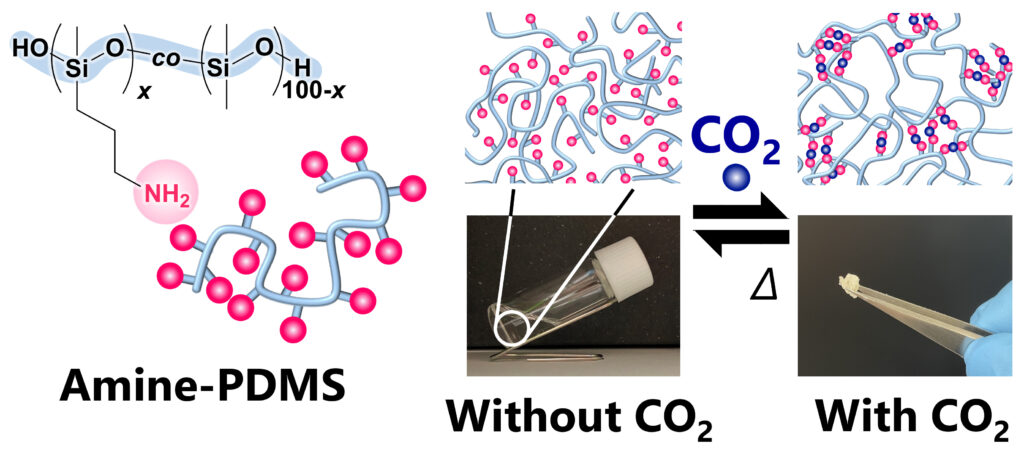
Polydimethylsiloxane (PDMS) is a silicone polymer known for its flexibility, chemical stability, and high permeability to CO₂. PDMS can be modified by introducing amine groups along the polymer chains and when these groups react with CO₂, they can form ionic connections that restrict chain movement and increase stiffness.
Previous studies have shown that CO₂ can alter the mechanical behavior of amine-containing polymers. For example, combining polyethylenimine with PDMS at the nanoscale allowed a soft elastomer to become rigid following gas exposure. This response depended on maintaining extremely small polymer domains, and adjusting the glass transition temperature of the hardened component remained difficult. The glass transition temperature (Tg) marks the change from a relatively rigid, glassy state to a softer, more mobile state.
Amine-functionalized PDMS provide another possibility because its reactive groups are incorporated directly into the silicone polymer. Earlier research demonstrated that materials with relatively low amine concentrations undergo CO₂-induced changes in flow and adhesion, however, much less was known about how higher concentrations affect the degree of hardening, internal structure, and rate of gas absorption. Increasing the number of amine groups could create more connections between polymer chains, but the resulting increase in rigidity might also make it harder for CO₂ to penetrate the material.
In a recent research paper published in ACS Applied Polymer Materials, Dr. Kazuma Okada, Dr. Hayato Nakamura, Dr. Kei Hashimoto, Dr. Shoichi Kutsumizu, and Professor Yohei Miwa from Gifu University in Japan investigated how amine concentration affects the response of PDMS to carbon dioxide. They examined how CO₂ changes the polymer’s internal structure and mechanical behavior.
The researchers prepared a series of amine-functionalized PDMS samples containing 20% to 100% amine-bearing repeat units. All were initially rubbery at room temperature, providing a consistent starting point for comparing their behavior after CO₂ exposure.
The authors conducted infrared spectroscopy which showed that CO₂ reacted with the amine groups to form mainly ammonium carbamates, along with smaller amounts of carbamic acid. They found ammonium carbamates form when CO₂ reacts with an amine group and another amine accepts a proton, creating an ionic pair. These interactions act as temporary physical cross-links between polymer chains.
Ammonium carbamates formed before carbamic acid during CO₂ exposure and decomposed more slowly when the gas was removed. Measurements of absorbed CO₂ also supported their predominance and provided further evidence that these ionic structures were central to the curing process. They found the chemical reactions were accompanied by changes in the polymer’s internal organization. Small-angle X-ray scattering revealed that CO₂ caused the material to separate into nanoscale regions enriched in ammonium carbamate and regions dominated by PDMS. As amine concentration increased, the spacing between these regions became smaller, which indicate that the increasing density of ionic structures restricted polymer-chain movement and contributed to greater rigidity.
When they performed thermal measurements to understand how these structural changes affected polymer mobility, they found at lower amine concentrations, the CO₂-treated polymers have two glass transitions, associated with the flexible PDMS-rich regions and the more rigid ionic-rich regions. The team reported that at higher concentrations, the behavior changed and a sample containing 52 mol % amine-bearing repeat units exhibited a single glass transition at approximately 32 °C after CO₂ treatment, compared with about −90 °C before exposure. Although the polymer still contained distinct nanoscale regions, its thermal behavior suggested that chain movement had become more cooperative rather than being controlled by independently mobile PDMS regions. The material therefore changed from a soft rubber into a glassy solid at room temperature.
The shear storage modulus, which describes a material’s resistance to elastic deformation, increased markedly with amine concentration. Samples containing fewer reactive groups developed gel-like or leathery properties, whereas the 52% sample reached approximately 1 GPa following CO₂ exposure.
The polymer also hardened significantly before reaching its full CO₂ absorption capacity. The same sample reached a high modulus after absorbing only part of the gas it could eventually capture and the stiffness remained largely unchanged when some of the absorbed CO₂ was released under nitrogen, suggesting that the rigid structure could persist despite partial gas loss.
However, adding more amine groups did not always produce a faster response. CO₂ uptake became progressively slower at higher concentrations, with a particularly sharp decline around 52%. The researchers attributed this behavior to hardening near the polymer surface, which restricted further gas penetration into the interior.
Samples with the highest amine concentrations showed this behavior most clearly. Their initial response was relatively slow, but prolonged exposure produced further changes in thermal behavior. After three months under CO₂, these materials exhibited glass transition temperatures above 50 °C, indicating that extensive curing remained possible when sufficient time was allowed for gas penetration. The team also examined whether the hardened polymers could return to their original state. Heating to approximately 80 °C initiated CO₂ release, and further heating restored their rubbery behavior, confirming that curing was reversible rather than permanent.
The new study by Professor Yohei Miwa and team establishes amine concentration as a key factor controlling the mechanical and thermal properties of CO₂-responsive PDMS. It also reveals an important relationship between curing and gas transport: increasing the number of reactive groups can produce greater stiffness, but the resulting hardening can slow CO₂ penetration into the polymer. This relationship provides excellent guidance for selecting material compositions and a higher amine content may be desirable when greater rigidity or a higher glass transition temperature is required, whereas the rate of CO₂ absorption must also be considered when a faster response is needed. Hence, the choice of composition depends on the desired combination of mechanical properties and curing behavior.
The ability to adjust the glass transition temperature over a broad range is another important outcome because it allows the thermal response of the cured polymer to be controlled through its chemical composition and can provide greater flexibility in material design than systems with a relatively fixed glass transition temperature.
The Gifu University researchers successfully established a reversible CO₂-curing system based on amine-functionalized PDMS that can transform from a soft rubber into a rigid, glassy material, with a shear storage modulus reaching about 1 GPa. By adjusting the amine content, they demonstrated control over the glass transition temperature and the rate of curing. This combination of adjustable mechanical properties and reversible behavior provides a basis for developing CO₂-responsive polymers with different performance requirements.


Reference
Kazuma Okada, Hayato Nakamura, Kei Hashimoto, Shoichi Kutsumizu, Yohei Miwa; CO2‑Induced Curing of Amine-Functionalized Polydimethylsiloxane across a Broad Amine Concentration Range. ACS Appl. Polym. Mater. 2026; 8 (8): 5725–5732.