 Advances in Engineering Advances in Engineering features breaking research judged by Advances in Engineering advisory team to be of key importance in the Engineering field. Papers are selected from over 10,000 published each week from most peer reviewed journals.

Significance
Identifying how a dynamic system behaves is important for detecting faults, recognizing abnormal operating conditions, and making safe control decisions. In autonomous driving, for example, a vehicle may need to determine whether a nearby driver is inattentive, cautious, or acting aggressively. Each possibility can be represented by a mathematical model that predicts how the nearby vehicle will respond under different conditions. However, determining which model best describes its behavior can be difficult when measurements are noisy and some aspects of the system remain uncertain.
These models can be distinguished by comparing their predictions with observed behavior. The challenge is that different models may produce similar outputs, making them difficult to tell apart through observation alone. Active model discrimination (AMD) addresses this problem by selecting control inputs that produce distinguishable responses, taking account of system constraints and uncertainties.
As new information becomes available during operation, control inputs can be adjusted to improve model discrimination. In autonomous driving, for example, the desired vehicle speed or measurements of surrounding vehicles may change over time. Incorporating this information can improve the identification of competing models, but repeatedly solving complex optimization problems in real time can be computationally demanding.
To reduce this burden, previous partition-based methods divide uncertain parameters and measurements into predefined ranges and calculate suitable control inputs for each range in advance. During operation, the system selects a stored input based on the information received. However, fixed divisions may not achieve the lowest expected control input cost, especially when some parameter values or measurements are more likely to occur than others. Selecting the boundaries more carefully could reduce this cost without compromising reliable model discrimination.
In a recent research paper published in Automatica, Dr. Ruochen Niu and Associate Professor Qiang Shen from Shanghai Jiao Tong University, together with Associate Professor Sze Zheng Yong from Northeastern University, developed a multi-stage active model discrimination (MS-AMD) method for discrete-time affine systems. Their method uses probability information to optimize how uncertain parameters and noisy measurements are divided into regions, with the aim of reducing the expected control input cost needed to distinguish competing models. The complex calculations are performed in advance, so the system can select suitable inputs as new information is received without repeating the optimization process.
The researchers designed the method to distinguish between competing system models within a specified time horizon, even when initial conditions, uncontrolled inputs, disturbances, and measurements are uncertain. The main requirement was to ensure that the output trajectories of each pair of models could be distinguished under all uncertainties within their specified bounds.
To achieve this, they divided the possible ranges of uncertain parameters and measurements into smaller regions, called templates, which could be combined into larger partitions. Binary decision variables were used to select the partition boundaries based on the likelihood of different values and measurements. This kept the optimization manageable by avoiding nonlinear terms that would make the calculations more complex.
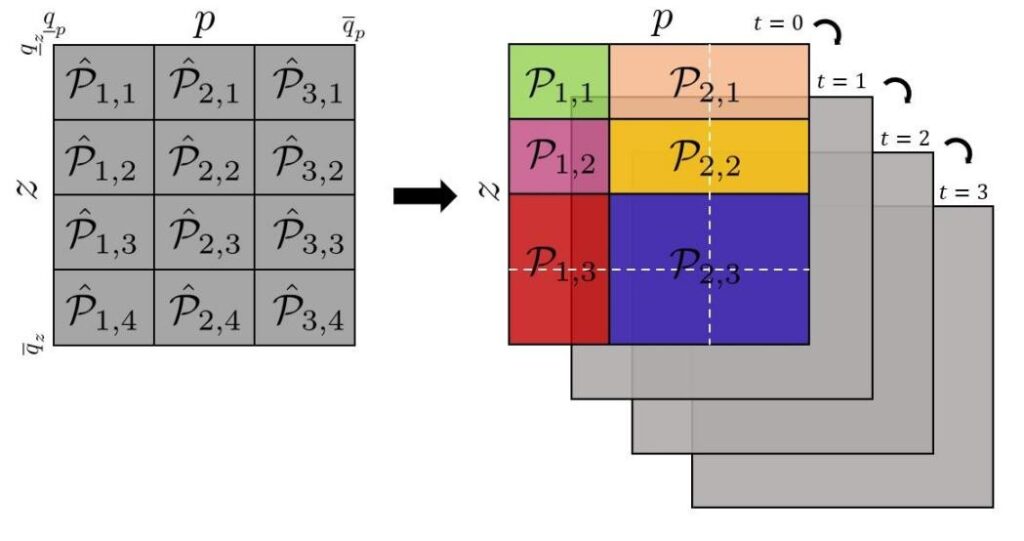
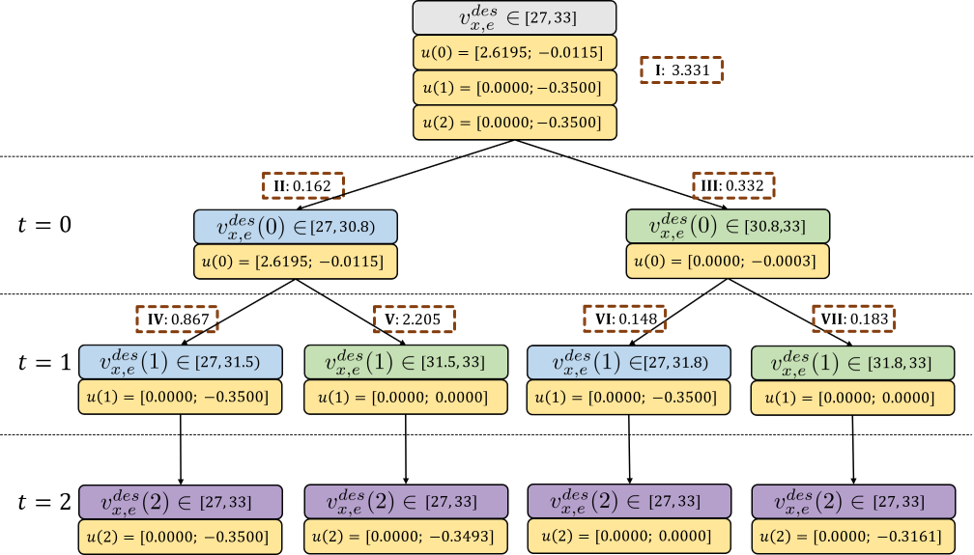
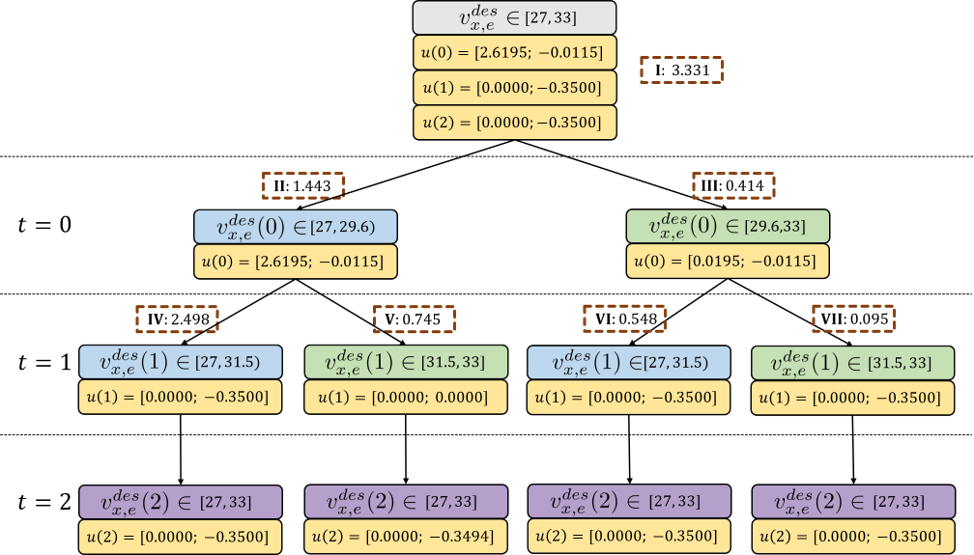
The resulting problem was formulated as a sequence of mixed-integer linear programming problems that could be solved using established optimization software. The calculated control inputs and their corresponding regions were stored in a lookup tree. During operation, the system used the incoming information to follow the appropriate branch and retrieve a suitable input. A model invalidation procedure then eliminated candidate models whose predicted behavior was inconsistent with the observations and the specified uncertainty bounds.
Ruochen Niu et al. evaluated the method through two simulated highway lane-changing scenarios involving an ego vehicle and another vehicle whose driving intention was unknown. Three possible behaviors were considered: inattentive, cautious, and malicious driving. The objective was to identify the behavior model with the lowest expected control input cost.
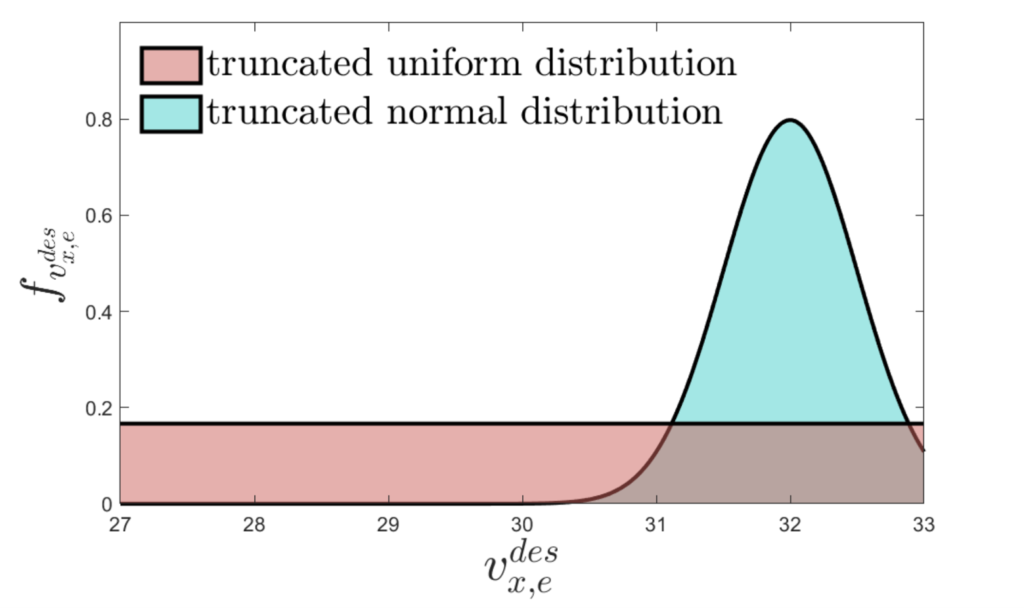
In the first scenario, the desired reference speed of the ego vehicle was treated as a parameter revealed during operation. Two probability distributions were examined: a uniform distribution, in which values within the specified range are equally likely, and a truncated normal distribution, in which some values are more likely than others.
Under the uniform distribution, adaptive partitioning reduced the expected input cost by approximately 7% compared with the earlier fixed-partition method at the initial stage. The improvement was much greater with the truncated normal distribution, reaching approximately 76%. At a later stage, reductions of up to 48% were observed under the truncated normal distribution. These savings reflected how the optimized partitions accounted for the likelihood of different speed values rather than simply dividing the range into equal sections.
The system also identified the driving behavior within three time steps. The inattentive model was eliminated first, followed by the malicious model, leaving the cautious model as the only candidate consistent with the observations.
The second scenario focused on a noisy measurement of the surrounding vehicle’s speed and by using the same two probability distributions, the researchers examined how adaptive partitioning performed when the newly received information came from output measurements rather than a system parameter.
For the uniform distribution, the initial reduction in expected input cost was approximately 4%, indicating that equal-sized partitions were already close to the optimized solution in this case. With the truncated normal distribution, the reduction reached approximately 43%. Additional savings of approximately 11% were obtained at a later stage under the uniform distribution. The competing driving models were successfully distinguished within two time steps.
The team also examined the computational requirements of the method. Preparing the control inputs offline took approximately 18 hours for the first scenario and six hours for the second on the laptop used in the simulations. In contrast, the online model invalidation procedure required approximately one second and 0.8 seconds, respectively. This difference illustrates the benefit of completing the demanding calculations in advance and keeping the computational effort during operation relatively low.
The research by Niu, Shen, and Yong demonstrated how probability information can improve control input design under uncertainty. By considering the likelihood of different operating conditions when selecting partition boundaries, the method can reduce the expected cost of distinguishing competing models. The simulations showed that this advantage was especially clear for nonuniform distributions, where some values were considerably more likely than others.
Reducing the expected cost does not weaken the requirement for reliable model discrimination. The separation conditions must still hold for all admissible uncertainties within their specified bounds. The method therefore considers the likelihood of different operating conditions without compromising the guarantee of model separation.
The proposed method also reduces the computational effort during operation by completing the complex calculations in advance. As new measurements and parameters become available, the system can select suitable control inputs from the stored solutions without repeating the optimization process and this is useful in applications that require quick decisions.
The highway lane-changing simulations demonstrate how the method can support driving-intention identification under uncertain conditions. The underlying mathematical formulation also provides a basis for exploring active model discrimination in more complex systems, including nonlinear and hybrid models.



Reference
Ruochen Niu, Qiang Shen, Sze Zheng Yong, Active model discrimination: A multi-stage approach with adaptive partitions, Automatica, Volume 190, 2026, 113067,