Advances in Engineering Advances in Engineering features breaking research judged by Advances in Engineering advisory team to be of key importance in the Engineering field. Papers are selected from over 10,000 published each week from most peer reviewed journals.

Significance
Angle-resolved polarized Raman (ARPR) spectroscopy is a Raman spectroscopy method in which the researchers change the polarizations direction of the incoming laser and/or the scattered Raman light while measuring how the Raman intensity changes with angle. In practice, they rotate the polarizations relative to the crystal axes and record the angular intensity pattern of each Raman mode. When the polarization angle is changed in an anisotropic layered material (ALM), the Raman signal does not behave in a clean and, stable way. The difficulty is that in these materials, the measured angular Raman pattern had already been known for years to shift with flake thickness, excitation wavelength, and even the dielectric environment beneath the flake. Once a technique behaves that way, interpretation becomes unstable. A pattern that looks like an intrinsic signature of the crystal may actually contain a large contribution from the optical path the light takes before and after the scattering event. This limitation had not been fully resolved because the usual simplified treatment applicable to isotropic layered materials assumes that the incoming and outgoing polarization vectors can be treated as fixed quantities at the sample surface. For ALMs, that assumption is too crude. Inside the flake, birefringence changes phase accumulation along different in-plane axes, linear dichroism determines how far light penetrates along those axes, and the flake together with the substrate forms a multilayer optical structure that introduces interference. Consequently, inside the ALM, neither the excitation field at the Raman scattering site nor the Raman-scattered field that propagates back out of the sample plane is identical to the polarization field that the experimenter defines outside the sample.. So the measured signal becomes depth-dependent, axis-dependent, wavelength-dependent, and substrate-dependent all at once. Earlier fits based on effective complex Raman tensor elements can phenomenologically describe specific measurements, but the fitted tensor elements vary with thickness, excitation wavelength, and substrate conditions even though a Raman tensor for a thick flake with bluk-like electronic structure should be intrinsic to the material, heavily limiting their transferability and restricting their predictive power across different structures and samples.
A further challenge arises when the anisotropic material enters the atomically thin limit. In these systems, the optical propagation effects discussed above still remain important, but the electronic structure itself also evolves with layer number. As a result, the associated optical anisotropy, electron–photon/electron–phonon couplings, and Raman tensor parameters can become layer-dependent, meaning that one cannot simply transfer a model from bulk-like crystals to few-layer systems.
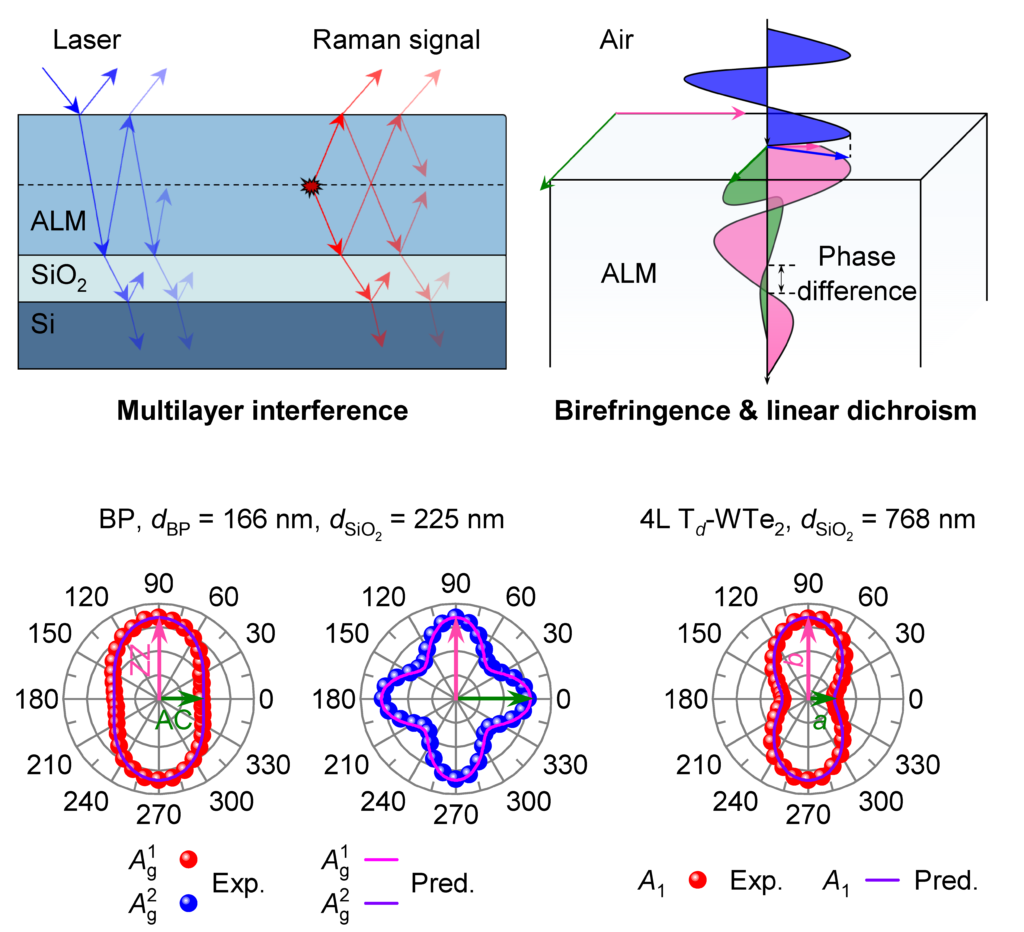
In a recent research paper published in Advanced Materials, Dr. Jia-Liang Xie, Dr. Tao Liu, Professor Miao-Ling Lin, and Professor Ping-Heng Tan from the State Key Laboratory of Semiconductor Physics and Chip Technologies, Institute of Semiconductors at Chinese Academy of Sciences and their collaborators developed a quantitative method that predicting the ARPR intensity in anisotropic materials across atomically-thin flakes to bulk-limits by separating the intrinsic Raman tensor of a phonon scattering event inside an ALM from the effective Raman tensor measured outside the crystal. They combined experimentally determined anisotropic complex refractive indices with transfer-matrix calculations to capture birefringence, linear dichroism, and multilayer interference in the full Raman process. They applied the new approach to thick BP and four-layer Td-WTe2 and predicted angle-resolved polarized Raman intensities across different substrate oxide thicknesses and excitation wavelengths. The distinctive step was not another fitted angular formula, but to establish a physically grounded mapping between the intrinsic scattering response inside the material and the Raman anisotropy observed under external experimental conditions.
The research team used BP as the proving ground for thick anisotropic flakes because its orthorhombic lattice, strong in-plane anisotropy, and well-known Raman modes make the mismatch between simple tensor fitting and physical expectation hard to ignore. The investigators exfoliated BP flakes onto SiO2/Si substrates with different oxide thicknesses, measured ARPR spectra under controlled polarization geometry, and tracked how the A1g and A2g angular intensity profiles changed with flake thickness. They observed that the fitted effective tensor ratios and phase differences varied substantially with thickness, even though BP in the tens-of-nanometers regime should not undergo dramatic electronic-structure changes. That observation matters because it forced the analysis away from ad hoc fitting and toward a propagation-based description of the full Raman process.
The authors then measured polarization-resolved reflectance along the two principal in-plane axes and extracted complex refractive indices for BP using a transfer-matrix treatment of the multilayer stack. With those refractive indices in hand, they calculated depth-dependent field factors for incident and scattered light inside the crystal. The researchers showed that these internal fields oscillate with position because the substrate stack creates a cavity-like interference pattern, and that the oscillations differ along the two crystal axes because birefringence and linear dichroism act simultaneously. That combination has a direct scientific consequence: the Raman event at one depth does not carry the same optical weighting as the event at another depth, so the observed spectrum is an integral over inequivalent local scattering conditions, not a single tensor contraction performed at the sample surface.
Using the new approach, the study extracted intrinsic in-plane Raman tensor elements for the BP A1g and A2g modes and found them to remain effectively thickness-invariant across thick flakes and bulk-like BP at a given excitation wavelength. The investigators also found mode-dependent differences in the intrinsic tensor ratios and phases, with the A2g mode showing stronger anisotropy than A1g under the measured excitations, which they connected to its more strongly in-plane vibrational character and its more effective coupling to the armchair-direction electronic transition dipole. The researchers then derived explicit relations linking the intrinsic tensor and the optical propagation factors to the effective tensor seen in experiment. Afterward, they reproduced the thickness dependence and substrate dependence of the BP angular Raman patterns without introducing extra fitting parameters for BP with different thickness on SiO2/Si substrates with varied oxide thickness.
The study examined few-layer Td-WTe2 to test whether the same logic could survive in a system where layer-number-dependent electronic structures complicate the optical constants themselves. The authors used four-layer Td-WTe2, measured Raman responses of A1 and A2 modes, extracted anisotropic complex refractive indices from reflectance measured across substrates with different oxide thicknesses, and fitted intrinsic tensor elements for the representative A1 (denoted P2) mode. They then predicted how the effective tensor and the ARPR pattern changed across widely different SiO2 thicknesses and across two excitation wavelengths, 633 and 532 nm. The researchers obtained agreement between predicted and measured angular profiles in both cases. That matters because the work is not limited to any specific symmetry class or thickness regime. By validating the framework in either thick BP or few-layer Td-WTe2, the study demonstrates that the separation between intrinsic scattering physics and external optical propagation is broadly adaptable across ALMs.
The authors’ findings are important because allows researchers to interpret Raman anisotropy in layered materials more reliably across changes in flake thickness, excitation wavelength, and substrate structure, instead of treating each measurement as an isolated fitting problem. The importance of the authors’ findings comes from the fact that it clarifies what ARPR measurements are actually reading in ALMs. More broadly, the work clarifies that the ARPR intensity observed in ALMs is jointly determined by the intrinsic Raman tensor and by anisotropic optical propagation effects such as birefringence, linear dichroism, and multilayer interference. By validating separate but connected strategies for thick BP and few-layer Td-WTe2, the study establishes a quantitative framework for predicting ARPR responses across different thicknesses, substrates, and excitation wavelengths. That gives the method practical value by providing a more reliable quantitative basis for interpreting ARPR measurements, including Raman-based crystal orientation identification, studies of anisotropic light–matter coupling, and for work on polarization-sensitive layered optoelectronic materials such as BP and Td-WTe2.
Reference
Xie JL, Liu T, Leng YC, Mei R, Wu H, Liu CK, Wang JH, Li Y, Yu XF, Lin ML, Tan PH. Quantitatively Predicting Angle-Resolved Polarized Raman Intensity of Anisotropic Layered Materials. Adv Mater. 2025 Oct;37(40):e2506241. doi: 10.1002/adma.202506241.
Go to Advanced Materials