Advances in Engineering Advances in Engineering features breaking research judged by Advances in Engineering advisory team to be of key importance in the Engineering field. Papers are selected from over 10,000 published each week from most peer reviewed journals.

Significance
The design and manufacturing of the next-generation aircraft engines require superalloy materials with remarkably high-temperature properties, critical in enhancing their efficiency and performance. Unlike the nickel-base superalloy comprising FCC matric (γ) and γ′ precipitate, cobalt-base superalloys exhibit a higher melting point suitable for aircraft engine applications. The microstructure of Ni-base superalloys is composed of an fcc matrix (γ) strengthened by γ′ precipitates, keeping these superalloys stable at elevated temperature. To improve the engine efficiency, the working temperature of the engine needs to be higher. However, the melting point of Ni is only 1,455 °C which cannot meet the requirement of the development of next generation aircraft engines. The melting point of Co is 40 °C higher than that of the Ni, where a 10 °C increase in the working temperature of aircraft engines could be regarded as a significant improvement. Thus, Co is considered as a potential high-temperature alloy.
Unfortunately, most traditional Co-based superalloys experience poor properties attributed to the negative effects of carbide precipitate strengthening. Over the past few years, considerable research has been conducted to enhance the properties of these superalloy materials at high temperatures. In particular, multiple strengthening elements such as titanium and tantalum have attracted significant research attention owing to their capabilities to improve the γ′ precipitate stability and solvus temperature.
However, effective use of these elements requires solving several contradictions that have been raised previously. For example, an increase in the solvus temperature can potentially lead to a decrease in the γ′ area fraction and poor properties of the resulting superalloys at elevated temperatures. As such, the influence of different strengthening elements on different properties is of great importance in achieving a balanced requirement of the multiple properties. With thousands of potential superalloy candidates available, experimental testing of all the compositions is impossible. Other methods like thermodynamic calculations and density functional theory (DFT) are time-consuming and inappropriate for accelerating the process. Therefore, developing an effective and efficient method for predicting the properties of such complex systems is highly desirable.
Designing materials by machine learning is a common scene in today’s technologically driven world. Such approaches entail building mathematical approaches describing the relationships between the composition, process variable, properties etc., of the conditions under investigation. Due to its advantages, machine learning has been used to predict single material properties and design different materials. The use of machine learning to predict multiple properties of Co-base superalloys is limited. On this account, researchers at is from Harbin Institute of Technology, Shenzhen: Mr. Jinxin Yu, Dr. Chenglei Wang, Dr. Yuechao Chen, Professor Cuiping Wang and led by Professor Xingjun Liu developed a new accelerated strategy to design Co-base superalloys with improved properties. Their research work is currently published in the journal, Materials and Design.
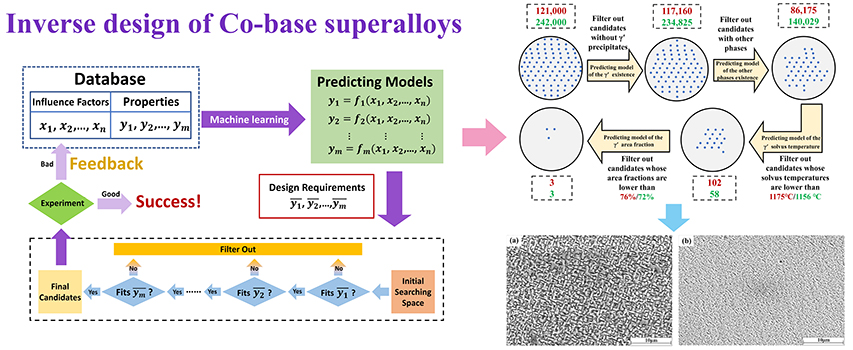
In their approach, predicting models for four key properties: the presence of precipitate, presence of other phases, the area fraction, and γ′ solvus temperature was developed first using multiple machine learning-based algorithms. The accuracy of the models was determined and compared. The best models with the highest accuracy were selected and used to design Co-base superalloys with desirable properties. Finally, the model-predicted superalloys were experimentally validated.
The authors observed that the proposed machine learning-based model was good for accurate prediction of the four critical properties of the superalloys. Moreover, after predicting the properties of the 363,000 possible candidates, six candidates that met the design requirements were identified and successfully validated. The experimental results showed that designed alloys fitted all the critical design requirements, including high γ′ solvus temperature and high γ′ area fractions.
In summary, the research team reported an innovative accelerated design strategy based on machine learning models to realize the multiple-properties design of Co-base superalloys. By overcoming the challenges of traditional experiments and calculation approaches, the properties of the thousand potential candidates were predicted. Besides the design of Co-base superalloys with high γ′ solvus temperature and area fraction, this method could facilitate further investigation of resistance and creep properties. Additionally, in a statement to Advances in Engineering, Professor Xingjun Liu, who is the corresponding author of the paper and the dean of Institute of Materials Genome and Big Data at Harbin Institute of Technology explained their new strategy could pave the way for the multi-properties design of different advanced materials.



Reference
Yu, J., Wang, C., Chen, Y., Wang, C., & Liu, X. (2020). Accelerated design of L12-strengthened Co-base superalloys based on machine learning of experimental data. Materials & Design, 195, 108996.