 Advances in Engineering Advances in Engineering features breaking research judged by Advances in Engineering advisory team to be of key importance in the Engineering field. Papers are selected from over 10,000 published each week from most peer reviewed journals.

Significance
Continuum mechanics deals with the mechanical behavior of materials modeled as a continuous mass rather than as discrete particles. Modeling an object as a continuum assumes that the substance of the object completely fills the space it occupies. Modeling objects this way ignores the fact that matter is made of atoms, and so is not continuous; however, on length scales much greater than that of inter-atomic distances, such models are highly accurate. The first more complete continuum model of surface stresses was developed by Gurtin and Murdoch (GM). In the GM model, surface stresses are reduced to a negligibly thin layer adhering to the underlying material without slipping. Mechanical behaviors of this layer combine both the elastic properties of a solid and the surface tension of liquid. An important element of this model is the conjugation condition in the form of Young–Laplace law, according to which surface stresses are balanced with bulk ones. A thorough review of published literature reveals that surface tension is often ignored during modeling.
In addition, a review of related literature shows that it was not so long ago when researchers started incorporating surface tension into bending equations. On this account, Professor Anatolii Bochkarev at the Saint Petersburg State University in Russia, proposed to clarify the role of surface tension in nanoplate bending. Specifically, he took into account surface tension with quadratic terms equal to the von Kármán-type strains. His works are currently published in the research journal, Mechanics Research Communications.
In his approach, a nonlinear von Kármán-type model of nano-plate bending was formulated incorporating the GM surface elasticity and basing on the Kirchhoff hypothesis. Unlike most of previous related theories, surface tension was taken into account with quadratic terms equal to the von Kármán-type strains. To be specific, the model was built by integrating the motion equations in moving coordinates associated with the middle surface to take into account quadratic terms of surface tension equal to von Kármán-type strains.
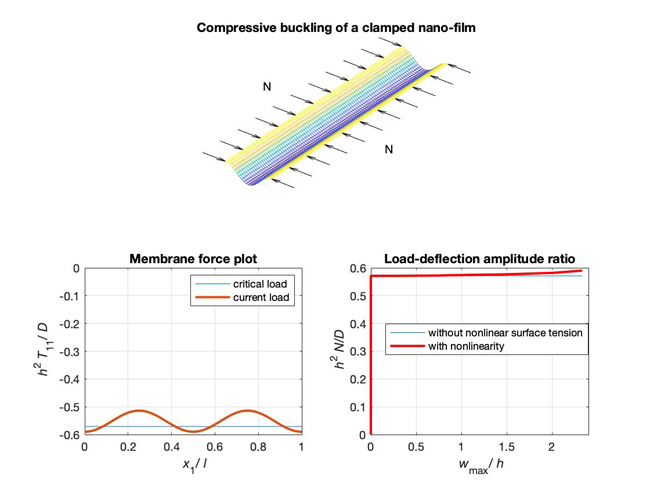
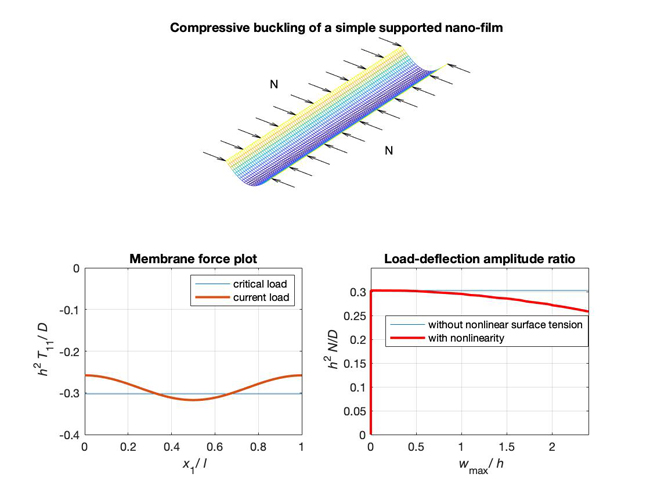
Professor Anatolii Bochkarev reported that when incorporated in bending equation, surface tension was responsible for the conjugation condition of Young–Laplace law in the transverse direction, which until recently has been usually omitted or indirectly satisfied. Further, the example of solving a nonlinear one-dimensional problem showed the effect of surface tension on bending, buckling and free vibrations of a nano-plate in comparison with its indirect accounting. In particular, it was shown that taking into account the nonlinearity of surface tension makes it possible to simulate postcritical deformation after buckling, which is described neither by the classical von Kármán theory, nor by its expansion with linear consideration of surface tension.
In summary, the study enhanced the von Kármán geometrically nonlinear theory of elastic plates so as to enable study statics and dynamics for ultra-thin films that are strongly influenced by surface tension.

References
Anatolii Bochkarev. On the account of surface tension nonlinearity under of nano-plate bending. Mechanics Research Communications, volume 106 (2020) 103521.
Go To Mechanics Research Communications
Anatolii Bochkarev. Comment on “On the account of surface tension nonlinearity under of nano-plate bending”. Mechanics Research Communications, volume 108 (2020) 103578.