Advances in Engineering Advances in Engineering features breaking research judged by Advances in Engineering advisory team to be of key importance in the Engineering field. Papers are selected from over 10,000 published each week from most peer reviewed journals.

Significance
Recent technological advancement has led to the development of functionally graded materials which are generally composites formed by combining different materials. In particular, plates made of functionally graded materials have attracted significant attention of researchers. However, to unleash their full potential, understanding their dynamic and static characteristics is highly desirable. Unfortunately, the vibration control of functionally graded materials has remained a great challenge. Among the available functionally graded materials, piezoelectric materials are widely used in various application owing to their electromagnetic characteristics. These materials are generally susceptible to various defects that negatively impact on their functionalities.
For instance, the composite gradient laminated structure is affected by the induced stress between the layers due to the material discontinuities. To this note, researchers have been looking for alternatives methods for reducing these defects.
Presently, several methods have been developed to control the vibration in functionally graded material plates. As a matter of fact, most of these methods involve the use of piezoelectric fiber-reinforced composite based sensors for vibration analysis control. However, active vibration control of plates that involving piezoelectric materials with varying gradient thickness have not been fully explored.
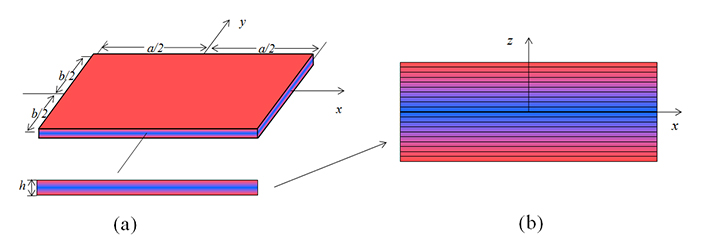
To this note, Dr. Jinqiang Li, Yu Xue (PhD candidate) and Professor Fengming Li from Harbin Engineering University together with Professor Yoshihiro Narita at Hokkaido University investigated active vibration control of functionally graded piezoelectric material plate under uniform and non-uniform electric fields. Fundamentally, the experiment was performed on four simple support edges. Their work is currently published in the research journal, Composite Structures.
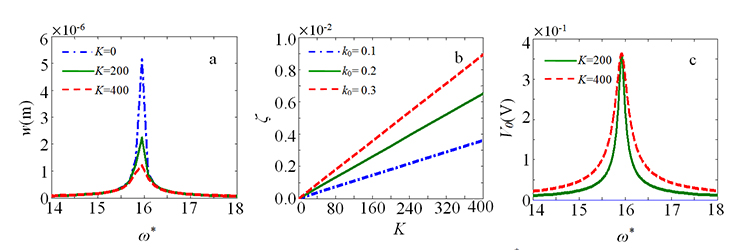
The authors evaluated the dynamic and static characteristics of functionally graded piezoelectric material plates. Next, they derived the equation of the coupling system using the Rayleigh-Ritz and Hamilton’s principle methods. Additionally, effective active damping was obtained via velocity feedback control methods. Furthermore, the authors utilized different types of piezoelectric materials to enhance the vibration control accuracy while at the same time applied varying voltages on different parts of the plate. Eventually, they investigated the parameters of the piezoelectric materials and their corresponding effects on the vibration control of the functionally graded piezoelectric material plates.
The authors observed that the distribution of piezoelectric materials exhibited significant effects on the vibration control of the functionally graded piezoelectric material plates. In addition, other factors such as volume fraction index and external voltage position equally had significant effects on the active vibration control. For instance, increasing the piezoelectric density from inside to outside of the plate improved the accuracy of the vibration control results. This was attributed to the fact that the outer layer highly influenced the active damping and stiffness properties of the plate than the inner layer.
On the basis of this study, the author further analyzed the active control of thermal buckling of functionally graded piezoelectric material plate using a temperature feedback control strategy, and the advantages of functionally graded piezoelectric material plate are discussed by comparing with other structures. (Li, J., Li, F. (2019). Active control of thermal buckling for plates using a temperature feedback control method, Smart Materials and Structures, 2019, 28(4): 045001.)
In summary, the research team successfully demonstrated the vibration control of functionally graded piezoelectric material plates. In general, the authors pointed out that optimizing the structure of functionally graded piezoelectric material plates and the control voltage are the key consideration in enhancing the viability of the control effects. Altogether, the study will advance the design and optimization of functionally graded piezoelectric material with desired properties for various applications.





Reference
Li, J., Xue, Y., Li, F., & Narita, Y. (2019). Active vibration control of functionally graded piezoelectric material plate. Composite Structures, 207, 509-518.
Go To Composite Structures