Advances in Engineering Advances in Engineering features breaking research judged by Advances in Engineering advisory team to be of key importance in the Engineering field. Papers are selected from over 10,000 published each week from most peer reviewed journals.

Significance
Solid-state batteries built around lithium-rich manganese oxide positive electrodes bring together two demanding aspects of electrochemical materials design: the use of oxygen redox to access high specific capacity and the need to preserve a stable interface against a solid electrolyte at elevated potential. In lithium-rich manganese oxides, charge compensation extends beyond transition-metal cations to include lattice oxygen associated with the Li–O–Li configuration. This additional redox contribution supports capacities above those of conventional layered oxides and permits operation near 4.6 V versus Li⁺/Li. Yet the same oxygen chemistry that provides this capacity can generate reactive oxidized oxygen species. Their formation may lead to irreversible oxygen release, transition-metal migration, structural rearrangement and chemical oxidation of the adjacent solid electrolyte.
These processes are closely coupled. Oxygen-related changes within the positive-electrode particle alter the near-surface crystal structure, and species reaching the particle boundary can react with the catholyte to form poorly conducting products. The resulting interphase impedes Li⁺ transfer and increases cell resistance, especially during charging above approximately 4.4 V, where oxygen redox becomes prominent. Lithium-rich manganese oxides also contain a Li₂MnO₃-derived component with intrinsically low electronic conductivity. Structural instability and limited transport therefore converge at the same region of the electrode: the particle surface and its contact with the solid electrolyte.
Surface modification offers a means of intervening at this junction, but the requirements are unusually specific. A useful surface layer must restrain oxygen-driven reactions without imposing a prohibitive transport barrier. Chemical passivation alone may protect the electrolyte yet slow Li⁺ exchange, whereas structural reconstruction can alter ion mobility but may not adequately control reactive oxygen species. The scientific problem is consequently one of coordinated interfacial design: stabilizing oxygen redox, limiting irreversible reconstruction and maintaining rapid lithium transport through the outermost region of the active material.
In a recently published research paper in Nature Communications Professor Daniel Rettenwander and colleagues addressed this problem using Li₁.₂Mn₀.₅₄Ni₀.₁₃Co₀.₁₃O₂ modified through immersion in a thiourea-containing aqueous solution followed by annealing. Their central premise was that thiourea processing could produce two chemically and structurally distinct surface features in a single treatment: an ultrathin sulfur-rich layer and a reconstructed Mn-rich spinel-type region beneath it. The investigation was designed to determine whether this coupled modification could regulate oxygen chemistry and interfacial transport simultaneously, and to establish how those effects arise across atomic structure, electrochemical kinetics and extended solid-state battery operation.
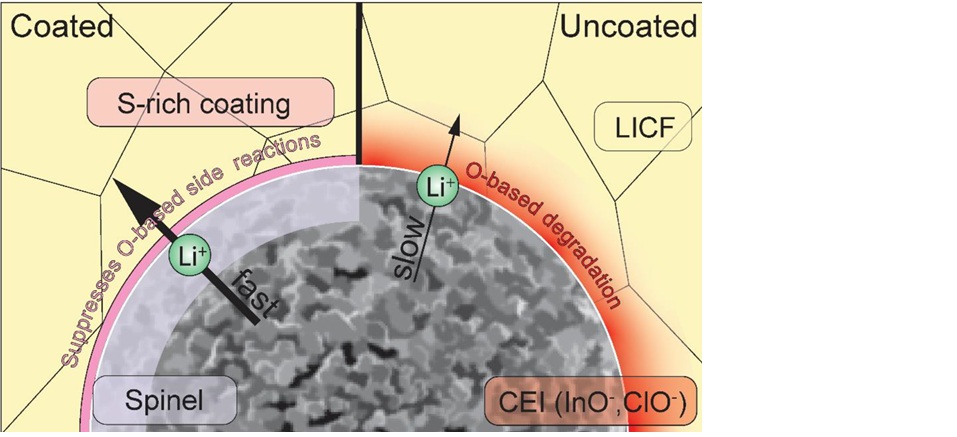
Synchrotron diffraction established that the treatment preserved the predominantly layered interior of the lithium-rich manganese oxide, with only minor changes in lattice parameters and antisite disorder. The principal structural alteration occurred near the surface. The proportion of spinel-type material increased from about 2.3 wt% in the untreated powder to 10.2 wt% after modification, and the broadened spinel reflections indicated nanoscale domains. Electron microscopy resolved the architecture more directly: an approximately 0.7 nm sulfur-containing outer layer covered a Mn-enriched subsurface region consistent with spinel LiMn₂O₄. Sulfite, sulfate and C–S–C species were detected at the surface, whereas nitrogen-containing products were absent. The authors propose that thiourea decomposition generates reducing species during processing, enabling partial conversion of Li₂MnO₃ into LiMn₂O₄ as sulfur is oxidized to sulfite and sulfate.
This surface architecture substantially altered cell behavior. In solid-state cells containing a Li₃InCl₅.₄F₀.₆ catholyte, the modified material delivered an initial discharge capacity of 220.2 mAh g⁻¹ and an initial Coulombic efficiency of 84.83%, compared with 138 mAh g⁻¹ and 75.46% for untreated LRMO. Its capacity remained higher across rates from 0.1 to 2 C. At 0.2 C, 95.6% of the initial capacity was retained after 100 cycles, and at 1 C the cell maintained approximately 147 mAh g⁻¹ with more than 97% capacity retention after 600 cycles. Cells prepared at an areal loading of 15.28 mg cm⁻² produced about 174 mAh g⁻¹ and maintained stable cycling, despite the kinetic constraints associated with the greater loading and secondary-particle morphology.
The authors performed cyclic voltammetry which showed reduced polarization and greater use of the high-voltage redox process. During initial charging, distribution-of-relaxation-time analysis separated the overlapping impedance contributions and showed that interfacial resistance increased far less in the modified cell than in the untreated one. This difference persisted during prolonged cycling, indicating that the coating limited the progressive formation of resistive interfacial products. The spinel-type layer beneath the sulfur-rich coating also had a direct transport consequence: its three-dimensional Li⁺ pathways supported faster motion near the particle boundary than the two-dimensional pathways of the layered bulk. Consistently, the modified material maintained higher lithium diffusion coefficients at high states of charge. Chemical and structural measurements linked these kinetic changes to oxygen stabilization. The modified electrode retained larger fractions of oxidized oxygen species in both delithiated and lithiated states, indicating more reversible oxygen redox. During operando diffraction, untreated LRMO developed high-voltage shoulders associated with oxygen loss, Mn migration and spinel-like reconstruction. These features were absent after thiourea treatment, and the lattice parameters evolved more regularly through charging. Following cycling, Cl–O, In₂O₃, InO⁻ and ClO⁻ products characteristic of catholyte oxidation were prominent beside untreated LRMO but minimal beside the modified particles. Sulfur-containing species and the surface spinel phase remained detectable after prolonged cycling. Density-functional calculations completed the mechanistic account: the lowest-energy peroxide configuration in spinel LiMn₂O₄ was 2.59 eV higher than its counterpart in layered LRMO, making stabilization and migration of oxidized oxygen through the spinel region energetically unfavorable.
The work of Professor Daniel Rettenwander and colleagues is important in treating oxygen stability and lithium transport as coupled surface phenomena. The sulfur-rich outer layer limits oxygen-mediated reactions with the halide catholyte, and the reconstructed spinel-type region changes the energetic and transport properties of the particle boundary. Neither component is presented as an isolated coating function. Their value follows from their spatial arrangement and complementary roles: one controls interfacial chemistry, while the other provides a more favorable near-surface pathway for Li⁺ and resists the migration of oxidized oxygen toward the electrolyte.
This interpretation clarifies why a nanometre-scale modification can influence both first-cycle reversibility and long-term operation. Preserving oxidized oxygen species within a reversible redox process reduces the loss of active oxygen and the associated transition-metal rearrangement. It also limits formation of resistive oxidation products in the catholyte. Lower interfacial impedance is therefore connected to the stabilization of the active material itself, not simply to improved physical contact. The operando structural data, post-cycling chemical analysis and calculated peroxide energetics converge on this relationship.
The treatment also leaves the layered particle interior largely intact. Capacity continues to arise from the lithium-rich bulk, with the reconstructed region confined to the surface-near volume where oxygen migration and electrolyte oxidation must be controlled. This separation of functions provides a clear materials-design logic: preserve the high-capacity layered phase internally, but give its outer boundary a crystal chemistry better suited to ion transfer and oxygen containment.
Within the cell chemistry and testing conditions examined, the modified electrode combined an initial discharge capacity above 220 mAh g⁻¹ with stable cycling over 600 cycles at 1 C. Performance at increased areal loading further indicates that the engineered interface remains electrochemically stable when more active material is introduced, although the paper confines its demonstrated scope to laboratory solid-state cells and identifies pouch-cell evaluation as future work. The broader implication supported by the evidence is that precursor chemistry can be used to construct a chemically protective layer and a transport-active reconstructed phase in one processing sequence.


Reference
Jin, F., Zhao, W., Ellingsen, I.S. et al. Thiourea-derived coating enabled lithium-rich manganese oxide positive electrode in solid-state batteries. Nat Commun (2026). https://doi.org/10.1038/s41467-026-75215-1
Go to Nature Communications