Advances in Engineering Advances in Engineering features breaking research judged by Advances in Engineering advisory team to be of key importance in the Engineering field. Papers are selected from over 10,000 published each week from most peer reviewed journals.

Significance
The global demand for paper products has significantly increased thereby resulting in a corresponding increase in paper production. Unfortunately, different processes involved in the pulp and paper industries result in the production of solid waste products including wood residues, barks and sand as well as inorganic liquor sludge, dregs and lime mud. Due to limited disposal space, the waste products have led to widespread pollution. This has compelled global leaders and policymakers to devise policies aimed at protecting and keeping the environment safe. Therefore, researchers have been looking for alternative ways of curbing paper waste pollution and have identified recycling as a promising solution. For example, paper waste sludge has been used in the construction and building industries. Besides, the porous nature of paper waste sludge particles opens the way for their applications in polymeric materials like polyurethane foams.
Presently, application of polyurethane materials has attracted considerable attention owing to their unique properties that can be altered by the type and composition of the components forming the materials. Considering the high cost of additional processes in the production of building materials such as particle milling and purification, the focus has shifted at the potential of using unpurified and large particle size distribution containing paper waste sludge in polyurethane foams.
A group of researchers at Vilnius Gediminas Technical University: Dr. Agnė Kairytė, Dr. Sigitas Vėjelis and Dr. Giedrius Balčiūnas in collaboration with Latvian State Institute of Wood Chemistry scientists: Dr. Mikelis Kirpluks, Dr. Aiga Ivdre, Dr. Ugis Cabulis developed a rigid polyurethane foam composite from bio-based polyol filled with paper waste sludge particles. Their main objective was to investigate the possibility of recycling and using paper waste materials for reinforcing the polyurethane composites. Consequently, they investigated the microstructure as well as the physical and mechanical properties of the obtained foam composites. The study is published in the journal, Polymer Composites.
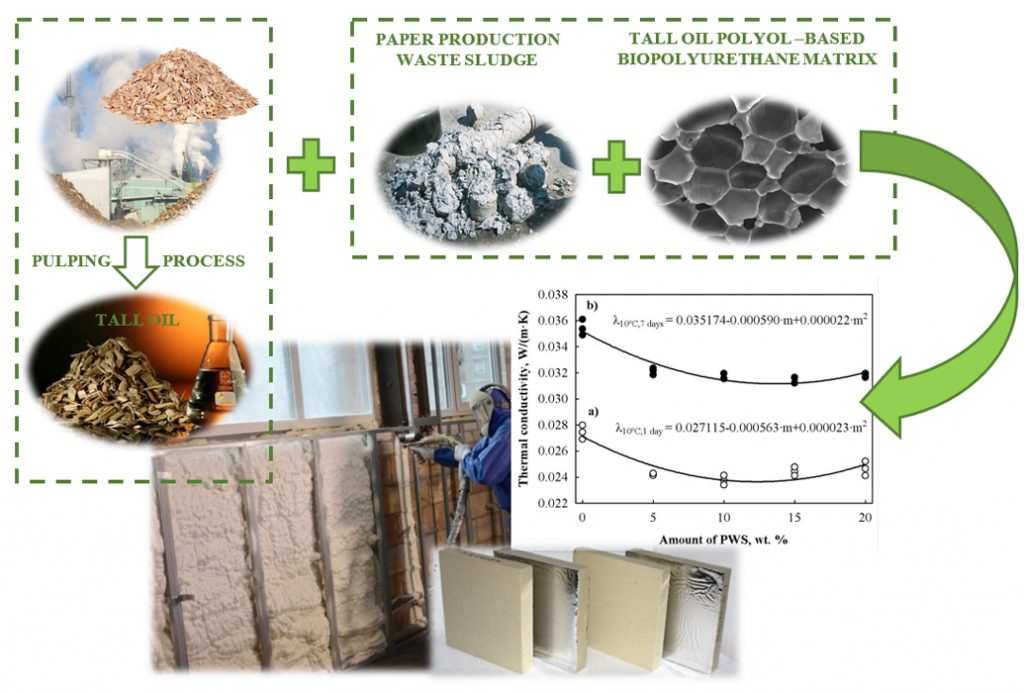
From their study, the authors observed that paper waste sludge particles significantly enhanced thermal conductivities, modulus of elasticities, compressive strength and water vapor resistance as compared to neat polyurethane foam. This was attributed to the small sizes of the paper waste sludge particles that acted as the nucleation sites during the foaming reaction process thus also resulting in the significant reduction of the cell size. Additionally, the foams were characterized by 10% low thermal conductivity after a day and a further 13% after a week of production. Furthermore, the particles increased the foam density thereby leading to an increase in the compressive strength as well as the modulus of elasticity.
The research team successfully developed a rigid polyurethane foam composite filled with paper waste sludge. The results show the possibility of recycling the foam composite as a reinforcement material for the building and construction industries. This was due to the enhanced physical and mechanical properties thus confirming the feasibility and practicability of the study. Therefore, the Lithuanian and Latvian scientists in the study are optimistic that their work will advance the efforts to minimize and eliminate environmental pollution caused by paper waste sludge by recycling the wastes into newer products for various applications such as the building and construction industries.


Reference
Kairytė, A., Kirpluks, M., Ivdre, A., Cabulis, U., Vėjelis, S., & Balčiūnas, G. (2018). Paper waste sludge enhanced eco-efficient polyurethane foam composites: Physical-mechanical properties and microstructure. Polymer Composites, 39(6), 1852-1860.
Go To Polymer Composites