Advances in Engineering Advances in Engineering features breaking research judged by Advances in Engineering advisory team to be of key importance in the Engineering field. Papers are selected from over 10,000 published each week from most peer reviewed journals.

Significance
Hydraulic fracturing with proppants has been widely applied to stimulate naturally fractured reservoirs to achieve economic production rates. However, most natural fracture apertures are relatively small to allow penetration of large proppant particles, particularly fractures far away from the injection point. Consequently, only a small region of the reservoir near the injection point where fractures are relatively larger gets stimulated.
In light of this, a graded proppant injection technique has been proposed where small proppant particles are injected first, followed by larger ones. In principle, small proppant particles will percolate deeper into the natural formations, while larger particles will tend to be trapped near the injection points. As a result, the entire fracture system is evenly supported by the proppant particles. Considering that kinematic apertures of natural fractures are very narrow, micro-sized proppants are normally used to prop them. In addition, a partial monolayer of proppants should be injected into the fracture system. This is why graded proppant injection or Graded Proppant Placement (GPP) usually refers to the monolayer injection of micro-proppants.
Former studies on Graded Proppant Placement have been based on many simplifications, leading to considerable discrepancies between previous studies’ modelling and experimental results. Negligence of Proppant Embedment into the fracture wall and Proppant Deformation (PEPD) is to blame for causing these discrepancies. The effects of these two factors are significant in soft and unconsolidated formations where rigid proppants are embedded into the fracture walls easily, and soft proppant particles easily deform, therefore, causing reduction of fracture aperture.
In a new study published in the Journal of Petroleum Science and Engineering, Engineer Huifeng Liu from CNPC Engineering Technology R&D Company Limited in China together with Engineer Zebo Yuan and Engineer Jv Liu from PetroChina Tarim Oilfield Company, Professor Pavel Bedrikovetsky from The University of Adelaide (Australia) and Dr. Yuxuan Liu from the Southwest Petroleum University established a new model for calculating Proppant Embedment into fracture wall and Proppant Deformation (PEPD) and incorporated them into the Graded Proppant Placement model. They also looked at the effects of proppant embedment and deformation on Optimal Proppant Packing Ratio, projected post-stimulation productivity increase, and optimal injection schedule.
A Graded Proppant Placement model considering Proppant Embedment into fracture wall and Proppant Deformation (PEPD) was established. The study entailed an investigation into the effects of proppant packing ratio, the elastic modulus of rock and proppant, closure pressure, and proppant particle size on propped fracture permeability.
The authors found that proppant diameter had little effect on the Optimal Proppant Packing Ratio. Slightly smaller proppant or rock elastic modulus led to a slightly bigger optimal proppant packing ratio. However, smaller proppant particles and smaller rock or proppant elastic modulus resulted in a lower permeability correction factor.
When PEPD was considered, the permeability correction factor was much lower, while the optimal proppant packing ratio was significantly larger. Khanna’s diagram was then redrawn taking into consideration PEPD to compute more accurate optimal proppant packing ratio values.
Conductivity Correction Factor was then introduced to determine optimal proppant packing ratio (OPPR). OPPR values were determined by the conductivity correction factor-based diagram and were observed to be much lower than those determined by the permeability correction factor-based diagram. However, the results matched Khanna’s experimental findings better than with the permeability correction factor-based diagram.
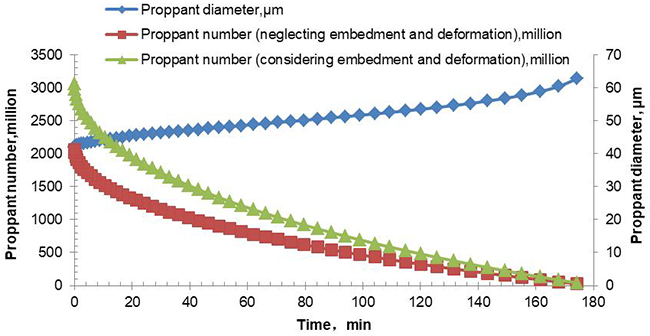
The research team reported that the optimal proppant particle numbers at different graded proppant placement stages were 32.5% more when PEPD was considered than when the two factors were neglected. Neglecting PEPD was also observed to cause an overestimation of the productivity increase folds by up to 27.5%. PEPD influence was found to be much higher on the projected productivity increase for a larger stimulation zone. They concluded that PEPD should always be considered when planning for large-scale graded proppant placement stimulations. Further research on the graded proppant placement model is still needed to get more insights into the influence of long-term proppant embedment and deformation.

Reference
Huifeng Liu, Pavel Bedrikovetsky, Zebo Yuan, Jv Liu, and Yuxuan Liu. An optimized model of calculating optimal packing ratio for graded proppant placement with consideration of proppant embedment and deformation. Journal of Petroleum Science and Engineering, issue 196 (2021), 107703.