Advances in Engineering Advances in Engineering features breaking research judged by Advances in Engineering advisory team to be of key importance in the Engineering field. Papers are selected from over 10,000 published each week from most peer reviewed journals.

Significance
The efficiency of a turbine engine is directly proportional to the lightness and heat-endurance ability of its heat section components. Presently, turbine engine heat-components made from Ni-based super-alloys have reached their upper limit in terms of temperature capabilities. To this note, the need to develop new heat-capable turbine engine component parts has attracted much attention. As of now, silicon carbide-based ceramic matrix composites have been envisioned as potential capable alternative materials for the next generation of turbine engine heat-components. To this note, the higher performance of this material has contributed to it being heavily utilized in the heat-sections of gas turbines. Unfortunately, the ceramic matrix composites have a punitive drawback in that their surface has been seen to recede in case of exposure to heat corrosion.
To this effect, a team of researchers led by Professor Kesong Zhou from Guangdong Institute of New Materials developed a new alternative environmental barrier coating. The purpose of this coating was to offer the much desired protection to the silicon carbide based ceramic matrix composites. Furthermore, they hoped to characterize the microstructure evolution of oxidation in both original and the aluminum-modified silicon carbide-based ceramic matrix composites and observe the thermal shock resistance of aluminum-modified silicon carbide-based ceramic matrix composite. Their work is now published in the research journal, Ceramics International.
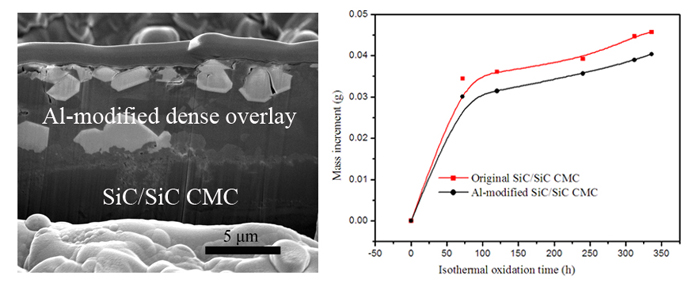
Briefly, the research method commenced by the deposition of an aluminum film on the surface of the silicon carbide based ceramic matrix composites which was then followed by heat treatment in a vacuum. The researchers then proceeded to fabricate a dense alumina overlay on the surface of the ceramic matrix composites. Eventually, the professors and their colleagues analyzed the microstructure evolution of silicon carbide based ceramic matrix composites and characterized the oxidation and thermal shock resistance of the same.
The authors observed that the aluminum-modified silicon carbide based ceramic matrix composites had a better oxidation resistance than the original silicon carbide based ceramic matrix composites. Additionally, they noted that the water-quenching tests showed that the aluminum-modified silicon carbide based ceramic matrix composites had a good thermal shock resistance due to the reactants of silicon oxide and mullite which had the potential to act as a mixture transition layer to release the mismatch between the dense aluminum oxide overlay and silicon carbide based ceramic matrix composites.
The Dr. Xiaofeng Zhang and colleagues study successfully presented an alternative environmental barrier coating design that helps improve the oxidation resistance of silicon carbide based ceramic matrix composites. This novel mechanism has been thoroughly investigated and the results obtained have matched well with the anticipated expectations. To this end, the proposed environmental barrier coating design is available for adoption and application for protective coating purposes of the silicon carbide-based ceramic matrix composites.


Reference
X.F. Zhang, K.S. Zhou, M. Liu, C.M. Deng, C.G. Deng, S.P. Niu, S.M. Xu. Oxidation and thermal shock resistant properties of Al-modified environmental barrier coating on SiCf/SiC composites. Ceramics International, volume 43 (2017) page 13075–13082
Go To Ceramics International