Advances in Engineering Advances in Engineering features breaking research judged by Advances in Engineering advisory team to be of key importance in the Engineering field. Papers are selected from over 10,000 published each week from most peer reviewed journals.

Significance Statement
Medium-manganese steel composed of about 2-10 wt% of manganese is considered a suitable candidate for the third generation of modern high-strength steels for application in lightweight automotive. This type of steel is designed to fill the gap between high manganese twinning-induced plasticity steels and low-alloy transformation induced plasticity steels (TRIP steels). Superior mix of strengths as well as elongation can be realized through retained austenite stabilization via partitioning of carbon and manganese implementing appropriate thermomechanical treatment in the inter-critical range.
Many researchers focused on improving process-ability and attributes in medium manganese compositions. Although complex heat treatment processes have been proposed the most preferable method for producing mechanically and chemically stabilized austenite is by inter-critical annealing of either cold-rolled or hot rolled material. In some earlier studies, manganese content varied between 3-11wt %, however in recent studies, the importance of aluminum in concentration of about 4 wt.% have been proposed as an effective approach to improve annealing temperatures, inhibiting cementite precipitation, and enhancing the overall retained austenite attributes.
Professor Gregory N. Haidemenopoulos and his PhD student John Aristeidakis at the University of Thessaly in Greece investigated systematically the Fe-C-Mn-Al-Ni composition space for medium manganese steels. Despite the considerable increase in cost, nickel was considered as an austenite stabilizer. The authors decided to study the effects of nickel taking into account that in the optimization stage, the reduction in total alloy content was taken into account. Their research work is published in Metallurgical and Materials Transactions A.
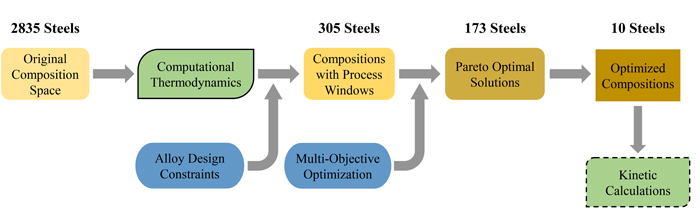
The authors presented a new alloy design methodology for identifying alloy compositions that exhibit process windows meeting particular design objectives and optimized for overall performance. This method applied in the design of medium manganese steels composed of aluminum and/or nickel. They investigated a large composition space systematically by applying computational alloy thermodynamics. This was in a bid to map the fraction as well as stability of retained austenite as a function of inter-critical annealing temperature.
The authors applied a multi-objective optimization (MOOP) method entailing Pareto optimally in order to identify a list of optimum alloy compositions. This maximized retained austenite amount as well as stability, and inter-critical annealing temperature. The authors finally employed a heuristic method to rank the optimum alloys. The authors then developed a short list of optimized alloys ranked consistent with their overall performance in relation to the design objectives.
The authors also observed that only a fraction of the 11% of the analyzed compositions in the original composition space indicated a process window. The majority of process windows were observed for the 0.1% carbon content and none was found above 0.25 wt% carbon. The authors found clear indications that more process windows existed outside the mapped region and hence an extension of the composition space needed to be investigated.
Quote from the Authors: “This research will be followed by kinetics calculations, which will enable the identification of industrially feasible intercritical annealing cycles. The research is a good example of the Integrated Computational Materials Design approach (ICMD)”
Professor Greg Haidemenopoulos is currently on sabbatical leave to the Department of Mechanical Engineering at Khalifa University, in Abu Dhabi, United Arab Emirates.


Reference
John S. Aristeidakis and Gregory N. Haidemenopoulos. Alloy Design Based on Computational Thermodynamics and Multi-objective Optimization: The Case of Medium-Mn Steels. Metallurgical and Materials Transactions A volume 48a, May 2017—2601.
Go To Metallurgical and Materials Transactions A