Advances in Engineering Advances in Engineering features breaking research judged by Advances in Engineering advisory team to be of key importance in the Engineering field. Papers are selected from over 10,000 published each week from most peer reviewed journals.

Significance
Considerable efforts have recently been put in the research and development of effective uses of excess exhaust heat from gas engines. Particularly, the major focus is reducing the amount of unused thermal energy by filling the existing gaps between the exhaust heat emission and heat demand occurrence. This will not only reduce the amount of heat energy consumption but also lower carbon dioxide emission, in line with the enacted greenhouse gas mitigation measures.
The development of phase change materials has shown great potential to solve the aforementioned thermal gap problems. Despite the availability of numerous phase change materials, only a few of them have phase transition points in the temperature range 60-100°C. Additionally, it has been showed that phase change materials have melting points in the temperature range of gas engines and thus can be used to effectively increase the use of exhaust heat. However, their ability to store the latent heat in the temperature range of excess exhaust heat from gas engines have not been fully explored.
To this end, Toho Gas Co., Ltd scientists in Japan: Dr. Kohei Nakamura and Takashi Ina developed new phase change materials designed for the effective use of excess exhaust heat from gas engines. They investigated their thermal energy storage and release properties together with Kobe University researchers in Japan: Professor Hiroshi Suzuki, Associate Professor Ruri Hidema and Associate Professor Yoshiyuki Komoda. This was completed with the help of a heat storage tank containing hot water and the fabricated phase change materials adjusted their melting point around 90°C and packaged into resin bags. Their research work is currently published in the International Journal of Refrigeration.
In brief, the authors commenced their work by preparing novel phase change materials by adding anhydrous sodium sulfate and D-mannitol to ammonia alum hydrate. Regarding its melting temperature that is close to the temperature range of excess exhaust heat from gas engines, ammonia alum hydrate has been considered a potential phase change material. Consequently, its phase change temperature can be controlled by adding other materials.
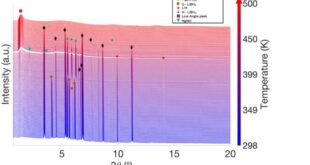
The Research Team observed that the phase change materials stored and released more than 400 MJ m-3 of heat. This was estimated to be approximately ten times higher than that of water with the same volume and at the same temperature range. During the cooling process, almost all amount of the stored latent heat was released. Together with the different scanning calorimeter measurements, part of the packaged phase change materials remained in the solid-state during the heating process thus triggering latent heat release during the cooling process. Due to the release of a large amount of stored heat, the volume of a heat storage tank with hot water and phase change material was noted to be much smaller than that with only hot water at the same temperature range.
Based on the results, the novel phase change materials exhibited great potential of reducing volume, surface area and heat dissipation speed of existing hot water tanks as well as storing and releasing excess exhaust heat from gas engines, attributed to their high-density latent heat.






Reference
Nakamura, K., Ina, T., Suzuki, H., Hidema, R., & Komoda, Y. (2019). Ammonia alum hydrate-based phase change materials for effective use of excess exhaust heat from gas engines. International Journal of Refrigeration, 100, 63-71.
Go To International Journal of Refrigeration