Advances in Engineering Advances in Engineering features breaking research judged by Advances in Engineering advisory team to be of key importance in the Engineering field. Papers are selected from over 10,000 published each week from most peer reviewed journals.

Significance Statement
Gold has been a very special and attractive element to mankind since the earliest civilizations. Nowadays, gold based materials receive interest as many of them exhibit long-lived and intense luminescence with the emission energies spanning the visible spectrum. The light emission of many gold compounds, however, can be highly sensitive to external physical and chemical stimuli, reflecting subtle changes in the environment.
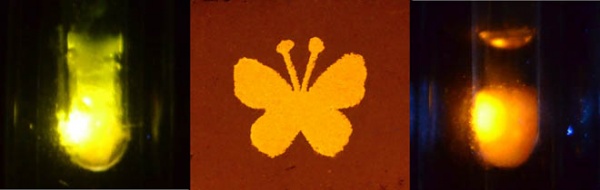
Researchers from “Lendület” Supramolecular Chemistry Research Group of MTA TTK SZKI (Hungarian Academy of Sciences) developed light-emitting gold based supramolecules that emit different colours of light in response to thermal, mechanical and chemical stimuli. These new gold based materials that change colour in response to a wide variety of external conditions could prove useful in detecting thermal or mechanical conditions, or indicate the presence of a particular chemical or biological compound. The mechano-responsive properties of this emerging new class of light- emitting gold based materials have potential applications in inks and papers for security outlets, as well as in stress and crack indicators in engineering.
Figure legend: Stimuli-responsive luminescent gold based material emitting different colours of light depending on the type of the stimulus applied.
Journal Reference
Chemistry. 2015;21(32):11495-508.
Deák A1, Jobbágy C2, Marsi G2, Molnár M2, Szakács Z2, Baranyai P2.
[expand title=”Show Affiliations”]- Hungarian Academy of Sciences, MTA TTK SZKI, “Lendület” Supramolecular Chemistry Research Group, 1117 Budapest, Magyar Tudósok körútja 2. (Hungary). [email protected].
- Hungarian Academy of Sciences, MTA TTK SZKI, “Lendület” Supramolecular Chemistry Research Group, 1117 Budapest, Magyar Tudósok körútja 2. (Hungary).
Abstract
A series of [Au2 (nixantphos)2](X)2 (nixantphos=4,6-bis(diphenylphosphino)-phenoxazine; X=NO3, 1; CF3 COO, 2; CF3 SO3, 3; [Au(CN)2], 4; and BF4, 5) complexes that exhibit intriguing anion-switchable and stimuli-responsive luminescent photophysical properties have been synthesized and characterized. Depending on their anions, these complexes display yellow (3), orange (4 and 5), and red (1 and 2) emission colors. They exhibit reversible thermo-, mechano-, and vapochromic luminescence changes readily perceivable by the naked eye. Single-crystal X-ray studies show that the [Au2 (nixantphos)2](2+) cations with short intramolecular Au⋅⋅⋅Au interactions are involved as donors in an infinite N-H⋅⋅⋅X (X=O and N) hydrogen-bonded chain formation with CF3 COO(-) (2 C) and aurophilically linked [Au(CN)2](-) counterions (4 C). Both crystals show thermochromic luminescence; their room temperature red (2 C) and orange (4 C) emission turns into yellow upon cooling to 77 K. They also exhibit reversible mechanochromic luminescence by changing their emission color from red to dark (2 C), and orange to red (4 C). Compounds 1-5 also display reversible mechanochromic luminescence, altering their emission colors between orange (1) or red (2) to dark, as well as between yellow (3) or orange (4 and 5) to red. Detailed photophysical investigations and correlation with solid-state structural data established the significant role of NH⋅⋅⋅X interactions in the stimuli-responsive luminescent behavior.
© 2015 WILEY-VCH Verlag GmbH & Co. KGaA, Weinheim.
Go To Chemistry.