 Advances in Engineering Advances in Engineering features breaking research judged by Advances in Engineering advisory team to be of key importance in the Engineering field. Papers are selected from over 10,000 published each week from most peer reviewed journals.

Significance Statement
Developing new materials for solar energy conversion has been the aim of most researchers. Solar energy can be considered a decentralized and an inexhaustible natural resource. Solar energy reaching the earth’s surface is thousands times more than the energy actually consumed in our societies. Apart from the photovoltaic technologies that convert solar energy into electricity, it has been found that it is necessary to come up with devices that use solar energy to initiate a chemical reaction that generates energetic molecules that can be stored and used on demand as a fuel.
Hydrogen is a storable chemical fuel that can be implemented in various processes including electricity production in fuel cells or even chemical preparation. Hydrogen comes with specific energy density that is three times more than that of methane while its combustion product is water only. Therefore, coming up with an eco-friendly procedure to generate hydrogen is a big challenge. Water splitting is one of the solar to hydrogen energy conversion process that depends on the use of a semi-conductor as a photo electrode to convert photons into electron-hole pairs that are in charge of oxidation and reduction of water into oxygen and hydrogen.
Water splitting demands a particular semiconducting material having particular attributes in a bid to realize effective solar to chemical energy conversion. The semiconductor conduction band energy should be above the hydrogen evolution reaction energy while its valence band energy should be below the oxygen evolution energy to thermodynamically realize the two reactions.
Titanium oxide is a material that has been investigated most for electrochemical water splitting. It possesses appropriate energy band positions along with superior features such as stability against photo-corrosion, non-toxicity, and low cost manufacturing. In a bid to improve its charge transport attributes and reactivity, it is necessary to control the preparation of titanium oxide at the nano-metric scale and control its electronic properties.
Thomas Favet, Dris Ihiawakrim, Valérie Keller, and Thomas Cottineau at the University of Strasbourg in France, synthesized (Nb, N and Ta, N) co-alloyed aligned titanium oxide nanotubes. This co-alloying approach aims to introduce large quantities of cationic (Nb5+ or Ta5+) and anionic (ex: N3-) hetero atoms species in a stoechiometric ratio in order to significantly improve the light absorption without creating unwanted defects in the structure. Cation insertion is achieved through an elementary anodization process. This was then followed by a thermal treatment in ammonia in order to introduce nitrogen. Their work is published in journal, Materials Science in Semiconductor Processing.
The authors tested various samples in a photo-electrochemical water splitting experiment. Cyclic voltammetry exhibited varying behavior dictated by the thermal treatment applied. At a preliminary annealing step at 450 °C under nitrogen led to black titanium oxide nanotubes that exhibited capacitive behavior as well as a low photo-activity. When the first heating step was achieved under airflow, the samples indicated a faradic characteristic with a distinct photocurrent at the positive potentials.
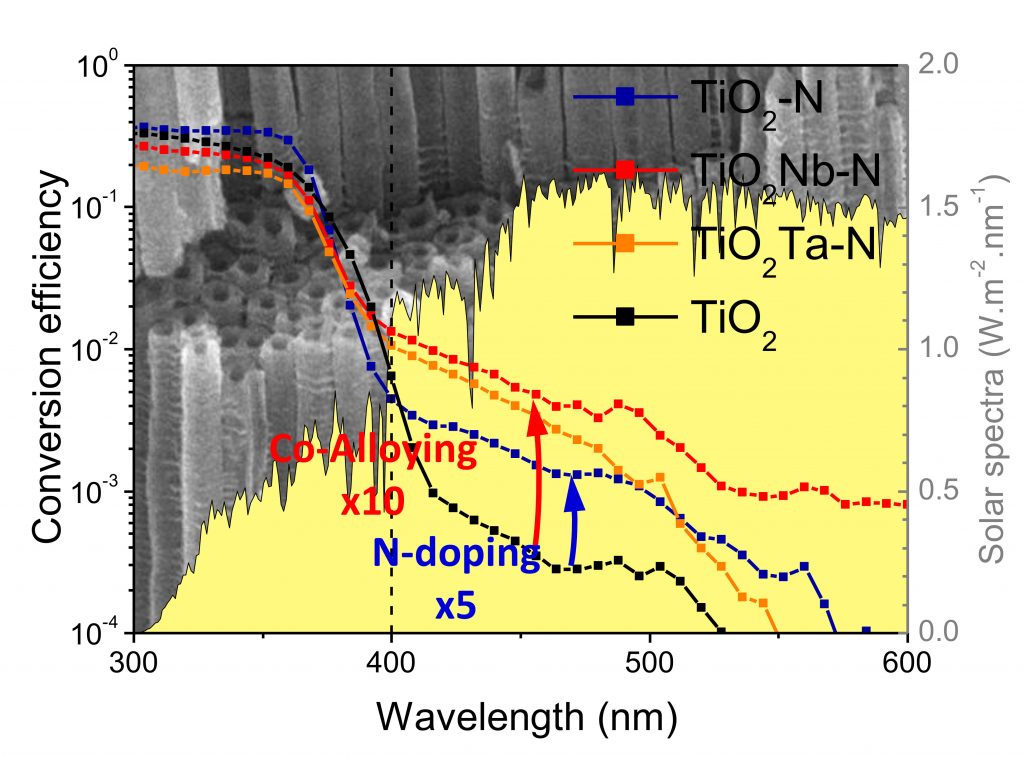
The photoelectrochemical response of the samples indicated that the co-alloyed samples presented an activity in the visible improved more than four times as opposed to N-doped titanium oxide nanotubes. The authors realized that this activity was maximal with an optimized thermal treatment encompassing the first step at 450 °C under airflow, which was followed by a 12 h thermal treatment at 500 °C under ammonia.
These conditions, the incorporation of cations and anions in the alloyed samples tends towards a perfect balance of the charge between N3- and M5+ anions. The co-alloying with high concentration allowed for an effective band gap narrowing followed by a charge compensation process. These two modifications of the features of titanium oxide enhanced the photo-electrochemical activity of the materials.




Reference
Thomas Favet, Dris Ihiawakrim, Valérie Keller, Thomas Cottineau. Anions and cations distribution in M5+/N3- co-alloyed TiO2 nanotubular structures for photo-electrochemical water splitting. Materials Science in Semiconductor Processing, volume 73 (2018), pages 22–29.
Go To Materials Science in Semiconductor Processing
