Advances in Engineering Advances in Engineering features breaking research judged by Advances in Engineering advisory team to be of key importance in the Engineering field. Papers are selected from over 10,000 published each week from most peer reviewed journals.

Significance Statement
Rechargeable alkaline batteries that incorporate the use of zinc anode are not widely used due to the formation of porous zinc after many cycles which often leads to higher chance of corrosion. In order to improve electrodeposition of zinc by using several metal substrates, researchers have discovered that structure of electrodeposited zinc is largely determined by its current density, mass transfer of the electrolyte, and the interaction between zinc and the substrate.
With the appropriate morphology of zinc electrodeposition on metal substrates, some positive results have been achieved. However, some metal substrates pose threats to the environment while some have not been tested with batteries having extended cycle life. Hence, more research needs to be conducted.
Dr. Xia Wei and colleagues from The City College of New York investigated the electrochemical behavior of environmental friendly substrates such as silver, bismuth, copper, iron, nickel and tin on zinc electrodeposition. The work published in the journal, Electrochimica Acta.
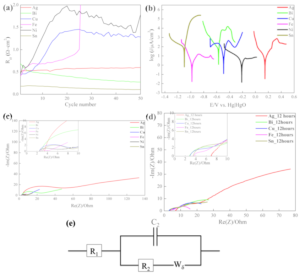
Results in their study from analysis of cyclic voltammetry showed that silver, copper and tin substrates highly benefit compact zinc deposition compared to others. Zinc dissolution was found to be the highest with tin substrate and the least with copper. The substrates of silver, bismuth, copper and tin were selected to be the most preferred substrates for zinc rechargeable alkaline batteries.
The result of studying effects of cycles on charge transfer resistance using electrochemical impedance spectroscopy showed that tin substrate followed by bismuth has the lowest charge transfer resistance over 50 cycles of zinc deposition and dissolution. Iron and nickel anode substrates possessed the highest charge transfer resistance which led to an eventual failure over cycles.
Corrosion rates of metal anode substrates in 9M KOH solution were observed with the highest corrosion current density found in tin substrate and the least comparable values for nickel and iron. However, comparing to silver substrates, zinc corrosion was highly found on iron and nickel substrates.
Iron and nickel substrates failed around 50 cycles which were attributed to hydrogen evolution, hence they are not qualified for being used as substrates for zinc anode. Coulombic efficiencies were high for substrates of silver, bismuth, copper and tin, however, tin itself has higher potential to corrode.
As a micron level characterization, XRD showed an increase in energy basal planes and pyramid planes on bismuth and tin substrates as cycling increases, which indicates higher corrosion resistance.
This study showed bismuth and copper substrates offer the best alternative, economic-wise performance for alkaline rechargeable batteries. Trying to have thousands of cycles by using low cost and environmental friendly zinc, anode substrate, i.e. the current collector is a very important factor in grid-scale energy storage development. This work definitely has profound impact on industrial applications involved zinc anode.

Reference
Wei, X.1, Desai, D.1,2, Yadav, G.G.1, Turney, D.E.1, Couzis, A.1, Banerjee, S.1 Impact of anode substrates on electrodeposited zinc over cycling in zinc-anode rechargeable alkaline batteries, Electrochimica Acta 212 (2016) 603–613.
[expand title=”Show Affiliations”]- CUNY Energy Institute & Department of Chemical Engineering, The City College of New York, New York 10031, USA
- Palo Alto Research Center, A Xerox company, 94304, USA
Go To Electrochimica Acta