Advances in Engineering Advances in Engineering features breaking research judged by Advances in Engineering advisory team to be of key importance in the Engineering field. Papers are selected from over 10,000 published each week from most peer reviewed journals.

Significance Statement
Poly(methyl methacrylate) is a biomaterial widely used in healthcare for its excellent attributes including ease of fabrication, physical and chemical stability, high flexibility, and palatable biocompatibility. This biomaterial is the main component of organic glass cranioplasty elements, prosthesis, contact lenses and bone cement for false teeth. Although Poly(methyl methacrylate) implants are suitable for in vivo usage, there is still a concern of their antibacterial modification counting on frequent bacterial infections and implant failure.
Various antibacterial agents have been identified for Poly(methyl methacrylate) antibacterial modification, but they have exhibited risks of developing drug resistance and potential toxicity on human as well as the environment. Therefore, a new approach is highly desired. Borneol-based polymers exhibit unique antibacterial adhesion attributes by minimizing biofilm formation as well as bacterial formation.
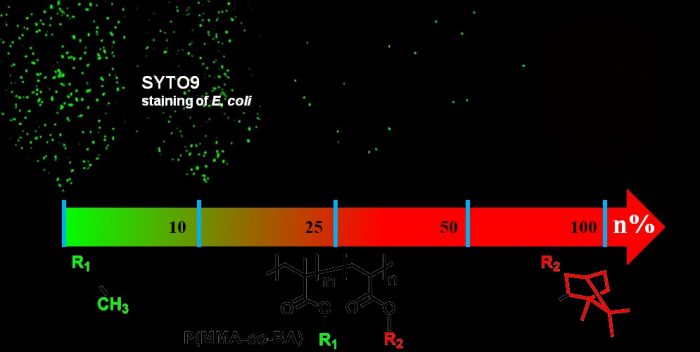
Borneol-grafted cellulose and subsequent modification has resulted in conversion of the antifungal activity from surrender of cellulose into resistance of borneol-grafted cellulose. These findings not only suggest that grafted borneol moieties are central in influencing microbial sensing and their inadhesion attributes, but also inspired a group of researchers Xueli Sun and colleagues from Beijing University of Chemical Technology to modify typical biomedical polymers for antimicrobial applications. They focused on employing methyl methacrylate and borneol acrylate in varying proportions to come up with copolymers via a facile approach of free polymerizations. They also investigated how borneol acrylate content affected the antibacterial attributes of the as-synthesized copolymer (P(MMA-co-BA)s). Their work is now published in Applied Materials and interfaces.
The authors synthesized copolymers with varying mole percentages of borneol acrylate by dissolving borneol acrylate monomers and methyl methacrylate in methanol then adding ammonium persulfate. They obtained a white solid with 92% yield. These bulk copolymers were then applied to synthesize films.
The researchers performed ‘prison break’ experiments in a bid to analyze the interactions between the bacteria and the obtained copolymers. They fixed five circular films with 0, 10, 25, 50 and 100 mole percentages of borneol acrylate onto beef-protein medium. The five circular films were then fixed onto these copolymer films and E. coli suspension added to each medium and cultured at 37 °C.
The researchers employed 40 mice for implantation with each, two films. They made about 1.5 cm incision on each dorsum side and made subcutaneous pouches in the incisions. The films were then implanted into each pocket. Tissues associated with copolymers were harvested and the results at varying time points recorded using a camera.
The authors observed that the E. coli managed to break restrictions of the 0% film and diffused outside within the first 24 hours. The 10% film did not sufficiently restrict E. coli outward spread although less E. coli was present. The 10% film exhibit improved antibacterial adhesion capability than the 0 %. At 48 hours, 25% film broke while for the 50 and 100 % films still had superior restriction for E. coli that didn’t manage to break the ‘copolymer prison’ even after 120 hours. These outcomes suggest that increasing the borneol acrylate units resulted in higher antibacterial efficacy.
Gram-positive B. subtilis bacteria was used to challenge the films. The 100 % film exhibited excellent restrictive for the B. subtilis for over 120 hours. The results suggest that increasing borneol acrylate units contributes to significant antibacterial activity of the copolymers. In vivo analysis of the subcutaneous implantation in mice provided a reference for the use of the borneol acrylate modified Poly(methyl methacrylate). The copolymers are biocompatible and offer a feasible approach for synthesizing bioaffinity and environmentally friendly interfaces and benign biomaterials for bacterial colonization prevention.

Reference
Xueli Sun, Zhiyong Qian, Lingqiong Luo, Qipeng Yuan, Ximin Guo, Lei Tao, Yen Wei, and Xing Wang. Antibacterial Adhesion of Poly(methyl methacrylate) Modified by Borneol Acrylate. ACS Applied Materials Interfaces, volume (2016), 8, pages 28522−28528.
Go To ACS Applied Materials Interfaces