Advances in Engineering Advances in Engineering features breaking research judged by Advances in Engineering advisory team to be of key importance in the Engineering field. Papers are selected from over 10,000 published each week from most peer reviewed journals.

Significance
Concrete materials are highly susceptible to deterioration due to microbial attachment and colonization when used in extreme environments. Therefore, it is imperative to develop antimicrobial concrete to enhance the appearance, integrity, durability, and functionality of infrastructures. In the last two decades, several methods for developing antimicrobial concrete have been proposed. These approaches mainly focused on incorporating additives such as antimicrobial agents into concrete to improve the antimicrobial performance of concrete materials. Moreover, the feasibility of using nanoparticles to inhibit microbial colonization in concrete has been extensively investigated, and promising results have been reported.
In light of the vast research interest in the control of infectious diseases specially the current COVID-19, Liangsheng Qiu (graduate student), Dr. Sufen Dong, and Professor Baoguo Han from Dalian University of Technology together with Professor Ashraf Ashour from the University of Bradford in England conducted a critical expert review on antimicrobial concrete for smart and durable infrastructures. Specifically, the authors reviewed and summarized various types of antimicrobial concrete fabricated with antimicrobial agents, both organic and inorganic. Their comprehensive review is currently published in the journal, Construction and Building Materials.
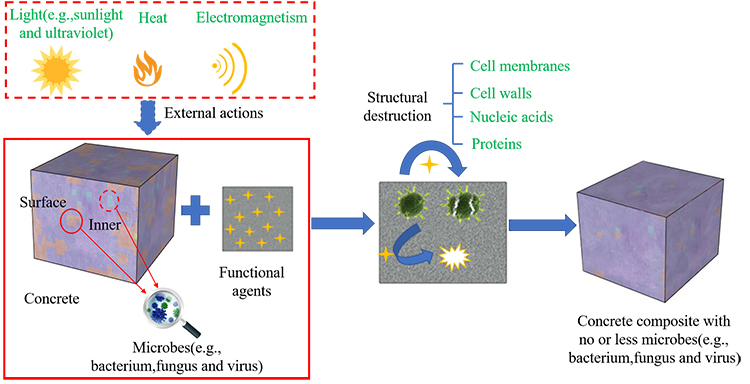
In brief, the authors explored the classification and application of antimicrobial agents in concrete. Next, a summary of the antimicrobial and structural properties of concrete materials incorporating antimicrobial agents was presented. Additionally, the antimicrobial mechanisms of selected organic and inorganic antimicrobial agents mainly towards bacteria were analyzed in detail. Lastly, the practical applications of antimicrobial concrete in different fields such as sewer systems and marine engineering were evaluated to validate the feasibility of the antimicrobial agents in protecting the materials against the microbial threat. Existing problems needed to be addressed were pointed out and future research opportunities of antimicrobial concrete were also explored.
They showed that the antimicrobial agents are generally classified into two types based on their chemical composition: organic and inorganic antimicrobial agents. Inorganic agents include heavy metals, metal compounds, free nitrous acids and nanomaterials, while organic antimicrobial agents include quats, copper phthalocyanine, calcium formate and ConShield. Antimicrobial concrete incorporating antimicrobial agents exhibited remarkable antimicrobial effects against specific microbial metabolism. contributing to the enhancement of aesthetic properties, durability, and longevity of infrastructures. The researchers observed that despite the extensive research and usage of antimicrobial concrete, key issues such as the relationship between the various affecting factors and the antimicrobial performance had not been comprehensively investigated. Furthermore, various concerns such as the toxic substances released by the inorganic antimicrobial agents into the environment, the temporary effectiveness of the organic antimicrobial agents and the resistance of microorganisms to antimicrobial agents hinder the widespread application of antimicrobial concrete.
In summary, the paper presented an excellent review of the development and application of antimicrobial concrete materials. Reports showed that most researchers are restricted to laboratory work with limited practical or field engagement, which is vital in verifying the efficiency of antimicrobial concrete with the above antimicrobial agents. Since the development of high-performance antimicrobial concrete depends on the advancement of antimicrobial agents, future research should focus on developing novel high-efficiency, long-lasting, broad-spectrum and environmental-friendly antimicrobial agents suitable for these applications. Moreover, the development of antimicrobial concrete can be promoted by combining new technologies such as nanotechnology and biotechnology. Especially, the antimicrobial concrete has potential capacity to combat against viruses (e.g., syndrome-associated coronavirus, Middle East respiratory syndrome coronavirus, and the novel coronavirus), so it could be used to develop smart infrastructures (e.g., building, hospital, and sewer systems) for preventing the spread and reproduction of the viruses. Therefore, the antimicrobial concrete could be extended to other fields to address various challenges such as the COVID-19 pandemic, thus improving human life and health as well as resilience of human society.


Reference
Qiu, L., Dong, S., Ashour, A., & Han, B. (2020). Antimicrobial concrete for smart and durable infrastructures: A review. Construction and Building Materials, 260, 120456.