Advances in Engineering Advances in Engineering features breaking research judged by Advances in Engineering advisory team to be of key importance in the Engineering field. Papers are selected from over 10,000 published each week from most peer reviewed journals.

Significance Statement
With respect to the rapid growth of urban and industrial regions the safe transportation of gases through such regions and the safe gas storage, e.g., in the subsurface is of safety-critical importance for human and infrastructure.
Fast leak detection and the spatial definition of the leakage affected area are important for the efficient damage minimization. In addition, a sudden occurrence of enhanced concentrations of explosive and harmful gases is possible, e.g., in geotectonic/volcanic active regions and regions around underground-mining.
The transportation of gases through the subsurface could be highly influenced by structures, traps and cavities in dependence of the locally varying gas permeabilities and depending also from the changing water saturations of permeable structures. Thereby, large gas filled lateral networks can be formed that could cause also the sudden flooding of cellars, tunnels and other subsurface infrastructure.
Due to the fast, spatially highly heterogeneous gas spreading, the early gas detection in the subsurface is an ambitious issue. The spatial assessment of a hazardous situation by a leakage would require a close meshed network of monitoring points, which may result in a highly complex installation and operation effort due to the large spatial extent of potentially influenced regions. In addition, in order to balance the accumulating gas plume, detailed knowledge of the hydrogeological/-pedological situation is required. In line with these points, a new gas measurement approach is proposed.
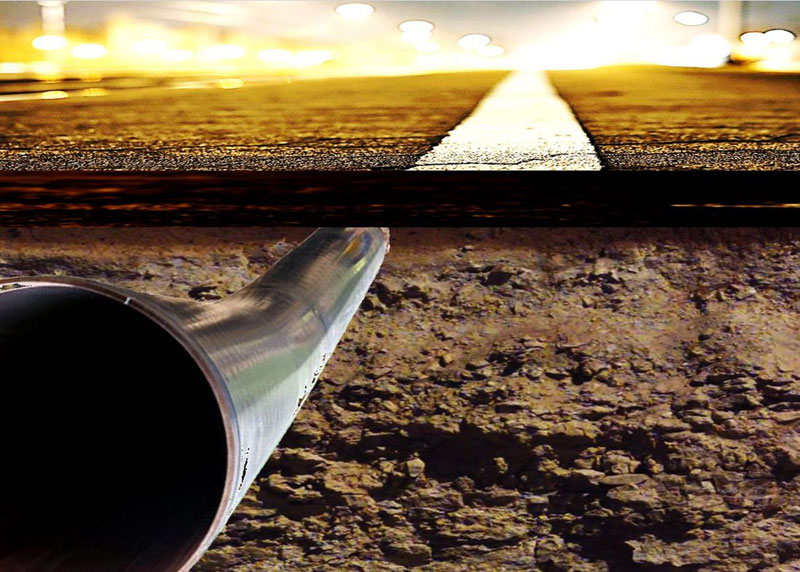
This approach enables the continuous detection and balancing of a gas that is spreading along a linear membrane-based gas sensor which is placed, e.g., within the soil. Important thereby are that i) the balancing takes place independent of the gas phase storage- and transport properties within the supporting environment of linear sensor, and ii) independent of the present subsurface gas pressure that is in general not known.
Balancing occurs in terms of a characteristic length prediction that describes the pressure relaxed, total size equivalent of the gas filled regions along the sensor irrespective of distribution and pressure of the contributing flow paths. Such linear gas sensors can be installed with a length of up to about 100 m in dependence of the observation target and the material properties of the membrane. Functional testing of this type of sensor and a gas specific calibration can be performed within the subsurface without removal of the sensor.

Citation: Lazik1,2, S. Ebert1, P.P. Neumann3, M. Bartholmai3. Characteristic length measurement of a subsurface gas anomaly—A monitoring approach for heterogeneous flow path distributions. International Journal of Greenhouse Gas Control, Volume 47, 2016, Pages 330–341.
[expand title=”Show Affiliations”]- Helmholtz Centre for Environmental Research—UFZ, Theodor-Lieser-Str. 4, D-06120 Halle (Saale), Germany
- Membranbasierte Gassensoren UG (haftungsbeschränkt)—MeGaSen, Am Bassin 12, D-14467 Potsdam, Germany
- BAM Federal Institute for Materials Research and Testing, Unter den Eichen 87, D-12205 Berlin, Germany