 Advances in Engineering Advances in Engineering features breaking research judged by Advances in Engineering advisory team to be of key importance in the Engineering field. Papers are selected from over 10,000 published each week from most peer reviewed journals.

Assessing the potential of multiscale wind farms towards a new era of wind power generation: Can the small-sized turbines benefit under the shade of the large ones?
Significance
Increasing strict regulations on carbon emissions resulted in the intense search for alternative renewable energy sources. Among the available renewable energy sources, wind power energy has attracted significant attention of researchers as it is favorable for large scale commercial power generation. Presently, horizontal axis wind turbines are widely used in wind farms to harness and convert wind energy into electric power. To maximize energy generation in large wind farms with arrays of wind turbines, the optimization of the farm’s layout is of great importance. For instance, it helps in minimizing the low-velocity region produced as a result of the interception of the turbulent flow by the turbines otherwise referred to as the wakes.
Currently, wind farm layouts are optimized by either horizontal or vertical staggering. The former involves offsetting wind turbines in consecutive rows while the latter entails offsetting the hub height. Unfortunately, little have been done in realizing the benefits of vertical staggering in enhancing the wind power production.
Alternatively, several model approaches have been presented to study vertical staggering of the wind turbines. For instance, multiscale wind farms that involve placing of small-sized wind turbines in between the large-scale wind turbines have been identified as a priming solution for enhancing vertical staggering configuration. Generally, the configuration has potential benefits such as increasing the wind farm capacity and reducing the overall farm setup and electrical installations costs. However, whether multiscale wind farms design is suitable for horizontal axis wind turbines or vertical axis wind turbines is yet to be discovered.
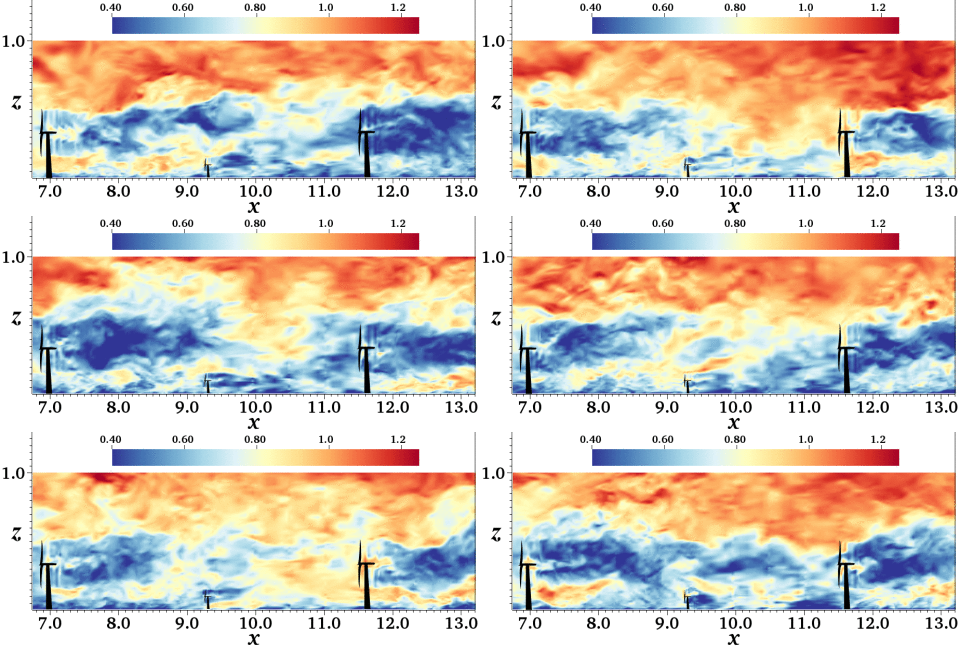
Recently, Dr. Tanmoy Chatterjee (currently Postdoctoral researcher at Argonne National Laboratory ) and Professor Yulia Peet at Arizona State University assessed the efficiency of multiscale wind farm design configurations. Fundamentally, they placed small-scale turbines in between the large-scale turbines to take advantage of the modulated flow structures by the large turbine rotors . Their work has been recently published in the journal, Wind Energy.
The researchers performed large eddy simulations of a multiscale wind farm using large eddy simulation tool. Secondly, the multiscale wind farm entailed: horizontal axis wind turbines, two rotor sizes and two hub heights in a vertically staggered layout. In particular, they accessed the influence of the hub heights of the small turbines on the interaction between the large and small turbines as well as the generated output power.
The authors observed a significant increase in the efficiency and reduction in power variability of the small turbines with lower hub heights as compared to its single-scale counterpart. On the other hand, small turbines with higher hub height performed poorly as compared to single-scale arrangements due to power loss and a rise in power variability. However,, incorporation of the small wind turbines had got little effects on the overall power production of the large turbines. Nonetheless , the overall power production of the farm increased by 20% for an equal number of small and large wind turbines. Dr. Chatterjee says that the concept of “multiscale wind farm optimization” is an unexplored research topic with a huge possibility and this study is one of the stepping stone towards understanding the subject. The small-scale turbines can be installed in the already existing location of the large-turbine farms without the necessity to acquire new land location. With so many optimization parameters like the rotors/hub-height of the smaller turbines compared to the larger ones, their spatial locations (how far-spaced from the larger ones, horizontal stagger of the small turbines), horizontal vs vertical axis as well as the influence of atmospheric stability, the researchers believe that the multiscale wind farms have a huge potential in the renewable/ wind energy sector, particularly in off-shore farm applications..



Reference
Chatterjee, T., & Peet, Y. (2019). Exploring the benefits of vertically staggered wind farms: Understanding the power generation mechanisms of turbines operating at different scales. Wind Energy, 22(2), 283-301.
Go To Wind Energy