 Advances in Engineering Advances in Engineering features breaking research judged by Advances in Engineering advisory team to be of key importance in the Engineering field. Papers are selected from over 10,000 published each week from most peer reviewed journals.

Significance statement
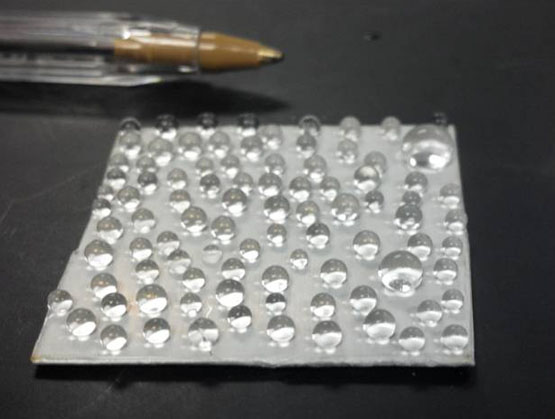
Figure Legend: Many small water droplets scattered on a piece of aluminum with a superhydrophobic coating.
Journal Reference
Surface and Coatings Technology, Volume 234, 15 November 2013, Pages 14–20.
David J. Marchanda, Zachary R. Dilwortha, Robert J. Stauffera, Erik Hsiaoa, Jeong-Hoon Kimb, Jung-Gu Kangb, Seong H. Kima.
a Department of Chemical Engineering and Materials Research Institute, The Pennsylvania State University, University Park, PA 16802, USA and
b SPS Co., Ltd., #305 Sinwoo Plaza, 83 Banwol-dong, Hwaseong-Si, Gyeonggi-do, 445-330, South Korea.
Abstract
Non-fluorine-based organic–inorganic-hybrid coatings exhibiting superhydrophobic properties were prepared using a single-step process of atmospheric rf glow discharge plasma deposition with a tetramethylsilane (TMS) precursor. The plasma was generated with He in air and the TMS precursor concentration was 0.01–0.04 vol.% of the He carrier gas. The dissociation of TMS in the atmospheric plasma accompanied the formation of particulates through gas-phase condensation reactions, which lead to organic–inorganic-hybrid coatings with a root-mean-squared roughness in the ~ 30–80 nm range and a water contact angle of ~ 150°–165° on a variety of substrates including flat wafers, papers, and cotton fabric without any sample pre-treatments. Due to the excitation and dissociation of ambient molecules (oxygen, nitrogen, and water) in the atmospheric plasma, the produced coatings contained oxygen and nitrogen, in addition to silicon and hydrocarbon groups. The oxygen species in the film appears to be a part of Si–O–Si networks similar to silicone compounds. The films produced with TMS exhibited an improved environmental durability compared to purely hydrocarbon-based films deposited with the same atmospheric plasma process.
