Advances in Engineering Advances in Engineering features breaking research judged by Advances in Engineering advisory team to be of key importance in the Engineering field. Papers are selected from over 10,000 published each week from most peer reviewed journals.

Significance
Cobalt based compounds have of late gained much attention as they are promising non-precious electro-catalysts of both the oxygen evolution reaction (ORE) and oxygen reduction reactions (ORR). These two reactions represent critical electrochemical processes in many renewable energy conversion systems although their kinetics are inherently sluggish. This drawback emphasizes the need to expedite both reactions and lower the over-potentials. Traditionally, ruthenium oxide and platinum have been applied as efficient electro-catalysts for the two reactions but their exorbitant price stands prohibitive. The need for a bi-functional yet economically feasible electro-catalyst has led to the considerations of cobalt compounds. Cobalt compounds have often been synthesized into various nanostructures and in combination with carbon nanomaterials by typical synthetic approaches, however, it is quite challenging to achieve large scale synthesis uniformity using these techniques. This paper reports on the creation of high surface area porous microstructure created on electrodes and with a coating layer of a highly active material created by atomic layer deposition.
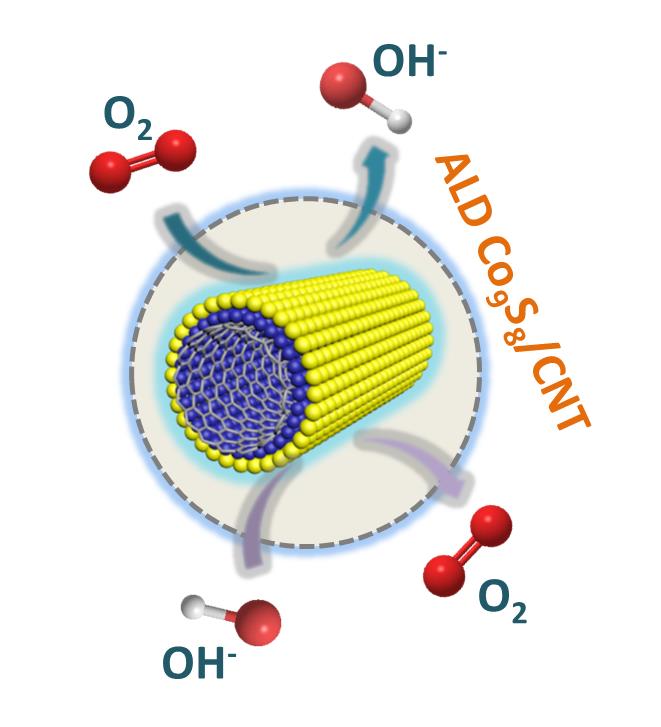
Researches led by Professor Xinwei Wang at Peking University Shenzhen Graduate School in China successfully synthesized novel efficient bi-functional OER/ORR electro-catalyst of nonacobalt octasulfide/carbon nanotubes, by utilizing an advanced atomic layer deposition technique to conformably coat a high-surface area carbon-nanotube scaffold structure with a uniform thin layer of catalytically active nonacobalt octasulfide material. The synthesized catalyst displayed remarkable electro-catalytic activity and stability toward both the OER and ORR reactions. Their work is currently published in the research Journal of Materials Chemistry A.
The researchers commenced their empirical procedure by fabricating the nonacobalt octasulfide /carbon nanotubes electrodes and a benchmark oxygen evolution reaction catalyst of ruthenium oxide. The team then undertook electrochemical measurements of the electro-catalysts where they used a standard three-electrode system. An aqueous rechargeable zinc–air battery was then assembled by using a zinc plate and a catalyst-loaded air electrode as the anode and cathode, respectively.
The authors of this paper observed that the atomic layer deposition technique-synthesized nonacobalt octasulfide/carbon nanotubes catalyst displayed remarkable electro-catalytic performance with excellent catalytic activity and stability toward both the oxygen evolution reaction and oxygen reduction reaction, and was further demonstrated to be a superior bi-functional oxygen catalyst for high performance rechargeable zinc–air batteries. The fabricated aqueous rechargeable zinc–air batteries were seen to be able to deliver a remarkably high power density with superior long-term cycling stability, and the fabricated solid-state rechargeable zinc–air batteries were also observed to be able to display very good flexibility and stability upon bending.
Xinwei Wang research team presented a novel efficient bi-functional oxygen evolution reaction/oxygen reduction reaction catalyst of nonacobalt octasulfide/carbon nanotubes, which can be synthesized using an advanced technique of atomic layer deposition for conformally coating a uniform thin layer of nonacobalt octasulfide on a high-surface area carbon-nanotube network scaffold. Considering that the oxygen conversion process is a core process in many renewable energy conversion systems, this novel atomic layer deposition technique-synthesized bi-functional nonacobalt octasulfide/carbon nanotubes electro-catalyst will have broad and promising applications for renewable energy conversion devices.



Reference
Hao Li, Zheng Guo, Xinwei Wang. Atomic-layer-deposited ultrathin Co9S8 on carbon nanotubes: an efficient bifunctional electrocatalyst for oxygen evolution/reduction reactions and rechargeable Zn–air batteries. J. Mater. Chem. A volume 5 (2017) pages 21353–21361.