Advances in Engineering Advances in Engineering features breaking research judged by Advances in Engineering advisory team to be of key importance in the Engineering field. Papers are selected from over 10,000 published each week from most peer reviewed journals.

Significance
Among the challenges facing the planet earth today, environmental pollution and global warming stand out. This has further compelled policymakers and relevant stakeholders to enact various rules and regulations aiming at protecting the environment and minimizing the emission of greenhouse gases. For instance, the development and use of renewable energy sources have tremendously increased in the past years thereby reducing the dependence on fossil fuels. However, due to various limitations such as the low energy densities, the potential of renewable energy sources have not been fully explored.
Presently, photovoltaic power generation is among the leading and most used renewable energy sources worldwide. As such, several techniques have been developed to enhance their efficiency and energy storage. Power-to-gas remain the most convenient technology for converting electricity to gas. In most cases, hydrogen is used as a carrier due to its excellent properties. Therefore, to enhance sustainable hydrogen production, development of efficient systems and processes is highly desirable. This will advance its application in several areas including biogas plants, steel manufacturing, and wind energy. Consequently, meeting the global photovoltaic power generation, batteries and electrolyzes targets have been achieved through clearly outlined technological roadmaps. Unfortunately, implementation of such plans has remained difficult due to several factors such as frequency fluctuation in the photovoltaic power generation grid. As such researchers have been looking for alternatives and have identified the use of batteries as a potential solution. This calls for improvement of the battery technologies to enable effective design and analysis through the inclusion of other technologies.
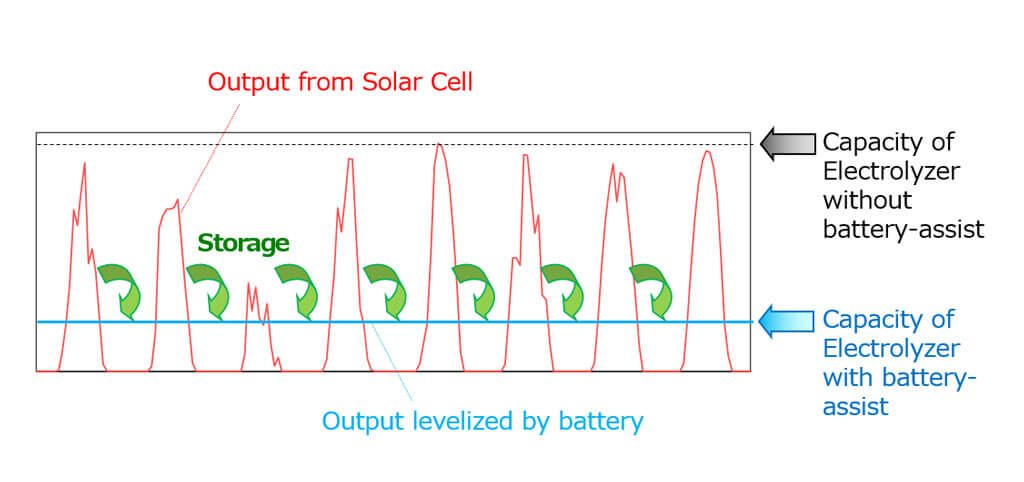
To this note, Professor Yasunori Kikuchi and Professor Michihisa Koyama from National Institute of Materials Science in collaboration with Professor Takayuki Ichikawa from Hiroshima University and Professor Masakazu Sugiyama from the University of Tokyo investigated hydrogen production from photovoltaic power generation system. The system was based on battery assisted electrolyzer. They conducted both technology and economic analysis of the system to validate its performance. Their work is currently published in the journal, International Journal of Hydrogen Energy.
In brief, the authors commenced their work by first exploring the individual technological roadmaps for the photovoltaic power generation, batteries, and electrolyzers that support hydrogen production so as to meet the set targets. Secondly, a case study focusing majorly in the production of off-grid hydrogen in Japan was adopted. Furthermore, they utilized an electrolyzer based on the proton-exchange membrane for the experiment. Eventually, analyzing the individual technology roadmap performance was carried out based on the unit cost of hydrogen.
The authors observed that using battery assistance enabled the production of hydrogen at low costs. This however required relatively cheap battery cost and ensuring proper system configuration. In addition, by combining different technologies to realize individual targets of photovoltaic power generation, electrolyzers and batteries, a hydrogen cost ranging from 17-27JPY/Nm3 was obtained.
In summary, The Japanese scientists successfully analyzed low-cost hydrogen production from solar energy based on battery assistance to meet the individual targets in terms of photovoltaic power generation, electrolyzers, and batteries. Therefore, the study will promote the development of battery application in hydrogen production. Additionally, it will advance development and utilization of renewable energy systems thereby reducing overdependence on fossil energy.
“The battery and hydrogen have been often discussed as “battery vs hydrogen”, as if they are incompatible competitors. An example discussed in the manuscript is an example different from such context. Harmonic integration of battery and hydrogen, i.e. “battery × hydrogen”, will be a key toward a renewable energy-centered energy system in future.” Said Professor Michihisa Koyama in a statement to Advances in Engineering.


Reference
Kikuchi, Y., Ichikawa, T., Sugiyama, M., & Koyama, M. (2019). Battery-assisted low-cost hydrogen production from solar energy: Rational target setting for future technology systems. International Journal of Hydrogen Energy, 44(3), 1451-1465.
Go To International Journal of Hydrogen Energy