Advances in Engineering Advances in Engineering features breaking research judged by Advances in Engineering advisory team to be of key importance in the Engineering field. Papers are selected from over 10,000 published each week from most peer reviewed journals.

Significance
Power demand has proportionally increased with surging global population. This has put significant strain on existing energy systems and calls for higher efficiency as the search for alternative sources continues. In the cooling industry, high power usage can be cut down via the use of Heat Driven Ejector Refrigeration Systems (HDRS). The main advantage of these cycles is their capacity to be activated using low-grade energy sources such as solar power or waste heat as primary input. Particularly, HDRS are known for their reduced maintenance requirements, fewer moving parts, lower operating costs and minimal electricity consumption. However, HDRS do suffer from one main drawback; their relative low performance. Typical coefficient of performance (COP) values for a HDRS using either R134a or R245fa lie indeed in the range [0.1–0.5]. Integrating an ejector in a HDRS can lead to COP improvement by up to 40%. In the past, researchers have employed thermodynamic models based on perfect gas behavior credit to their simplicity and generally good experimental agreement. Moreover, attempts have been made to enhance ejector performance by droplet injection inside the ejector, although mixed results have been reported.
On this account, researchers from the University of Constantine: Mehdi Bencharif (PhD candidate) and Professor Said Zid, in collaboration with Dr. Hakim Nesreddine at Hydro-Québec, Dr. Sergio Croquer Perez and Professor Sébastien Poncet at Université de Sherbrooke, proposed to use droplet injection to enhance the performance of HDRS but with a different approach: to inject the droplets in between the ejector and the condenser. Technically, their idea was to avoid flow perturbations in the ejector and to reduce the condenser inlet temperature, while at the same time maintaining a relatively simple cycle configuration. Their work is currently published in the research journal, International Journal of Refrigeration.
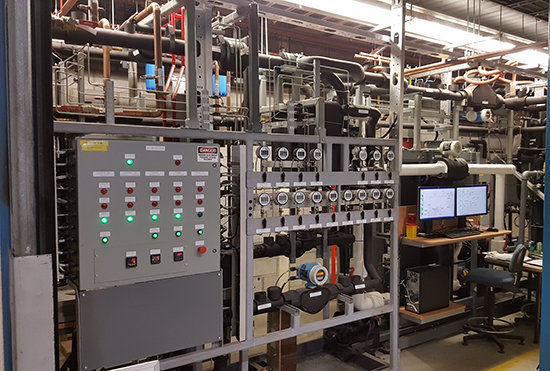
In their approach, the researchers explored their hypothesis using a combined experimental and thermodynamic modelling analysis on the effects of droplet injection on the performance of an ejector-based HDRS working with R245fa. Thermodynamic models were developed within MATLAB for each component of the cycle. The developed models were then validated against experimental data of an R245fa test rig installed at Hydro-Québec’s Energy Technologies Laboratory (LTE).
The authors reported that the numerical models agreed fairly well with the experiments. In fact, the results demonstrated that injecting R245fa droplets at the end of the ejector diffuser with different glycol temperatures ranging from 20 to 26 °C had a significant impact on the performance of the ejector itself and more interestingly, on the performance of the whole cycle.
In summary, the study presented the use of a combined numerical and experimental approach to study the influence of droplet injection on the performance of an ejector-based refrigeration cycle working with R245fa. The ejector was modelled by solving the conservation equations across each section of the device. Remarkably, the model was reported to predict quite well the temperature profile and heat capacity along the heat exchanger. In a statement to Advances in Engineering, Professor Sébastien Poncet highlighted that based on their work, droplet injection between the ejector and the condenser might be a simple and feasible alternative for increasing the heat driven ERS performance.





Reference
Mehdi Bencharif, Hakim Nesreddine, Sergio Croquer Perez, Sébastien Poncet, Said Zid. The benefit of droplet injection on the performance of an ejector refrigeration cycle working with R245fa. International Journal of Refrigeration, volume 113 (2020) page 276–287.