 Advances in Engineering Advances in Engineering features breaking research judged by Advances in Engineering advisory team to be of key importance in the Engineering field. Papers are selected from over 10,000 published each week from most peer reviewed journals.

Significance Statement
The success at which electrochemical devices for energy conversion and storage can be commercialized heavily depends on the long term stability of the materials used in these devices. The solvents used in conventional batteries present considerable safety concerns with regard to their volatility and inflammability, which command for lower operating temperatures, despite their desirable high ionic conductivities. Recently, solvate ionic liquid has emerged as a promising prospective alternative owing to its relative non-volatility and non-flammability. However, its deficiencies in terms of low ionic conductivity when compared with conventional organic carbonate electrolytes discredits its adoption. Consequently, enhancement in thermal and transport properties of the solvate by blending it with viscosity reducing solvents have thus been necessitated.
A team of researchers led by Professor Sitaraman Krishnan at Clarkson University reported an enhancement of thermal-physical and transport properties of blends of an ether-derivatized imidazolium ionic liquid and a lithium ion based solvate ionic liquid. Their main objective was to derive theory-based mixing rules for the thermodynamic (volumetric) and transport properties (viscosity and conductivity) of the blends, with temperature and solution compositions as the variables. They also sought to quantify the effect of the complexation of lithium ions with tetraglyme, by studying two electrolytes that contained the same molar concentration of lithium ions-one with tetraglyme, and the other, without. Their research work is now published in the peer-reviewed journal, Journal of Materials Science.
First, an ether-derivatized imidazolium ionic liquid was synthesized in high yield and its mixtures with a lithium-tetraglyme complex, of several different compositions were prepared and characterized. The researchers then measured the volumetric and transport properties of the solutions at ambient pressures over a temperature range of 10-85°C, using oscillating U-tube densitometry, cone and plate viscometry, and electrochemical impedance spectroscopy, and correlated to the solution composition.
They observed that the addition of the ether-derivatized ionic liquid lowered the viscosity and increased the ionic conductivity of the blends. The blends were also observed to exhibit an increased thermal stability in thermogravimetry experiments. The research team also noted that the addition of unchelated lithium bis(trifluoromethanesulfonyl)amide salt to the ether-derivatized imidazolium resulted in a decrease in the ionic conductivity at all temperatures of measurement. However, when the lithium salt was added as a 1:1 complex with tetraglyme, the conductivity was higher, at the same molar concentration of lithium ions.
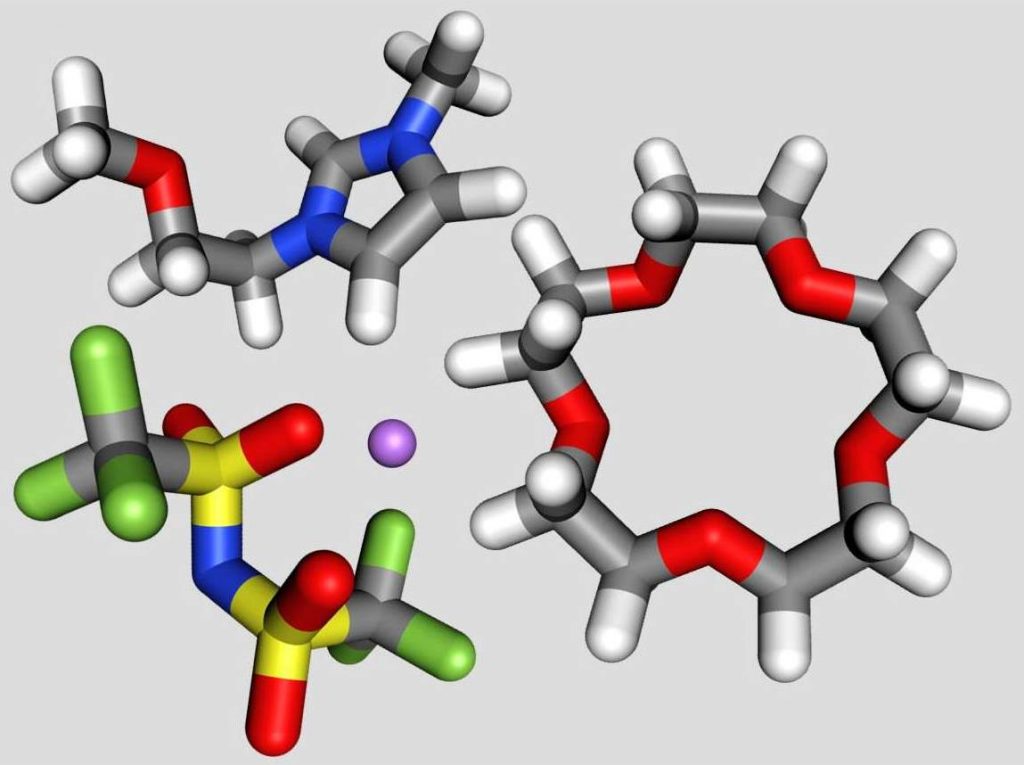
“I would like to point out here that tetraglyme increased the fluidity of the solution, and that the increase in conductivity, not surprisingly, was proportional to the increase in fluidity. The unexpected observation, however, was how a complex mixture, comprising three different ionic species (the lithium ion, and the ionic liquid cation and anion) and one nonionic compound (tetraglyme) of vastly different sizes and shapes—see the cartoon on the following page—showed simple, nearly linear mixing rules, as if the ingredients of the solutions were just passive alkanes. On the basis of the complex intermolecular interactions that exist in these solutions, one would expect large excess solution properties, with nonlinear dependence on mole fractions.” Said Professor Sitaraman Krishnan. He then added “An excess property is the deviation of a property from its ideal-solution value. Generally, mixtures of molecules that are similar in structure and intermolecular interactions exhibit zero excess property values, that is, the ideal solution behavior. Interestingly, the molecules in the mixtures of the present study have vastly different sizes, shapes and polarities, and yet could be modeled as ideal binary solutions“.
It is crystal clear from the work presented herein that in the electrolytes investigated, the lithium ions were effectively solvated by tetraglyme and the ionic liquid, and made available to support adequate charge transport over a relatively broad range of temperatures. These findings on the thermophysical and transport properties of the blends lead to favorable implications in the practical context of lithium ion battery electrolytes. In totality, diluting the chelate ionic liquid with the ether-derivatized ionic liquid, not only improved the thermal stability of the resulting electrolyte, but also increased the ionic conductivity significantly. Thus, the mixture of tetraglyme and ether-derivatized ionic liquid is promising as a nonvolatile electrolyte for lithium-ion batteries, over a relatively wide temperature range.


Reference
Yanni Wang, Michael C. Turk, Malavarayan Sankarasubramanian, Anirudh Srivatsa, Dipankar Roy and Sitaraman Krishnan. Thermophysical and transport properties of blends of an ether-derivatized imidazolium ionic liquid and a Li+-based solvate ionic liquid. Journal of Materials Science, 2017, Volume 52, Issue 7, pp 3719–3740.
Go To Journal of Materials Science