 Advances in Engineering Advances in Engineering features breaking research judged by Advances in Engineering advisory team to be of key importance in the Engineering field. Papers are selected from over 10,000 published each week from most peer reviewed journals.

Significance
Numerical simulation of turbulent flows under high-Reynolds-number conditions has remained a big challenge despite its practical relevance in many applications. Direct numerical simulations, resolving all scales in wall-bounded turbulent flows, are prohibitively expensive and computationally demanding, especially for high Reynolds numbers. For large-eddy simulations, the required mesh counts still scale up and increases with Reynolds number in , which are still too expensive to be applied for many practical engineering applications.
Turbulence activities are naturally more intense in the near-wall region, giving rise to the highest resolution needed computationally due to significantly small temporal and spatial turbulence scales. As the result of the high-mesh-count requirements, this region has become a critical component in developing effective solutions for turbulent flows. The key aspect of this region is its self-sustainability and universal autonomous behavior that has provided a strong impetus for developing modeled treatments for near-wall turbulent flow regions
However, the recent revelations on near-wall turbulence have brought more challenges to the existing modeling techniques. Of great interest is the ‘foot printing’ behavior exerting on the near-wall turbulence by the large coherent structures away from the wall. The near-wall region is not so ‘universal’ per se. Instead of modeling, resolving the near-wall region and doing so more efficiently, has emerged as an appealing alternative path. This approach considers locally resolved fine-mesh solutions, which need to accurately capture the large-scale footprints on the near-wall region and resolve the associated local scale interaction. Thus, it is important to develop an effective approach for capturing and resolving Reynolds-number-dependent effects of the outer flow on the near-wall turbulence based on the ‘foot-printing’ behavior of the coherent structures and the scale interactive ‘modulation’ effects.
Herein, Mr. Chen Chen and Professor Li He from the University of Oxford proposed a robust locally embedded two-scale approach for solving wall-bounded turbulent flows. This new method comprised a local and instantaneous direct interaction between the local fine mesh domain and the global flow of large structures to accurately capture the ‘footprints’. Next, the local fine mesh domain and the global coarser mesh domain were coupled based on the space-time averaging generated source terms to eliminate the discretization errors associated with the under-resolved coarse-mesh near-wall region. The effectiveness and validity of the method were examined in incompressible channel flows at different Reynolds numbers. The research work is currently published in the journal, Journal of Fluid Mechanics.
The researchers showed the applicability of the proposed method in capturing the effects of outer flow large-scale structures on the embedded fine-mesh domains via the scale-dependent interface treatment compared to the existing methods. It allowed a direct exchange of the coarse-mesh resolved disturbances across the interface, with only the fine-mesh resolved fluctuations encompassing the coarse-mesh resolved variables being subjected to periodic conditions in the spanwise and streamwise directions. The results showed both the ‘footprints’ of the outer flow on the local embedded block and the intermediate scales associated with the ‘modulation’ in the near-wall region are captured. Furthermore, no assumption regarding the scale-separation or spectral gap was made, and a smooth overlap between the local- and global-domain energy spectra was reported.
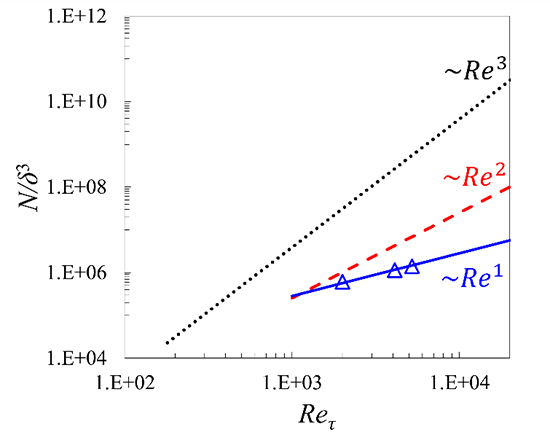
In summary, Mr. Chen Chen and Professor Li He reported the ‘foot-printing’ and ‘modulation’ captured in the local near wall fine-mesh block. The global domains provided enhanced conditioning for the local fine-mesh block, which in turn provided corrections to improve the near-wall solution accuracy of the global flow domain. Scaling with Reynolds number, the mesh-count was reduced from O(Re2) for existing wall-resolved large eddy simulations to O(Re) for the present two-scale solutions. Interestingly, the obtained data, including the energy spectra and means statistics, were consistent with full direct numerical simulation data, suggesting its feasibility. In a statement to Advances in Engineering, Professor Li He, the Statutory Chair of Computational Aerothermal Engineering and the corresponding author said that the presented framework provides a feasible path for solving wall-bounded turbulent flows far more efficiently and would potentially enhance the corresponding practical applications.



Reference
Chen, C., & He, L. (2022). On locally embedded two-scale solution for wall-bounded turbulent flows. Journal Of Fluid Mechanics, 933, A47-33.