 Advances in Engineering Advances in Engineering features breaking research judged by Advances in Engineering advisory team to be of key importance in the Engineering field. Papers are selected from over 10,000 published each week from most peer reviewed journals.

Significance
This research demonstrates how a simple self-assembly strategy can be used to functionalize carbon surfaces through the use of first generation amino-ended dendrons (G1-NH2) The method has been proven to be quite easy and cheap when it comes to manipulation of surface properties in the production of a film on an electrode. This is enhanced by the presence of van der Waals forces between the adsorbents and the carbon surface. Modification of carbon surface by dendritic polymers is better as they exhibit multi-valency and multifunctional properties that are essential in allowing synergic interaction between the material and the environment they work in. Moreover, the material formed shows hydrophilic characteristics with better biocompatibility while other incorporated organic materials during surface functionalization help in immobilization of striking structures. Further, the study investigates G1-NH2 adsorption onto carbon electrodes so as to determine the hydrogen bond interactions in the dendronization process.
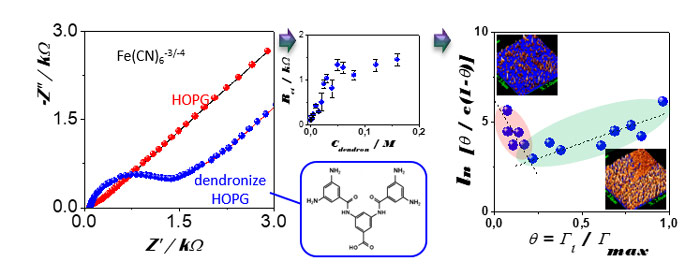
Researchers led by Professor Verónica Brunetti at the National University of Córdoba in Argentina demonstrated for the first time that it is possible to efficiently tailor carbon surface by functionalizing it with amino-ended dendrons through a self-assembly method. The electrical and visco-electrical properties of the modified surfaces are characterized while the thermodynamic adsorption parameters are investigated through electrochemical impedance spectroscopy method. This work has been published in peer review journal Thin Solid Films.
The authors observed a voltamperommetric behavior on the coated electrode confirming that modification of the surface doesn’t block transfer of electrons. The electron transfer property between the electrode surface and the electrolyte is determined by EIS which shows a repulsive interaction for low coverage. However, at higher coverage’s, the intermolecular hydrogen bond brings the amino ended dendrons closer hence allowing better relations. The acid-base properties of the layer that have been self-assembled have shown that the modified surface impedance is dependent on the level of pH PH. The modified surface also indicates even distribution of nanometric deposits at their early formation stage. Additionally, the electrical properties are also evaluated indicating that the work function of the material is modified by the intrinsic dipoles of the molecules oriented on the surface.
According to Professor Verónica Brunetti and her research team it is possible to come up with a carbon surface functionalized with an amino dendronized layer. The dendron immobilization was monitored by methods including electrochemical impedance spectroscopy, Kelvin probe and atomic force microscopy. The results supported by those of the microscopies and electrochemistry techniques allow the authors to claim that dendronized carbon surfaces with amino-ended groups are promising electron transfer mediators in electrochemical sensors. At higher coverage, the intermolecular forces due to hydrogen bonds are high among dendrons hence forms regions which are more compact on the electrode layer. When compared with nitro-ended dendrons, the amino-ended dendron surfaces show a reduction in contact potential difference with the functional groups donating electrons while on the electron receptor, an increase in contact potential difference is observed. It is therefore clear that the carbon properties can be improved through modification with amino-dendrons which will contribute to an advancement in electrochemical applications.



Reference
E.D. Farias, M.C.G. Passeggi Jr, V. Brunetti, Tuning properties of carbon surfaces functionalized with amino-ended dendron layers by exploring their supramolecular interactions. Journal of Thin Solid Films, (2017) 642: 339-344
Go To Journal of Thin Solid Films