Advances in Engineering Advances in Engineering features breaking research judged by Advances in Engineering advisory team to be of key importance in the Engineering field. Papers are selected from over 10,000 published each week from most peer reviewed journals.

Significance
New gas separation membranes using plastic crystal composites.
The power industry is one of the main carbon dioxide producers. Thus, it has become the main target for most of the greenhouse effects mitigation strategies. One of the most commonly used strategies to reduce CO2 emission is separating it from the flue gas stream and reusing it in other industrial applications such as polymer synthesis. The presently used technologies to capture and store carbon dioxide downstream the combustion systems are mainly based on chemical absorption favorable for enhancing performance and gas selectivity. Unfortunately, these technologies require the use of solvents and are energy-intensive, thus reducing fuel efficiency. Therefore, the development of cost-effective and more efficient CO2 capture and storage (CCS) technologies is highly desirable.
Membrane separation is arguably one of the most efficient gas separation technology. Unlike the traditional CCS technologies, it is more energy-efficient and requires mainly pressure gradient to operate. However, the effectiveness of this technology for CCS is compromised by several factors, including the large stream flow rates associated with most power industries and the low CO2 concentration. Lately, membrane separation technologies based on room-temperature ionic liquids (RTILs) have been identified as promising solutions. They exhibit competitive permeability and remarkable solubility-driven selectivity. Consequently, organic ionic plastic crystals (OIPCs) that exhibit similar ionic structures to RTILs have drawn significant research attention. However, use of OIPCs for developing efficient gas separation membrane technologies requires a thorough understanding of the various types of OIPCs and how to optimize the mechanical and physical properties of their associated polymer composites.
On this account, Mr. Fernando Ramos (Ph.D. Candidate), Professor Maria Forsyth and Professor Jennifer Pringle from Deakin University in Australia investigated the potential application of OIPCs for developing highly efficient and cost-effective gas separation technologies. Specifically, the authors investigated the feasibility of using a new membrane preparation method and a different type of OIPC to design novel and more selective membranes for CO2/N2. Their research work is currently published in the research journal, ChemSusChem.
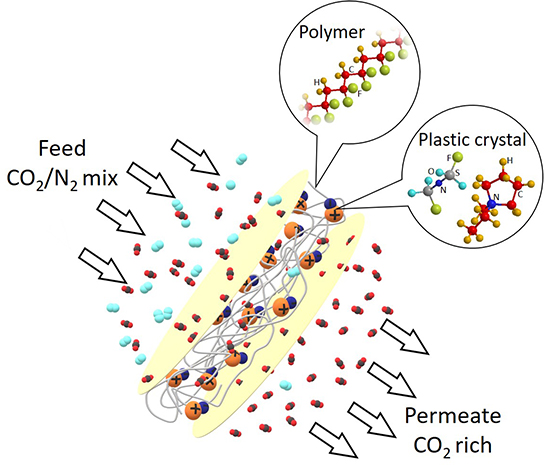
In their approach, the research team used two OIPCs: methyl (diethyl)isobutylphosphonium hexafluorophosphate ([P122i4][PF6]) and N-methyl-N-ethyl pyrrolidinium bis(fluorosulfonyl)imide ([C2mpyr][FSI]), fabricated via solvent-casting or co-casting with poly(vinylidene difluoride) (PVDF). The former was studied in their previous research and was used as a benchmark in this study, while the latter was studied for the first time., Their gas transport properties were determined and compared, with the [C2mpyr][FSI]-based membrane recording a remarkable selectivity of aCO2/N2 > 40. The impact of the ion type and the casting method was studied in detail using various experimental techniques such as gas permeation experiments using N2 and CO2.
The main difference between the two OIPCs reside in the chemistry. Whilst both OIPCs contain fluorinated anions associated with the CO2-philicity, the degree and nature of the ionic interactions determine the structure, thermal behavior, and the capacity to absorb and diffuse gas. The co-casting method resulted in improved thermophysical properties of the composites and was identified as the most feasible method for producing mechanically stable and durable membranes. It also resulted in higher permeation reproducibility and an increase in the CO2 solubility than the solvent-casting method. Additionally, co-casting allowed the production of tougher, thinner and more homogenous membranes by enhancing robustness and reducing OIPC flow in the membranes. Furthermore, the thermal behavior of the composites fabricated via co-casting depended on the chemical interaction between the OIPCs and PVDF. All the evidence suggests that the polymer should not be consider as a mere support, and the authors are investigating this impact of polymer, and a wider range of OIPCs, as part of their future work in this exciting new area.
In summary, the authors demonstrated the potential application of OIPCs for developing novel gas separation membrane technologies. Co-casting proved to be effective for preparing thin OIPC-based composite membranes with improved thermophysical properties. The OIPC/PVDF co-cast composites also demonstrated improved molecular interactions, providing a new approach for synthesizing highly selective membranes for light gas separation.
In a statement to Advances in Engineering, Professor Jennifer Pringle said that the insights from the study are very exciting as they show that the types of OIPC used, the polymer content and the method of fabrication of the membrane can all have an impact on the properties and performance. This information paves the way for designing and synthesizing more high-performance OIPC-based membranes, and for further optimization of their performance in gas separation applications.



Reference
Ramos, F., Forsyth, M., & Pringle, J. (2020). Organic Ionic Plastic Crystal‐Based Composite Membranes for Light Gas Separation: The Impact of Varying Ion Type and Casting Method. Chemsuschem, 13(21), 5740-5748.