Advances in Engineering Advances in Engineering features breaking research judged by Advances in Engineering advisory team to be of key importance in the Engineering field. Papers are selected from over 10,000 published each week from most peer reviewed journals.

Significance Statement
The growth in global population and rapid industrialization have caused a rise in water pollution. Continuous efforts are needed to ensure the sustainability of clean water resources for our future. Pollutants removed by chemical means especially via chemical reduction is favorable. This technique can transform harmful pollutants into economical products. For instance, the reduction of toxic p-nitrophenol to p-aminophenol, an important intermediate for drugs’ synthesis.
The catalytic reduction of nitro compounds over polymer-metal catalysts have been widely reported recently. Nevertheless, most of the available works are focused on synthetic polymers, little attention are paid to natural polymers. In view of the rising concern on environmental issues, synthesis and application of green composites are much desired. Although few works on the preparation of chitosan-stabilized Cu (chi-Cu) nanoparticles have been reported, none of them have been applied in catalysis so far. This work, for the first time, demonstrates the use of chi-Cu as a catalyst for the reduction of p-nitrophenol.
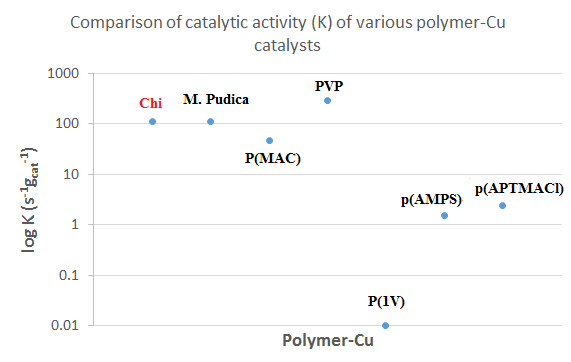
As the whole, this work contributes knowledge on how the chitosan content can influence/govern the morphologies and sizes of the in-situ formed Cu particles and indirectly its relation to the catalytic performance for p-nitrophenol reduction. Furthermore, the performance of these chi-Cu catalysts (in terms of activity factor, K) are also compared to other reported polymer-Cu catalysts to better illustrate their stand amongst the polymer-Cu systems in literature.
Journal Reference
Catalysis Letters, 2015, Volume 145, Issue 8, pp 1626-1633.
W.L. Tan, N. H. H. Abu Bakar, M. Abu Bakar
School of Chemical Sciences, Universiti Sains Malaysia, 11800, Penang, Malaysia
Abstract
A range of chitosan stabilized copper (chi-Cu) nanoparticles have been prepared and characterized using UV–Vis, TEM and FTIR. The chi:Cu ratios affect the morphologies and sizes of the outcome Cu particles. The rate constant (k) of the catalytic reduction of p-nitrophenol follows the decreasing trend of the chi:Cu ratio viz. 2:1 > 4:1 > 6:1 > 1:5. These trends are believed to be closely related to the size and accessibility to the Cu particles in the colloids.
Go To Catalysis Letters


Figure Legend
Chi = chitosan; M. Pudica = Mimosa Pudica leave; P(MAC) = poly(methacrylic acid); PVP = polyvinylpyrolidone; p(AMPS) = poly(2-acrylamido-2-methyl-1-propansulfonic acid); p(APTMACl) = poly-(3-acrylamidopropyl)-trimethylammonium chloride); P(1V) = poly(1-vinylimidazole)