Advances in Engineering Advances in Engineering features breaking research judged by Advances in Engineering advisory team to be of key importance in the Engineering field. Papers are selected from over 10,000 published each week from most peer reviewed journals.

Significance Statement
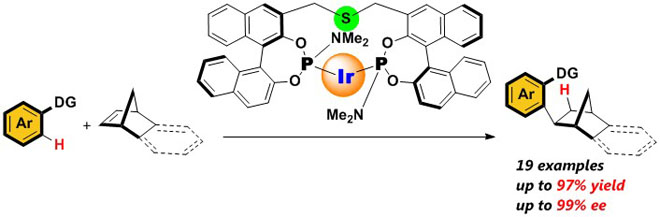
A new synthetic method by C-H functionalization for the catalytic enantioselective hydroarylation of bicycloalkenes is presented in this article. This transformation is realized by using a newly developed catalyst system, cationic Ir/sulfur-linked bisphosphoramidite (S-Me-BIPAM). The study shows the first example of highly enantioselective intermolecular hydroarylation of alkenes via C-H bond activation. This reaction gives 2’-norbornyl-acetophenones or benzamides with excellent enantioselectivities. Furthermore, the method allowed for the concise approach of highly functionalized cyclopentane, that is useful chiral building block in synthetic organic chemistry, from simple starting materials. Besides, preliminary mechanistic studies were also carried out to determine the turnover-limiting step.
Journal Reference
Angew Chem Int Ed Engl. 2015;54(34):9894-7.
Shirai T1, Yamamoto Y2.
[expand title=”Show Affiliations”]- Division of Chemical Process Engineering and Frontier Chemistry Center (FCC), Faculty of Engineering, Hokkaido University, Kita 13 Nishi 8 Kita-ku, Sapporo, Hokkaido 060-8628 (Japan).
- Division of Chemical Process Engineering and Frontier Chemistry Center (FCC), Faculty of Engineering, Hokkaido University, Kita 13 Nishi 8 Kita-ku, Sapporo, Hokkaido 060-8628 (Japan). [email protected].
Abstract
Highly enantioselective cationic iridium-catalyzed hydroarylation of bicycloalkenes, by carbonyl-directed C-H bond cleavage, was accomplished using a newly synthesized sulfur-linked bis(phosphoramidite) ligand (S-Me-BIPAM). The reaction provides alkylated acetophenone or benzamide derivatives in moderate to excellent yields and good to excellent enantioselectivities. Notably, the hydroarylation reaction of 2-norbornene with N,N-dialkylbenzamide proceeds with excellent enantioselectivity (up to 99% ee) and high selectivity for the mono-ortho-alkylation product.
© 2015 WILEY-VCH Verlag GmbH & Co. KGaA, Weinheim.
Go To Angew Chem Int Ed Engl