Advances in Engineering Advances in Engineering features breaking research judged by Advances in Engineering advisory team to be of key importance in the Engineering field. Papers are selected from over 10,000 published each week from most peer reviewed journals.

Significance
Biomass pyrolysis oil, also known as bio-crude oil, is generally a liquid obtained from the pyrolysis of biomass, which is among the methods for biofuel generation. Presently, climate change and global warming are among the global challenges that require urgent solutions. Among the mitigation measures for reducing the emission of greenhouse gases, renewable energy sources have been developed as an alternative to fossil fuels. In particular, biomass fast pyrolysis oils have attracted significant attention due to their potential applications in numerous areas including automobiles and gas turbines. Unfortunately, high viscosity and flame instability are among the several challenges affecting the efficiency of fast pyrolysis oil combustion.
Generally, the spray combustion of pyrolysis oil is more complicated than that of conventional fuels. Thus, addressing the aforementioned challenges requires a proper understanding of the combustion behavior of the fuel. This will in turn allow for better practical utilization. Recently, comprehensive predictive numerical tools – Computational Fluid Dynamics, CFD – have been found promising in designing combustion technology that runs on pyrolysis oil. Presently, combustion models such as the Relax to Chemical Equilibrium model are used for this purpose. However, most of these models are yet to be validated experimentally.
To this note, a group of researchers at the RISE Energy Technology Center in Sweden: Dr. Pál Tóth, Dr. Yngve Ögren, Dr. Alexey Sepman, Therese Vikström and Dr. Henrik Wiinikka, in collaboration with Dr. Per Gren at Luleå University of Technology assessed the feasibility of using CFD models for characterizing fast pyrolysis oil spray combustion in various applications. Their main aim was to investigate the predictive power of the model and assess its suitability in numerical optimization cases. To this end, a detailed experimental validation study was carried out. Their work is currently published in the research journal, Fuel.
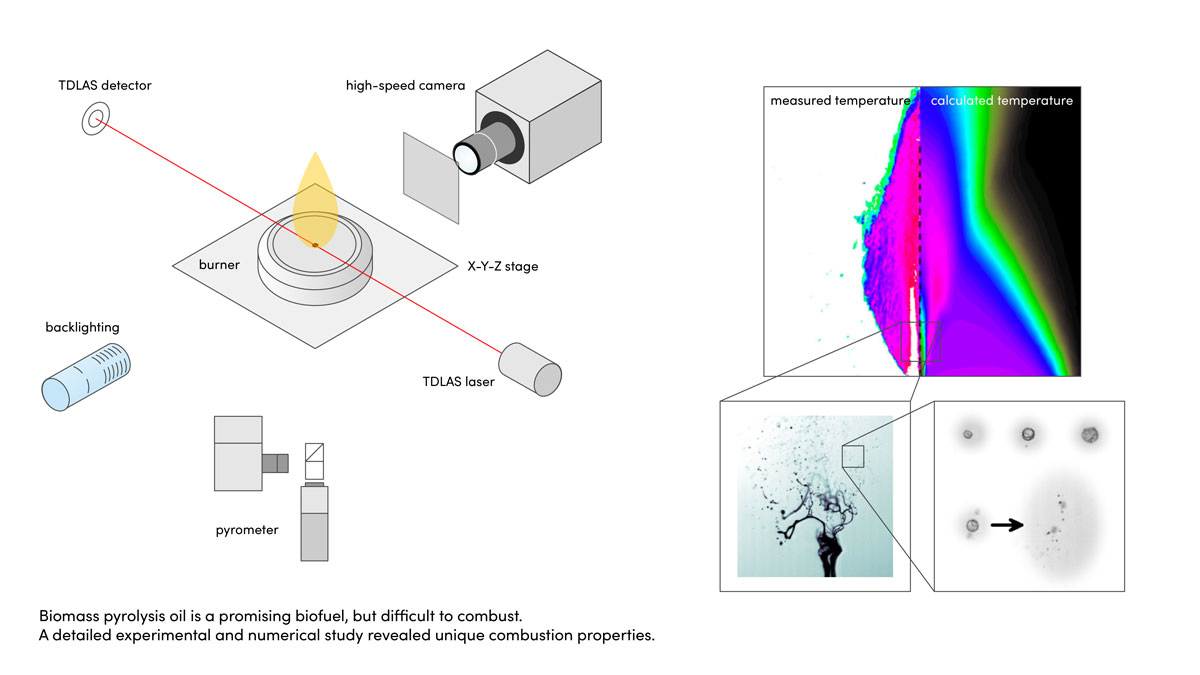
In brief, the research team commenced their work by experimentally and numerically modeling the fast pyrolysis oil flame. Secondly, various measurements techniques: tunable diode laser absorption, two-color pyrometry, and high magnification shadowgraphy were used to characterize and measure various parameters of the spray flame including droplets size distribution, flame temperature, and spatial pyrometric temperature distribution.
The authors observed that the model could be used to correctly predict the flame structure. However, it was not suitable for estimating the droplet size distributions. Based on the sensitivity analysis, it was found that the numerical solutions were highly affected by the variations in droplet size distribution but were less affected by the fuel formulation. Additionally, in the validation experiments, a small portion of the droplets were observed to show signs of micro-explosions.
“Biomass pyrolysis oil holds great potential as a carbon-neutral liquid fuel, but also as a renewable-based platform chemical. The unique properties of the oil present technical challenges in combustion. Our group is currently investigating practical applicability in gas turbines via the numerical optimization of combustion chambers. We validate our models using in-house produced pyrolysis oil and our pilot-scale research infrastructure.” Said Pál Tóth, lead author in a statement to Advances in Engineering.
In summary, the study by Pál Tóth and his colleagues is the first to perform detailed validation experiments on fast pyrolysis oil spray flames using CFD models. In general, the model was effectively used to predict general trends and spray flame structures. Altogether, the study provided essential information that will advance various engineering applications.

Reference
Tóth, P., Ögren, Y., Sepman, A., Vikström, T., Gren, P., & Wiinikka, H. (2019). Spray combustion of biomass fast pyrolysis oil: Experiments and modeling. Fuel, 237, 580-591.
Go To Fuel