Advances in Engineering Advances in Engineering features breaking research judged by Advances in Engineering advisory team to be of key importance in the Engineering field. Papers are selected from over 10,000 published each week from most peer reviewed journals.

Significance Statement
Pyrophyllite has widely been utilized in plastic, rubber, ceramic, pressure transmission and as a photo-catalyst. These expansive uses are highly attributed to its good physiochemical characteristics such as low electrical and thermal conductivity, low reversible rate of thermal expansion, low expansion coefficient and an excellent reheating stability. In many flotation systems, these characteristics heavily influence the flotation behavior. This necessitates consideration of charge properties of the pyrophyllite at both the basal plane and edge plane surfaces. These surface charge properties on other elements have been intensively studied while minimal attention has been paid to examine the relationship between the surface property, chemical composition and flotation recovery for the pyrophyllite particle.
In a recent paper published in Advanced Powder Technology professor Xiaowen Liu and Mingjun Bai a PhD student at Central South University in China investigated chemical composition effect on the surface charge property and flotation behavior of pyrophyllite particles. This was significantly important for the phyllite particles flotation.
First, the mineral phase and morphology of different pyrophyllite samples were analyzed. They collected five kinds of pyrophyllite samples and listed their chemical composition. For the flotation test, the minerals were crushed and ground then milled by ball milling to 50-100 micrometer size. The morphology of the pyrophyllite samples were observed with the use of an electron microscope. The Zeta Plus instrument was used to measure the zeta potential of the mineral suspension. Mechanical agitation in a flotation machine was also necessary in carrying out the flotation test of the mineral suspension that had been made using deionized water.
The team then determined the isoelectric points of the different pyrophyllite particles. It was also seen necessary to study the effect of chemical composition on the flotation recovery of pyrophyllite particles.
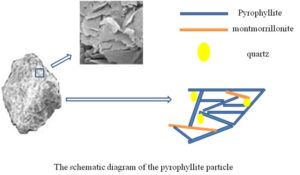
From the tests and studies, it was observed that all the five samples mainly consisted of pyrophyllite although traces of montmorillonite were present. Also, pyrophyllite in the particles was observed to be foliated and of 2-3 micrometers width and 0.1 micrometers thickness. Measurements of zeta potentials and pyrophyllite particles were observed to have similar trends when taken between different zeta potentials and pH but vary when determined under the same conditions.
From studying the effects of the chemical composition on the zeta potentials of the pyrophyllite samples the authors of this paper noted that the zeta potential of the pyrophyllite particles showed negative correlation with mass fraction of silicon oxide. However, positive correlation was observed from the flotation recovery and chemical composition relationship.
Surface zeta potential variations as a pH function have similar trend for the different pyrophyllite samples. As the isostatic electric point of the different samples vary a negative correlation with the mass fractions of silicon oxide and sodium oxide is notable. Positive correlation with mass fractions of calcium oxide and silicon oxide can be observed. The flotation experiments conducted indicate that more silicon oxide is beneficial to the flotation recovery of the pyrophyllite particles.


Reference
Xiaowen Liu, Mingjun Bai. Effect of chemical composition on the surface charge property and flotation behavior of pyrophyllite particles. Advanced Powder Technology volume 28 (2017) pages 836–841.
School of Minerals Processing and Bioengineering, Central South University, Changsha 410083, China Key Laboratory for Mineral Materials and Application of Hunan Province, Central South University, Changsha 410083, China.
Go To Advanced Powder Technology