 Advances in Engineering Advances in Engineering features breaking research judged by Advances in Engineering advisory team to be of key importance in the Engineering field. Papers are selected from over 10,000 published each week from most peer reviewed journals.

Significance
With the current technological advancement, the family of 2D materials is expected to proliferate from the current 100+ monolayers to an estimated 1000+ 2D solids, obtainable from simply exfoliable compounds, not counting those synthesized. Such materials of enviable properties are in high demand globally owing to the desirable attributes they possess, such as excellent electronic and optical performance coupled with great mechanical robustness. The rate at which these materials are being developed exceeds the prevalent techniques of experimental and theoretical property determination procedures, specifically, mechanical properties. To be specific, density functional theory calculations are the chief source of information on the mechanical properties of 2D solids. However, these calculations are essentially limited to the determination of intrinsic properties. An alternative technique, also suitable for studying defective materials, involves the use of the less demanding molecular dynamics simulations but with a compromise on accuracy. It is imperative that alternative modeling procedures that would extend the range of accessible materials be developed.
In a recently published study in Physical Chemistry Chemical Physics, authored by professor Peter Hess at the Institute of Physical Chemistry, University of Heidelberg in Germany, a generalized reference model was employed to predict unknown fracture-mechanics quantities from Young’s moduli for large groups of related compounds belonging to similar covalent or covalent-ionic structures. Professor Peter Hess focused on his research in assessing a reference model paying detailed attention to intrinsic linear and nonlinear mechanical properties whose verification was solely based on density functional theory calculations.
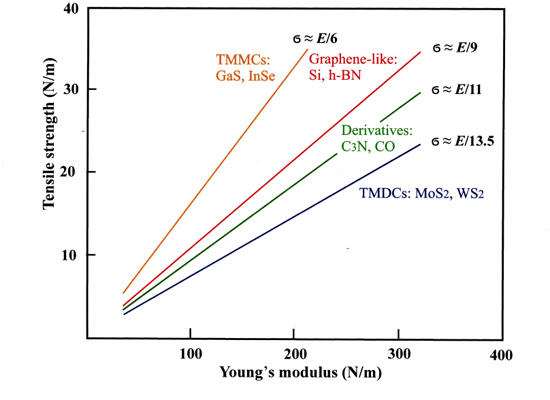
The research technique employed was based on the fact that the linear correlation between the ratios of linear and nonlinear intrinsic mechanical properties allow for the prediction of largely unknown nonlinear fracture properties of brittle 2D solids using a reference model. To achieve his goal, Peter Hess utilized the correlation between the linear Young’s moduli and the nonlinear theoretical strengths of 2D solids by calibrating the referenced linear stiffness ratios with the nonlinear strength value of a prototype compound. Lastly, by utilizing this model, he was able to evaluate the intrinsic strength of various graphene derivatives, graphene-like monolayers, transition-metal monochalcogenides (TMMCs) and transition-metal dichalcogenides (TMDCs).
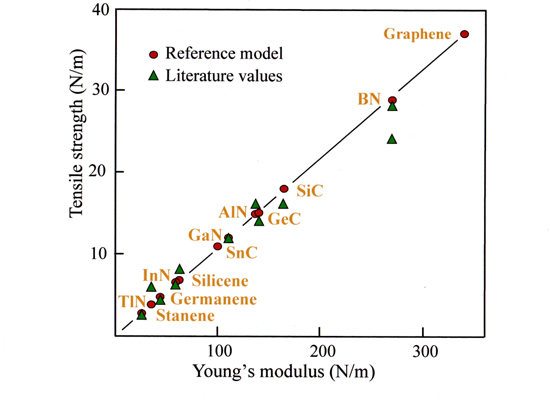
The author observed that for the previously mentioned related groups of the fast growing family of 2D materials, characteristic ultimate strengths can be revealed. The linear correlation shown below for the tensile strengths of graphene-like monolayers with honeycomb structure as a function of Young’s moduli yields a modulus/strength ratio of about nine. This value is well established for 3D solids such as diamond or silicon. Notably, other groups of compounds possess smaller ratios such as transition-metal monochalcogenides or larger ones as transition-metal dichalcogenides. Additionally, the estimated unknown intrinsic strengths were noted to represent the upper limits for the mechanical performance of 2D compounds and could be used to judge the actual deviations between real monolayers and their ideal counterparts.
In summary, the Peter Hess study successfully developed a reference model that allowed for a first estimate of intrinsic mechanical properties for chemically and structurally related groups of compounds using simple rules or by correlation employing a small database. Collectively, he established that owing to the relatively facile structure of 2D solids, as compared with 3D materials, models can predict nonlinear mechanical properties that can subsequently be tested first by widely established ab initio calculations and then by currently rarely performed experiments. Altogether, the reference model has potential to play a crucial role in the exploration of the fundamental physical and chemical properties of monolayers.

Reference
Peter Hess. Predictive modeling of intrinsic strengths for several groups of chemically related monolayers by a reference model. Physical Chemistry Chemical Physics, 2018, volume 20, 7604
Go To Physical Chemistry Chemical Physics