 Advances in Engineering Advances in Engineering features breaking research judged by Advances in Engineering advisory team to be of key importance in the Engineering field. Papers are selected from over 10,000 published each week from most peer reviewed journals.

Significance
The call for sustainable development and uses of renewable energy sources with the aim of environment protection has compelled many researchers to develop more efficient energy storage devices. To this note, high-performance lithium-ion batteries have been identified as a promising solution for large energy storage due to their high gravimetric density. Unfortunately, the main problem with lithium-ion batteries is the large volumetric change that occurs during the lithiation and delithiation process. This further induces electrode pulverization as well as capacity fading. Therefore, significant efforts have been directed towards finding a lasting solution to the capacity fading problem.
The advancement in nanotechnology over the past decades has seen the use of nanostructured electrode materials including nanorods and nanowires with the aim of solving the capacity fading challenge induced by the large volumetric change. However, the nanomaterials have high porosity and void spaces thus limiting the functional capability of the anodes and cathodes. Presently, numerous electrode materials have been developed to enhance the volumetric energy densities of the lithium-ion batteries. For example, yolk shell and bowl like hollow nanostructures have bored excellent results. However, synthesis of these nanostructures is challenging due to the difficulties in manipulating the materials to specific desired patterns. Recently, hierarchical nanostructures have been identified as better materials not only for enhancing the volumetric energy density but also for achieving better electrochemical performances. For instance, they can be used to fabricate lithium-ion batteries with both high gravimetric and volumetric energy densities.
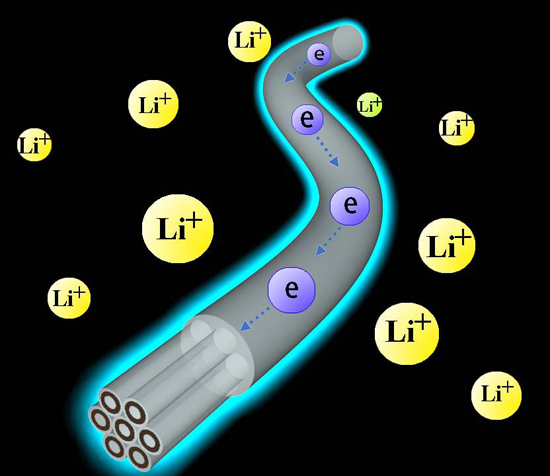
Sichuan University researchers: Prof. Xin Huang, Prof. Bi Shi and co-workers fabricated a hierarchical fibrous bundle composed of C@Sn@C nanofibers in a close packing arrangement. They successfully eliminated the electrode pulverization problem and to realize high-performance lithium-ion battery with a high cycling stability, large gravimetrical energy density as well as high volumetric energy density. Their work is published in Chemical Engineering Journal.
The authors observed that the sandwiched C@Sn@C nanofibers were capable of effectively buffering the large volumetric change during the cycles. This was attributed to the capability of the C@Sn@C nanofibers to relieve the induced mechanical stresses through simultaneous expansion and contraction of the external carbon coating and internal nanofibers, respectively. Accordingly, the sandwiched C@Sn@C nanofibers exhibited large reversible gravimetric energy density, suggesting that the electrode had the potential of increasing the cycling life of the resulting lithium-ion batteries. More interestingly, the close packing arrangement of the nanofibers minimized the voids and porosity present in the self-assembly fibrous bundle thus leading to high volumetric energy density.
The study successfully demonstrated that hierarchically fabricated electrode materials for lithium-ion batteries are effective for achieving both high volumetric and gravimetric energy densities simultaneously. Furthermore, collagen fibers are readily available, generally cost-effective and environmentally friendly. Thus, the study will advance the synthesis of cost-effective electrode materials for high-performance lithium-ion batteries for large-scale energy storage.
Reference
Wang, X., Gao, K., Ye, X., Huang, X., & Shi, B. (2018). Close-packing of hierarchically structured C@Sn@C nanofibers for high-performance Li-ion battery with large gravimetric and volumetric energy densities. Chemical Engineering Journal, 344, 625-632.
Go To Chemical Engineering Journal