 Advances in Engineering Advances in Engineering features breaking research judged by Advances in Engineering advisory team to be of key importance in the Engineering field. Papers are selected from over 10,000 published each week from most peer reviewed journals.

Significance Statement
The presence of a catalyst involved in catalytic pyrolysis eventually leads to the reduction of hydrocarbon yields as a result of coke deposition which also reduces the effective performance of a catalyst. Previous kinetic models that aimed to study relation of catalyst deactivation with coke deposition had inaccuracies as fast rate of catalytic deactivation accompanies the technology involved in biomass catalytic pyrolysis. Therefore there is a need study how reactions needed to inhibit coke deposition and improvement of kinetic models for the capture of fast biomass catalytic pyrolysis.
Dr. Huiyan Zhang and colleagues from School of Energy and Environment, Southeast University in China investigated the catalytic conversion features of furfural, a lignocellulosic biomass material to olefins and aromatics with consequences of reaction conditions and chemistry, mechanism of catalyst deactivation and kinetic model of coke deposition with respect to the conversion process. The research work is now published in the peer-reviewed journal, Combustion and Flame.
They used of ZSM-5 as a catalyst and the catalytic conversion process of furfural was observed in a fixed bed reactor. Certain ranges for reaction conditions such as temperature, weight hourly space velocity, reaction time and the furfural partial pressure were set. Various techniques were used for to characterize the coming behavior of catalyst including gas chromatography test, thermogravimetric analysis, x-ray diffraction analysis and scanning electron microscopy.
The authors noticed that an increase in temperature favored the production of olefins, aromatics, carbon monoxide and coke while that of furan decreased. Also, an increase in partial pressure and a decrease in weight hourly space velocity led to an increased formation of olefins and aromatics.
When observing the conversion of furfural at the optimum reaction conditions, a sudden reduction in the conversion rate of furfural was noticed at 30min time of the stream which also led to a rapid increase in coke yield. An increase in time of stream also led to a decrease in the formation of carbon monoxide, carbon dioxide, olefins and aromatics unlike furan which increased. The catalytic reaction processes of the furfural first involved decarboxylation into furan and carbon monoxide before transforming to olefins and aromatics.
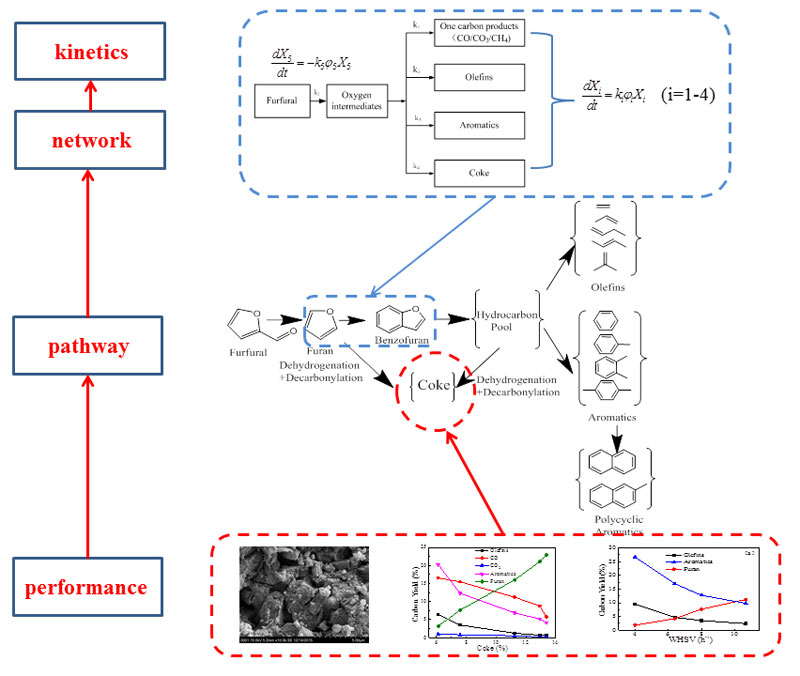
The proposed kinetic model in this study was divided into six lumps with five elementary reaction steps, including coke formation which was build based on experimental data. Statistical analysis verified the credibility of the proposed kinetic model. At all working conditions, experimental results of each lump and the calculated results when using the kinetic model showed good correlation.
The result achieved by the way of the authors with the developed kinetic model provides a landmark achievement for the study of biomass catalytic pyrolysis.



Journal Reference
Huiyan Zhang, Yun Wang, Shanshan Shao, Rui Xiao. An Experimental and Kinetic Modeling Study including Coke Formation for Catalytic Pyrolysis of Furfural, Combustion and Flame 173 (2016) 258–265.
Ministry of Education of Key Laboratory of Energy Thermal Conversion and Control, School of Energy and Environment, Southeast University, Nanjing 210096, PR China
Go To Combustion and Flame
