Advances in Engineering Advances in Engineering features breaking research judged by Advances in Engineering advisory team to be of key importance in the Engineering field. Papers are selected from over 10,000 published each week from most peer reviewed journals.

Significance
Driven by economic factors and social awareness, the world steel industry is trying over the last few years to establish a coherent model that encompasses low-carbon, sustainable and circular economies. Many research and innovation projects demonstrate the potential of newly developed steel grades and their benefits in lightweight structural applications. Given its entire life cycle, stainless steel has one of the lightest impacts on Earth of all known engineering materials. And at the end of its life, stainless steel can be recycled to create a new stainless steel that is as strong and durable as the original. Its application in engineering structures has been underpinned by active scientific research projects. Specifically, efforts have been directed to generate structural design rules and protocols to facilitate the development of international design rules for cold-formed stainless steel (CFSS) structures.
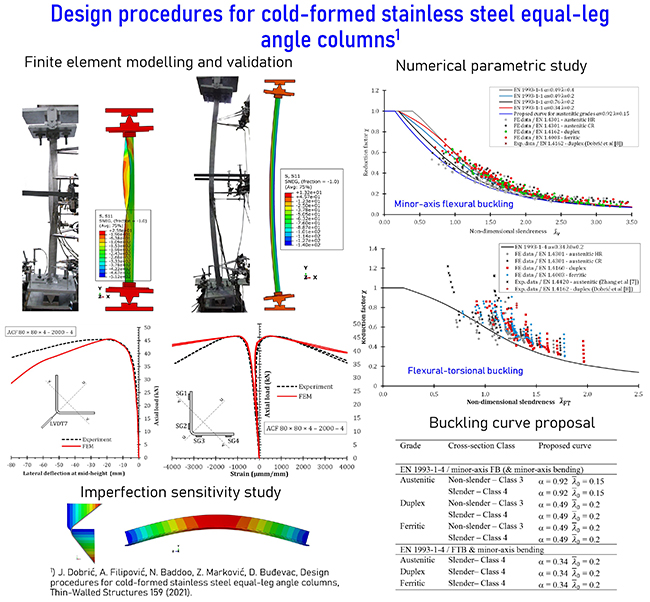
To meet these challenges, associated professor Jelena Dobrić, assistant professor Aljoša Filipović, Professor Dragan Buđevac and Professor Zlatko Marković of the University of Belgrade, Faculty of Civil Engineering in collaboration with Nancy Baddoo, an associate director of the Steel Construction Institute in the United Kingdom, performed a comprehensive investigation addressing cold-formed stainless steel equal-leg angle columns with pin-ended boundary conditions. The investigation included experiments and geometric and material nonlinear finite element (FE) failure analyses. Comprehensive FE quantitative parametric studies were performed to generate reliable data over a wider range of column slenderness, including both slender and non-slender equal-leg angle sections for the three most significant stainless steel families − austenitic, duplex and ferritic. The current European and Australian/New Zealand specification approaches involving local buckling, flexural-torsional buckling and flexural buckling were evaluated by a reliability-based method and the potential for their improvement for CFSS angle columns was thoroughly investigated and discussed. The research outcomes were fully reported in the recently published paper in the journal Thin-Walled Structures.
Based on the obtained results, the authors clearly demonstrated shortcoming to the existing European column buckling curve proposed in EN1993-1-4 and the need to revise its length plateau. For minor-axis flexural buckling, the buckling curve c in conjunction with the non-dimensional limiting slenderness of 0.2 may be used for ferritic and duplex grades for all cross-section classes. Following analysis of the assembled austenitic dataset, a new buckling curve for cold-formed austenitic equal-leg angle columns, of the same form as the existing European curves, was proposed, with the higher imperfection factor equal to 0.92 and with a reduced limiting slenderness of 0.15, with the aim of offering safe, but efficient predictions. The flexural-torsional buckling column resistance may be safely but quite conservatively predicted by using buckling curve b in conjunction with non-dimensional limiting slenderness of 0.2. The results of the statistical study also showed that this buckling curve results in significantly high data scatter for all three stainless steel grades. In addition, it was shown that the current AS/NZS codified design procedure safely and accurately quantifies column compressive capacities, especially for minor-axis flexural buckling failure. Similar to Eurocode 3, the design procedure addresses flexural-torsional buckling with significantly conservative predictions of the column ultimate strengths.
In summary, a detailed non-linear numerical investigation of the structural responses and ultimate resistances of pin-ended CFSS equal-leg angle columns was reported and the new design guidelines were proposed per stainless steel grades. The applicability of proposed recommendations was verified via reliability analysis. The overall research findings fill the existing gap created by the lack of experimental results and explicit design guidelines for CFSS equal-leg angle columns. In a statement to Advances in Engineering, Professor Jelena Dobrić said the new design recommendations would ensure the safe and robust design of cold-formed stainless steels angle columns for a wide range of structural applications.





Reference
Dobrić, J., Filipović, A., Baddoo, N., Marković, Z., & Buđevac, D. (2021). Design procedures for cold-formed stainless steel equal-leg angle columns. Thin-Walled Structures, 159, 107210. https://doi.org/10.1016/j.tws.2020.107210