Advances in Engineering Advances in Engineering features breaking research judged by Advances in Engineering advisory team to be of key importance in the Engineering field. Papers are selected from over 10,000 published each week from most peer reviewed journals.

Significance
Presently, kinetic energy and fluence of radiation beams is monitored using radio-chromic films, ionization cells or phosphor screens coupled to photodiodes. With the widespread application of radiation beams, monitoring has become a prerequisite for efficient application. Currently, beam fluence measurements utilizes well established procedures, however, for the purposed of evaluation of the kinetic energy of the beam particles, intricate and more specific techniques have to be called upon for each particle type and energy range. For the latter, ionization cells have been utilized in the modern linear accelerators used for radiotherapy treatment. Alternatively, phosphor screens consisting of homogeneously distributed luminescent components with tuned selectivity and sensitivity to a particular type of radiation can be used to identify the position and shape of a particular beam of charge particles impinging onto a surface. Unfortunately, these systems are unable to provide adequate beam-energy information since their color emission response has only a negligible dependence on beam energy.
Recently, Spanish National Research Council (CSIC) researchers, Jorge Gil-Rostra, Francisco J. Ferrer, Juan Pedro Espinós, Agustín R. González-Elipe and Francisco Yubero developed a novel scintillator concept for the determination of the kinetic energy of electron and ion beams, that would help overcome the aforementioned drawback in the detectors. They proved the validity of the novel luminescent multilayer concept. In addition, they purposed to show that their novel concept complied with the strict composition, doping level, thickness and morphology characteristics as well as the well-known quantitative luminescent behavior when excited with radiation beams of charged particles within the kinetic energy range of interest. Their work is currently published in the journal, ACS Applied Material and Interfaces.
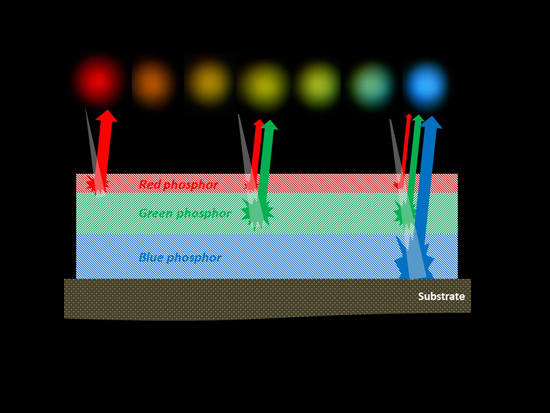
In brief, the research method employed entailed building of a multilayer system through the stacking of different phosphor and slowing-down layers at given depths and the correlation of the spectral distribution of the emitted light with the kinetic energy and nature of the radiation beam. As an overview, this procedure commenced with the qualitative description of the luminescent photonic multilayer concept. Two examples depicting the application of the general concept were then presented. Lastly, a brief analysis of the accuracy of the proposed colorimetric quantification was undertaken.
The authors observed that the developed devices could be designed “a la carte” according to the energy range and type of particles to be detected. Additionally, they noted that the emitted signals from the multilayer detectors were easily collected onto suitable spectrometers, thereby making the quantitative analysis of the spectral signal, using fingerprint spectra of the single luminescent layer stacked in the device as reference, quite easy.
In summary, the CSIC scientists successfully demonstrated the development of a novel photonic multilayer scintillator approach. Generally, this approach has been proven to be powerful and yet simple system for energy monitoring of charged-particle beams, either ions or electrons. Altogether, their technology has potential to be expanded to three dimensions, macroscopic beam monitors consisting of layered luminescent structures, where color and light intensity from each voxel would provide information on the kinetic energy and fluence of the particles reaching that point.





Reference
Jorge Gil-Rostra, Francisco J. Ferrer, Juan Pedro Espinós, Agustín R. González-Elipe, Francisco Yubero. Energy-Sensitive Ion- and Cathode-Luminescent Radiation-Beam Monitors Based on Multilayer Thin-Film Designs. ACS Applied Material and Interfaces 2017, volume 9, page 16313−16320.
Go To ACS Applied Material and Interfaces