 Advances in Engineering Advances in Engineering features breaking research judged by Advances in Engineering advisory team to be of key importance in the Engineering field. Papers are selected from over 10,000 published each week from most peer reviewed journals.

Significance
Fabric softeners are widely used for clothes treatment as they impart smoothness, flexibility, sewability and anti-static properties to textiles. Fabric conditioners are produced either for household application or for textile finishing. Household conditioners are mainly made of double-tail cationic surfactants assembled in vesicles in water. [1] Vesicles provide the stability to the formulation and act as a cargo to deliver fragrances or additives to the fibers. Textile finishing is a process performed at the final stage of fabric manufacturing, after dyeing, to improve the look, performance, or “hand” feel of the cloth and make it attractive to consumers. For the latter one, textile softeners are utilized. These textile conditioners are generally based on silicone oils which exhibit low glass transition temperature, significant hydrophobicity and are effective in textile softening. These softeners are based on silicone oil emulsions. The oil droplet size distribution and the surfactant used for stabilizing the emulsion define the softener properties. Different silicone molecules, non-ionic or ionic have been tested, with the latter being more efficient.
With the rising consumer demands, sustainability challenge and market competition, further improvement of the fabric conditioners for both textile finishing and household applications is desirable. Besides, both surfactant and silicone based softeners have various environmental issues that need to be addressed. Recently, the association of an amine-modified silicone oil and a double-tail surfactant assembled in vesicles has been identified as a promising approach for formulating high-performance fabric softeners. This approach benefits from the distinctive advantages of the two different technologies. To this note, Dr. Evdokia Oikonomou, Ms. Camille Grandisson, Dr. Konstantin Golemanov, Dr. Ritu Ahuja and Dr. Jean-François Berret from Université de Paris and Solvay industry combined these technologies in a new formulation in presence of biopolymers derived from natural polymers (guar) modification. The biopolymers allow for a reduced surfactant content by 50 % wt. resulting in a product with lower environmental impact. [3]
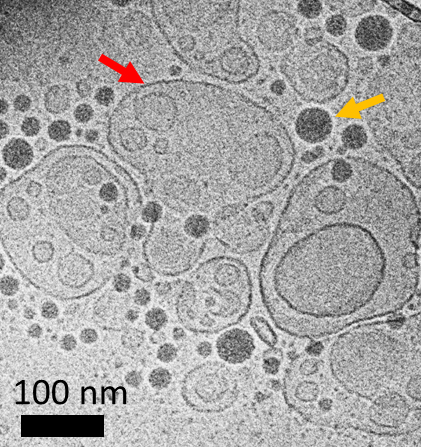
This work is currently published in the research journal, Colloids and Surfaces A: Physicochemical and Engineering Aspects [2]. The main challenge was to develop a robust method for incorporating the silicone oil in a preformed surfactant/biopolymers softener without compromising the softener properties. For this, instead of utilizing common emulsifiers for silicone oil, the authors proposed to take advantage of the interfacial properties of the ingredients already present in the softener, namely surfactant or guar, and use them as stabilizers. This approach resulted in well-distributed silicone nano- and micro-droplets in the formulation. A representative cryogenic transmission electron microscopy (cryo-TEM) image revealing the silicone oil droplets (yellow arrows distributed between the surfactant vesicles (red arrow) is presented in Fig. 1.
The impact of the silicon insertion on the softener properties was investigated by a combination of techniques including optical microscopy, dynamic light scattering and cryogenic transmission electron microscopy. Interestingly, the new fabric conditioner was found to be stable upon time with appropriate physical-chemical characteristics despite the silicone oil insertion into the vesicles/guar formulation.
In summary, this research team demonstrated the effectiveness of using guar biopolymer or surfactant vesicles as silicone stabilizer resulting in a new formulation with two softening agents (surfactant vesicle and silicone oil) with appropriate physicochemical properties, improved performance and reduced environmental impact. This indicated the versatility of the approach and its potential applications in fabricating other type of conditioners. In a statement to Advances in Engineering, the authors explained that the proposed methodology is a promising approach for developing new softener formulations for multi-purpose fabric softening.


Reference
- E.K. Oikonomou, F. Mousseau, N. Christov, G. Cristobal, A. Vacher, M. Airiau, C. Bourgaux, H. Laurent, J.-F. Berret, Fabric softener–cellulose nanocrystal interaction: a model for assessing surfactant deposition on cotton, J. Phys. Chem. B 121 (2017) 2299–2307
- Oikonomou, E., Grandisson, C., Golemanov, K., Ahuja, R., & Berret, J. (2021). Silicone incorporation into an esterquat based fabric softener in presence of guar polymers. Colloids and Surfaces A: Physicochemical and Engineering Aspects, 615, 126175.
Go To Colloids and Surfaces A: Physicochemical and Engineering Aspects
- E.K. Oikonomou, N. Christov, G. Cristobal, C. Bourgaux, H. Laurent, I. Boucena, J.- F. Berret, Design of eco-friendly fabric softeners: structure, rheology and interaction with cellulose nanocrystals, J. Colloid Interf. Sci. 525 (2018) 206–215