Advances in Engineering Advances in Engineering features breaking research judged by Advances in Engineering advisory team to be of key importance in the Engineering field. Papers are selected from over 10,000 published each week from most peer reviewed journals.

Significance Statement
A group of researchers from “Petru Poni” Institute of Macromolecular Chemistry in Romania investigated the electrocatalytic activity of nickel-cobalt alloy nanoparticles deposited on different carbon materials,including graphene, multi-wall carbon nanotubes and fullerene for their potential use in glucose detection. The authors who published their work in Journal of Applied Electrochemistry looked at modifications in morphology and composition of nickel-cobalt nanoparticles with respect to the applied potential range and cyclic time at some point of electrodeposition.
They found that when the anodic stripping process is involved during cyclic voltammetry, the deposition resulted in an excessive agglomeration of metallic nanoparticles on graphene support whilst application of a higher value of cathodic potential led to a higher homogenous dispersal of metal nanoparticles on graphene surface. Redox peak currents when evaluated in potassium hydroxide solution increased with a lower size of nanoparticles, which also increased with a boom in number of nanoparticles. However, lower peak currents were observed at certain cathodic potentials. The ratio of nickel to cobalt deposits varied and was greater than that in the initial electrolyte solution indicating higher presence of nickel in the blended alloy.
The effect of cycling time on electrodeposition process became additionally found. An increase in deposition cycling time until 15 scans led to an increase in anodic peak currentof deposited nickel–cobalt . A further increase of deposition cycling time between 20 -25 scans led to an increase in oxidation peak current of nickel-cobalt with a non-uniform increase of reduction peak current. At 30 scans, an excess of agglomerated nanoparticles was observed with no favor applications on further electrochemical reactions. The results correlated through the scanning electron microscopy images provided a suitable range for electrodeposition of nickel-cobalt alloy.
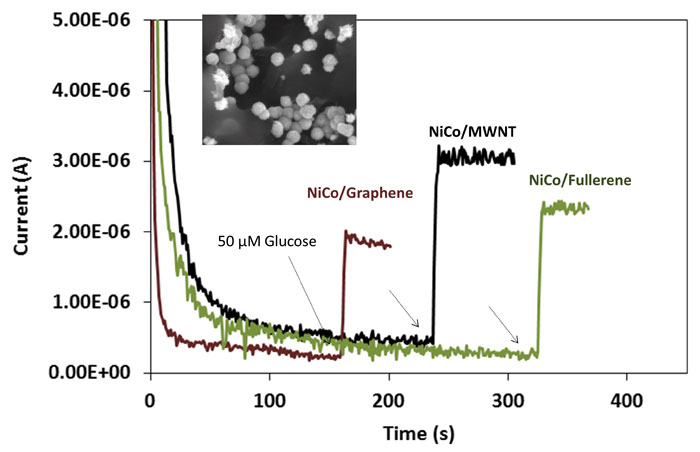
Among carbon nanomaterials tested in this study, multi-wall carbon nanotubes showed to be the best support comparative to fullerene and graphene for reduction of nickel and cobalt ions, respectively for nucleation of nickel-cobalt nanoparticles. When investigating the redox activity, a higher anodic current was observed for nickel-cobalt deposited on multi-wall carbon nanotubes. These results show that the multi-wall carbon nanotubes favor the electrodeposition of nickel-cobalt compared to fullerene and graphene, through the density of existent active sites.
Moreover, multi-wall carbon nanotubes decorated with nickel-cobalt particles provided higher oxidation of glucose in alkaline solution compared to that of analogous graphene and fullerene materials. The electrodes with deposited nickel-cobalt nanoparticles on multi-wall carbon nanotubes had the lowest detection limit of 1.8µM and highest sensitivity of 1868uAmM-1cm-2 for electrochemical detection of glucose. From this end result, it can be concluded that a larger surface area for nanotubes coupled with higher numbers and smaller size of nickel-cobalt deposits favor electrocatalytic activity and sensing overall performance towards glucose oxidation.
The results of this study coupled with a lower applied potential of 0.3V for glucose detection would be of relevance in sampling of biological fluids where level of glucose is very low.
Acknowledgments
This work is part of a project that has received funding from the European Union’s Horizon 2020 research and innovation programme under grant agreement No667387 and part of a project that received funding from the Romanian National Authority for Scientific Research, CNCS – UEFISCDI, NoPN-III-P3-3.6-H2020-2016-0011.
Journal Reference
Adina Arvinte, Florica Doroftei, Mariana Pinteala. Comparative Electrodeposition of Ni–Co Nanoparticles on Carbon Materials and Their Efficiency in Electrochemical Oxidation of Glucose, Journal of Applied Electrochemistry 46 (2016) 425-439.
“Petru Poni” Institute of Macromolecular Chemistry, Centre of Advanced Research in Nanobioconjugates and Biopolymers, Iasi, Romania.
Go To Journal of Applied Electrochemistry