 Advances in Engineering Advances in Engineering features breaking research judged by Advances in Engineering advisory team to be of key importance in the Engineering field. Papers are selected from over 10,000 published each week from most peer reviewed journals.

Significance Statement
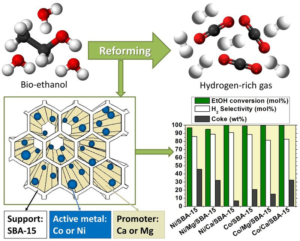
Drs. Arturo J. Vizcaíno, Alicia Carrero and José A. Calles from Rey Juan Carlos University in Spain studied the effect of incorporating Mg and Ca into SBA-15 and investigated the catalytic performance of each metal (Co and Ni) during ethanol steam reforming. Their work was published in peer-reviewed journal, Fuel Processing Technology.
Renewable energy supply has variation in demand, time and places, and hydrogen has been found to be promising concerning this regard. Hydrogen can be obtained from several feed stock, direct biomass conversion, pyrolysis and through biological processes. However, there are few shortcomings of hydrogen such as blockage to pipe, formation of soot, tar, charcoal and ash in thermo chemical processes. It is important to note hydrogen rich material can be produced through steam reforming by decomposing ethanol in the presence of water.
According to the authors both Nickel and Cobalt catalysts reach a high ethanol conversion and their cost is lower than that of noble metals. The nature of the support was expected to influence the catalytic performance of the supported catalyst. Catalytic activity and selectivity in the ethanol steam reforming ESR process is influenced by the chemical nature of the support and by its textual properties. SBA-15 is a well-ordered hexagonal mesoporous silica structure with uniform pore size that can accommodate metallic particles due to their controllable pore size, pore volume and high surface area.
In this research Mg and Ca was incorporated into SBA-15 as the support of both Ni and Co catalyst and the catalytic performance of each metal during ethanol steam reforming was studied. The team also studied the difference in ethanol conversion and coke formation in short operation time.
Two series of Ni and Co catalyst were prepared on Mg or Ca modified SBA-15. The prepared materials M/P-SBA, where M and P refer to metal and promoter, are used as active phase and loaded sample respectively. To test the catalyst, ESR were carried out on a Microactivity-pro unit. Crystallite sizes of the Ni and Co oxides were calculated by DRX (using the Scherrer equation).
The team found out that incorporating Mg or Ca into SBA-15 caused a shift in reduction profile of the metal phases of the catalyst and led to higher temperature to take place. Mg and Ca promoted Co crystallites needed higher temperature to be reduced. They said that the promoted Co was not able to maintain enough active Co sites under reaction conditions to convert C2 intermediate compounds, thereby leading to lower ethanol conversion and hydrogen selectivity than a Co/SBA-15 catalyst. For Mg and Ca promoted Ni catalyst, it possess an intermediate reduction temperature, leading to a higher hydrogen production when compared with Ni/SBA-15 sample at 700 ºC.
The researchers pointed out that addition of Mg and Ca decreases coke formation for both Ni and Co catalyst, because of the need of lower temperature for carbon oxidation. They realized that the addition of alkaline-earth promoters in the SBA-15 support are responsible for decrease in coke formation from ethylene.
Vizcaíno, Carrero and Calles obtained an excellent catalyst Ni/Ca/SBA-15 which was stable for 50 h. And their method diminished coke formation on adding Ca and Mg.
Journal Reference
A.J.Vizcaino, A. Carrero and J.A. Calles, Comparison of ethanol steam reforming using Co and Ni Catalysts supported on SBA-15 Modified by Ca and Mg, Fuel Processing Technology, 146 (2016) 99–109.
Department of Chemical and Energy Technology, Rey Juan Carlos University, c/Tulipán s/n, 28933 Móstoles, Spain.
Go To Fuel Processing Technology