Advances in Engineering Advances in Engineering features breaking research judged by Advances in Engineering advisory team to be of key importance in the Engineering field. Papers are selected from over 10,000 published each week from most peer reviewed journals.

Significance
Polymer composites-based conductors have recently attracted significant interests among the academic researchers as well as the industrialists. They possess a wide range of desired properties such as chemical resistance, flexibility, and lightweight. Their use has however been escalated by the discovery of the carbon nanotubes and the graphene conductive fillers. This can allow construction of series of nano-composites with renowned mechanical and electrical functionalities.
With the need for large-scale application of such composites on the rise, the challenge towards realizing the desired electrical conductivity has however remained the high cost of the carbon nanotubes needed as well as countering the self-aggregative behaviors experienced in the polymer matrix. For instance, the previously used processes require many carbon nanotubes that many at times are expensive and complicated to construct. Therefore, the need for a more stable and efficient network for multidimensional carbon nanotubes has led to proposals of various concepts of achieving such constructions with the most recent one being, double-percolation network.
Several difficulties including the thermal processing methods and the inherently self-entangling/aggregating nature of the carbon nanotubes, may limit the double percolation methodology, more improvements need to be made to overcome such setbacks.
A research work done a group of researchers at Sichuan University in China: Professor Wei Liu (Institute of New Energy and Low-Carbon Technology), Dr. Yuanyi Yang (Department of Materials Engineering) and Professor Min Nie (Polymer Research Institute) developed a stable and efficient double-percolated network construction method, in a multiwalled carbon nanotubes system. Their work is currently published in the journal, Composites Science and Technology.
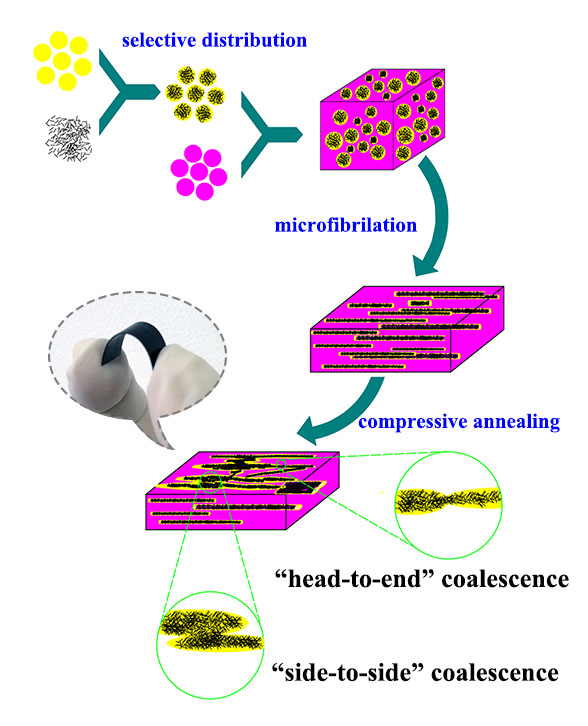
The authors’ experiment constituted a novel twin-screw extrusion technique for uniformly dispersing the multiwalled carbon nanotubes (MWCNTs) contained in the dispersed phase (PS). Subsequently, they employed a two-step procedure for the construction of the double-percolated conductive network. The thermal processing procedure comprised of the melt-drawing extrusion and the compressive annealing treatment of the produced blend. Finally, the scanning and transmission electron microscopy techniques were used in observing the conductive microfibers and networks.
The authors observe an excellent conductive performance in the constructed network. This is clearly shown by the decrease in the electrical volume resistivity and carbon nanotubes dosage standing at 4600 Ω.cm and 1 wt % respectively.
A significant contribution to this newly developed technology is the capacity to control the trans-phase migration experienced in the conductive fillers. The surface wetting phenomenon allows selective immobilization and distribution of the multiwalled carbon nanotubes used in the two phase system. This phenomenon facilitates the control over conductive filler, which aids the completion of the double-percolated network.
The Sichuan University’s research team offers further understanding of a set of thermodynamic principles of this versatile method, which can be adopted for the construction of double-percolated structures in many other multiphase systems. Its simplicity and cost efficiency will benefit many explorations and applications in a variety of fields.



Reference
Liu, W., Yang, Y., & Nie, M. (2018). Constructing a double-percolated conductive network in a carbon nanotube/polymer-based flexible semiconducting composite. Composites Science and Technology, 154, 45-52.
Go To Composites Science and Technology