Advances in Engineering Advances in Engineering features breaking research judged by Advances in Engineering advisory team to be of key importance in the Engineering field. Papers are selected from over 10,000 published each week from most peer reviewed journals.

Significance Statement
Researchers led by Professor Chi-Wen Lin from National Yunlin University of Science and Technology in Taiwan developed an innovative biotrickling filter-microbial fuel cell BF-MFC for production of electricity and removal of ethyl acetate that is emitted from a gaseous stream in their work published in the peer-reviewed Journal, International Journal Of Hydrogen Energy.
Ethyl acetate is a volatile organic compound and need to be captured for further treatment, and it can escape into the atmosphere. Exhaust emissions of ethyl acetate from various industrial processes cause environmental damage and are hazardous to human health. Prior to this research, physicochemical methods have been proven to be successful in removing volatile organic compounds from waste gases, but due to the high cost and potential byproduct formation have limited their use. Another biological treatment method, which involved biofiltration, has long been considered to be a more cost-effective and environmental friendly means to treat air flows that contain moderate-to-low concentrations of volatile organic compounds. To improve on ethyl acetate removal, they introduced biotrickling filters which the researchers believe it will outperform the conventional method.
According to the team, biotrickling filter is a continuously and intermittently flowing aqueous phase provides better control over environmental conditions purging of hazardous degradation byproducts. Microbial fuel cells MFCs have attracted much attention as they combine electricity generation with pollutant treatment. The air-cathode MFC is said to be one of the best configurations, because it does not require aeration and oxygen is the most sustainable and environmentally friendly electron acceptor, explained the research team.
The newly membrane design provided effective delivery of the protons that were released from the anode to the cathode, and was developed using a polyvinyl alcohol membrane electrode assembly PVA-MEA, this combined proton exchange membrane into cathode in the MFC.
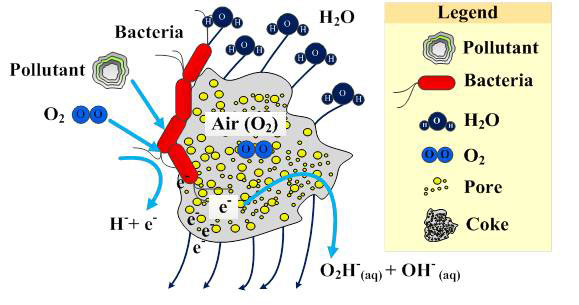
A BF-MFC system was used to measure and compare the redox reaction removal efficiency of waste gases that contained ethyl acetate and the generation of electricity under open-circuit and closed-circuit conditions. In the open circuit, when a biofilm began to form, the researcher observed that the electrons that were released by the microorganisms were not delivered to the anode, the team explained that the electron could only be transferred within the microorganisms. In the closed circuit, electrons from the microorganisms on the anode continued to be delivered through the MFC system to the cathode, these electrons participated in a redox reaction with oxygen and protons on the cathode, so the electrons and protons were continuously consumed. According to the research team, to generate biomass, the microorganisms at the anode must consume organic compounds to obtain electrons that were lost during metabolism, this continuously biodegraded the ethyl acetate to obtain energy.
The team observed that the oxygen stopped receiving the electrons, instead they were directly transferred to the anode, this shows that dissolved oxygen penetration depth decreased with increasing biofilm thickness, which resulted in the formation of anaerobic zones in the biofilms. The researcher also found out that high substrate concentrations influence the metabolic rate of microorganisms and thereby affect the removal efficiency and output voltage.
The newly developed biotrickling filters presented in this study outperform others in removal of ethyl acetate and also generate electricity. It has biofilters which continuously and intermittently allow flowing of aqueous phase and provides better control over nutrients, pH and the purging of hazardous degradation byproducts.



Journal Reference
Chih-Hung Wu, Jing-Chen Shih, Chi-Wen Lin, Continuous Production of Power Using Microbial Fuel Cells with Integrated Biotrickling Filter for Ethyl acetate-Contaminated Air Stream Treatment, International journal of hydrogen energy 47 ( 2016 ) 21945-21954.
Department of Safety, Health and Environmental Engineering, National Yunlin University of Science and Technology, 123 University Rd., Sec. 3, Douliou, Yunlin 64002, Taiwan, ROC
Go To International Journal of Hydrogen Energy