 Advances in Engineering Advances in Engineering features breaking research judged by Advances in Engineering advisory team to be of key importance in the Engineering field. Papers are selected from over 10,000 published each week from most peer reviewed journals.

Significance
Controlling the movement of small droplets on walls is a promising approach for achieving rapid heat transfer and highly efficient interfacial interactions. This has paved the way for the development of droplet movement control techniques. Other than methods based on the continuous or gradual changes in wettability due to electrowetting-on-dielectric or difference in the chemical properties of the wall, the use of gravity in controlling droplet direction has particularly attracted research attention. Even though this method requires a wall having two different wettability area, which can be simply prepared, to control the movement of the droplets, the wettability difference is based on photochemical reactions and deterioration in the control due to aging was observed. To address this problem, the micro-wrinkle surface exhibiting wetting anisotropy was recently introduced. These surfaces having anisotropic wrinkles have been used to achieve desirable properties of lighting equipment such as optical diffusion. However, the influence of gravity on the anisotropic wettability induced by the micro-wrinkle has not been fully explored.
Herein, Professor Kenji Katoh, Professor Eriko Sato, Dr. Shin’ya Yoshioka and Dr. Tatsuro Wakimoto from Osaka City University investigated the role of anisotropy of wettability caused by a micro-wrinkled surface in controlling the direction of a droplet sliding on an inclined surface. The main objective was to measure the wetting anisotropy on the micro-wrinkled surfaces and discuss the feasibility of using gravitational force to control the direction of the droplet movement. Their research work is currently published in the journal, Experiments in Fluids.
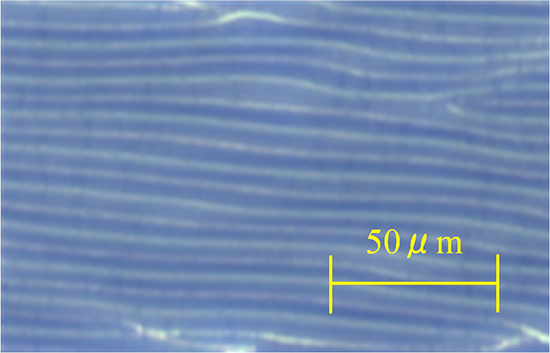
Briefly, the research team commenced on their experimental work by fabricating the micro-wrinkles using a thin film buckling phenomenon under several strains. First, they stretched the polyvinyl chloride (PVC) followed by spin-coating the poly(N-vinylcarbazole) (PVK) on the base PVC surface, and anisotropic micro-wrinkles were formed on PVK by releasing the strain of PVC. Additionally, they experimentally measured the drag against the droplet sliding for the parallel and perpendicular movements of the wrinkle. Finally, a theoretical model was proposed. Based on the principle of minimum work, the model was used to predict the deflection angle and the droplet movement.
The authors observed the formation of a two-dimensional micro-wrinkle with micrometer wavelengths on the surface. This was attributed to the release of strain in the thermostatic chamber upon heating above the glass transition temperature. On the other hand, several degrees of contact angle anisotropy were noted. For instance, setting the droplet on a wrinkled surface inclined at an angle of 45° to the gravitational force, a 20° change in the direction of the droplet movement was observed from the gravitational direction. This change in direction was successfully determined through the model based on the minimum work of the contact line movement.
When the theoretical values and experimental results were compared, the proposed model proved to be a better approach for estimating the deflection angle despite the existing small deviations. Altogether, as highlighted by Dr. Kenji Katoh in a statement to Advances in Engineering, the study provides a promising approach for controlling the droplet movement on a plate with micro-wrinkle based on the difference in the wettability.






Reference
Katoh, K., Sato, E., Yoshioka, S., & Wakimoto, T. (2019). Control of droplet movement on a plate with micro-wrinkle by difference of wettability. Experiments in Fluids, 60(9).