Advances in Engineering Advances in Engineering features breaking research judged by Advances in Engineering advisory team to be of key importance in the Engineering field. Papers are selected from over 10,000 published each week from most peer reviewed journals.

Significance
Finding quantitative relations between the crack length, the material’s inherent resistance to crack growth, and the stress at which the crack propagates at high speed to cause structural failure are well established in dense ceramics. However, little effort has been made to develop equations focusing on fracture mechanics for green ceramics. Such equation would come in handy as they would help improve the green strength and toughness of ceramics thereby, ensuring minimized chipping and breakage during manufacture. Up to date, it has been more challenging to develop fracture models for unsintered bodies than for dense ceramics due to the inhomogeneity of the microstructure and of the uncertainty of the mechanism of bonding between particles in green ceramics. A few modeling attempts have been made on binderless powder compacts since assumptions tend to be simpler but these computational models assume only contact flattening due to the high pressure of dry pressing and Van der Waals attraction between particles whose interfaces must be broken for the crack to propagate. Unfortunately, it is wrong to assume these are the only forces holding the particles together.
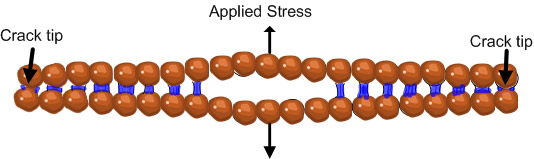
A team of researchers led by Professor W. Roger Cannon from the Idaho National Laboratory, developed an equation to predict fracture toughness of green powder compacts. They purposed crack tip toughness is due only to the rupture of flattened interparticle contacts but that closure forces along the crack surface supplied by the meniscus from moisture are significant, as well. Their work is now published in Journal of American Ceramic Society.
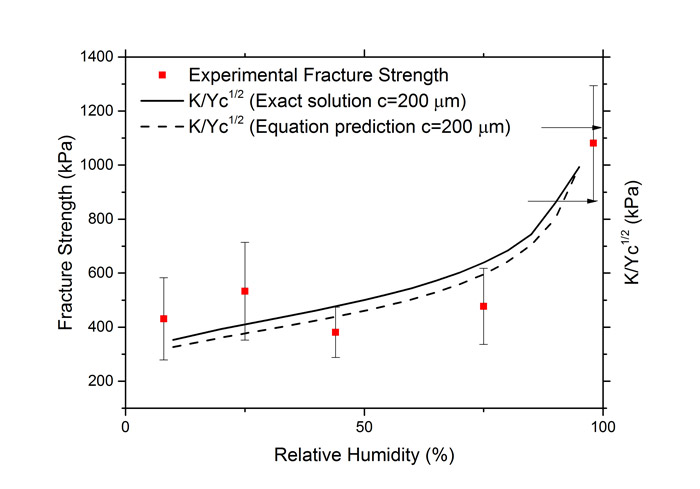
The research team initiated their experiments by preparing the pellets from cerium dioxide powder to be utilized in the fracture studies. The powders were pressed without binder and stored for a specific period in five different jars of varying relative humidity. Afterward, the moisture content was measured. Then pellets were randomized and tested using the standard diametral compression test to determine the fracture strengths.
The authors observed that storing the pellets at high relative humidity for an extended period of time led to fracture strength more than double those stored at lower relative humidity. However, it was seen that at lower relative humidity, there was no noteworthy increase in fracture strength with increased relative humidity which was in accordance with the predictive model. The lower strength at low relative humidity was considered to be either due to insufficient capillary and surface forces as predicted by the model or may have also been related to the insufficiency in the adsorbed moisture to form the bridging meniscuses.
W. Roger Cannon and colleagues have presented for the first time a novel equation for predicting fracture toughness of green compacts. This equation is the sum of Kendall’s equation for contact flattening between particles combined with Van der Waals attraction and the crack bridging equation based on capillary and surface tension forces of the meniscus developed along the crack. Their work presents significant development that upon application would help minimize chipping and breakage of green ceramics during processing.




Reference
W. Roger Cannon, Rita E. Hoggan, Arnold Erickson, Bryan Forsmann, Robert C. O’Brien, Paul A. Lessing. Controlled relative humidity storage for high toughness and strength of binderless green pellets. Journal of American Ceramic Society. 2017; volume 100: pages 4442–4449
Go To Journal of American Ceramic Society